Wednesday, January 9, 2013

Echoes of 'Marvellous Melbourne'

From a distance, Melbourne looks like a glass and steel Oz.


Up close however, at street level, it's still Marvellous Melbourne, the architectural beauty of the 19th century.

Chapel Street, Prahran, my old stomping ground rediscovered

The city has changed a lot since I last lived there in 1987. I remember in those days you would never have walked west of Spencer Street after hours (or anytime, if you didn't need to). Now it's the Docklands, sought-after. It's as if the whole city has been re-orientated to face west. But they're on the brink of overdoing the formulaic apartment blocks.


Monday, January 7, 2013

A lot to not sing about

The United States has made genuine contributions to world thought. In 'their' Revolution and Civil War and  in the documents associated with those conflicts, the players in American history have refined the concepts of liberty and freedom and civil rights. Even more... if William Jennings Bryan had won the 1900 presidential election, his address to the Democratic National Convention - The Perils of Imperialism - might forever have spelt out the difference between a republic and an empire. ("A republic can have no subjects. A subject is possible only in a government resting upon force; he is unknown in a government deriving its just powers from the consent of the governed.")       

I often wonder what Australia has contributed to world progress. Women got the vote in South Australia before most of the rest of the world, the High Court's MABO decision of 1992 knocked for six any idea that a country is uninhabited ("terra nullius") just because it's not inhabited by the conquerors.

The other day, in Carlton, I realised that Australia played perhaps the major role in implementing the 8-hour day. Yes, the 8-hour day movement started in Britain. The British socialist and factory owner Robert Owen may have coined the slogan "Eight hours labour, eight hours rest, eight hours recreation", but the movement's biggest splash was made in Victoria, Australia. In April 1856, stonemasons working on the University of Melbourne downed tools and marched on parliament, also under construction. As a result of their protest parliament decided that they could work eight hours a day with no loss of pay. Stonemasons celebrated with a holiday and procession on 12 May 1856.

Just outside the Melbourne CBD (Downtown), in Carlton across the road from the Trades Hall Council, is the 8-hour day monument. The triple-eight symbol later became decoration on many union buildings.


How many Australians are proud of this, or even know anything about it? We don't make much of a song and dance. (If Dr. Martin Luther King Jr had addressed an Australian audience in his 'I Have a Dream' speech and rung out: "No, no, we are not satisfied and will not be satisfied until justice rolls down like water and righteousness like a mighty stream", some prosaic Australian up the back would have called out, "Oh, turn it up!" )

And yet, Australia has a democracy to be jingoistically proud of; a democracy with a slightly more liberal nuance to the idea of freedom. Because it isn't just personal liberty, which can easily be perverted into exploitative behaviour by successful individuals; it's real practical rights across the board. And it could be argued that we have greater real liberty because Australian workers were able to form themselves, as unions, into more exact counterweights to the controllers of capital. At any rate, the fact that we don't trumpet our achievements too loudly is also perhaps a sign of a non-intrusive humility.


Sunday, January 6, 2013

A trip through the yellow inland

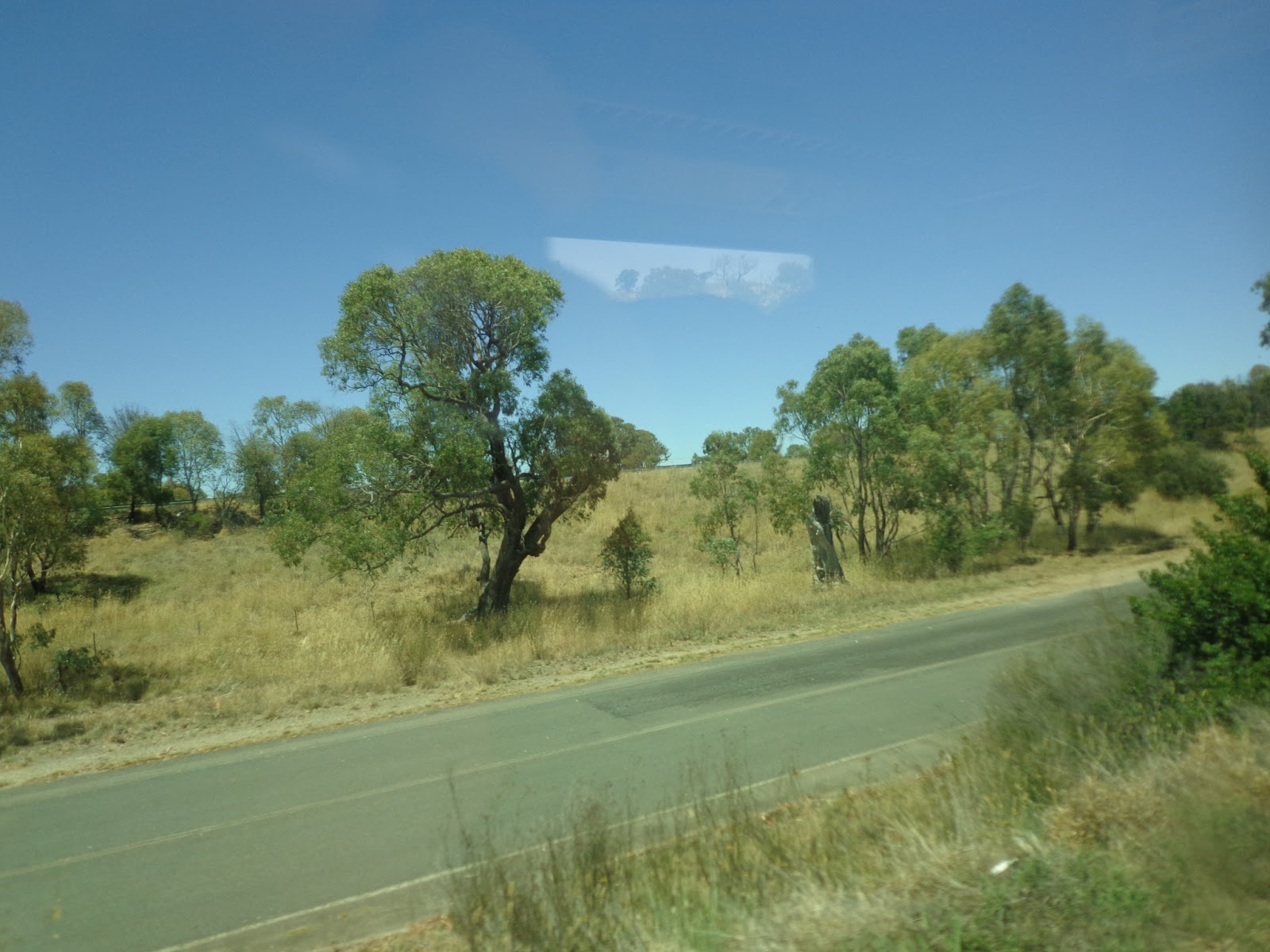
Australians often complain that the country between Sydney and Melbourne is boring. I don't find it so. Once you get past the sandstone of the Highlands and the scribbly gum country of Goulburn the country is essentially, for about 8 hours, that expanse of yellow and blue that was celebrated by the Australian Impressionists in the 1890s. However, I'm reminded of the statement by Tchaikovsky to Mme von Meck after he came back to Russia from Switzerland: "Mountains are fine, but I'm dying for a plain."

I took some shots from the window as we travelled by XPT between Harden-Murrumburrah (NSW) and Seymour (Victoria) on Thursday.


Getting into the foothills of the Australian Alps around Albury
On this journey you see typically Australian country towns:


and it's not all plain:

Back through the Southern Highlands going the other way

Some might say this is boring country, but I disagree and I don't think I'm anticipating a future nostalgia because I don't know when I'll be coming this way again.


Wednesday, December 26, 2012

What Puccini would have looked for (Philippa, an opera - blog 13)

Continuing my blog on the development of the opera Philippa, about the Harlem-born concert pianist, Philippa Duke Schuyler who died in Vietnam rescuing schoolchildren in 1967.

Philippa Duke Schuyler, 1959. Photo: Fred Palumbo, World Telegram staff photographer. Public Domain.


Giacomo Puccini could judge the operatic suitability of a play even if he saw it in another language. The Italian speaker saw Sardou's La Tosca in French, and Belasco’s Madam Butterfly and Girl of the Golden West in English. The operatic potential of these plays he divined from broad stage action. How might Philippa portray its dramatic concerns in stage pictures?


Act I

Requiem Mass at St. Patrick’s Cathedral, New York, 18 May 1967. A mostly-segregated congregation, but George the African-American father and Jody the white Texan mother sit together. Words of praise from Sammy Davis Jr, Ella Fitzgerald, President Johnson, and others. Cardinal Spellman says they have met to celebrate the life of Philippa Duke Schuyler, pianist, composer, first US woman war correspondent to die in Vietnam. Pianism dominates the liturgical music; “Little girls everywhere who were inspired by Philippa’s example” play the music for her requiem on grand pianos. (They are mostly, however, African-American girls.) Jody wants to know how Philippa can “rest in peace when her potential lies unfulfilled”. She rejects George's attempts at consolation.

Vietnam, September 1966. 35 year-old Philippa arrives in war-torn Vietnam. She is confronted by signs of war – machine-gun emplacements, barbed wire entanglements. She is briefed on the restrictions on her movements and shown where she will play – on a broken-down upright piano in a ramshackle hall. She bristles at the ‘control’ the embassy is trying to exercise – it reminds her of her mother, Jody – and she tries to disguise her disappointment at how far she has fallen “from Carnegie Hall”. Three black servicemen invite her to play with them. She begins with Bach, but they begin to swing it. She should feel comfortable but does not. Once again she feels neither white nor black, even though she was supposed to be "the Answer [to America's racial problem]".

In a Saigon marketplace, Philippa meets a Vietnamese necromancer who says she will “spend some time in the dragon’s mouth, but then find a way out of it”. She tries on an áo dài and is taken for Vietnamese. She realises she can give her embassy chaperone the slip.

The three servicemen take her north and after they have left, she stays overnight in a Vietnamese hamlet controlled by the Viet Cong. Yes she can blend in but she doesn’t belong; this does not pacify her and is not the ‘dragon’s den’ the necromancer was referring to.

Before heading back south she meets a priest who is disturbed by her frantic seeking – (necromancy, Tarot, a new-found catholic faith!) He introduces her to the ‘orphans’, the abandoned children of US servicemen and Vietnamese women. She immediately feels a kinship with these children who are between cultures like her and she wants to stay and help. But the embassy chaperone finds her, and presents her with Jody’s demand to return home to New York.


Act II

Back in Harlem, Jody is plotting Philippa’s future - guaranteeing “continuity” by finding her a Mr Right and mapping out a showcase career. It is as if she is talking to Young Philippa (who is in fact present). But adult Philippa knows she will never play those major venues again – no longer “safely cute”, she is a problem for well-heeled audiences who don't know how to categorize her. In fact she is bitter. She is angry with George who books her concerts with the John Birch Society and believes she must succeed regardless of colour but fails to acknowledge that “colour is held against us”. (She recounts something she experienced with the three black servicemen).

Unwilling to rake over the family argument about Felipa Monterra y Schuyler (Philippa’s proposed new identity from a few years back), Jody buries herself in memories of uncomplicated Young Philippa and Young Philippa plays. In a brief moment of happy reminiscence, adult Philippa joins in. But she stops short when Jody reminds her of the scrapbooks, the books that plotted and predicted her every move. “I was merely a puppet.” concludes adult Philippa “and never stood where I could place myself”. Things are said that would have been better left unsaid, Philippa concluding that Jody controlled her every move.

Vengefully, Philippa has bedded the latest ‘Mr Right’ and he is bemused when the first thing she puts back on when dressing is a large crucifix. He mocks her beliefs and she attempts to defend herself, but a chorus of all her past men come back to back up Mr Right's low opinion of her. One of them, an African politician, mourns the son she aborted because he might prove to be “too obviously black”. Philippa determines to get out of New York.


Act III

For a brief moment, George rekindles in Jody the tenderness which lay at the heart of their little family experiment to prove ‘the American genius of hybridization’. They relive the optimism of their marriage (Downtown in 1928) and their high hopes that Philippa’s birth would undo the hatred between American blacks and whites after hundreds of years of “lynchings and lashings”. But Jody feels Philippa’s mission will stall if she stays in Vietnam.

In Vietnam, Philippa gets to know the orphans (among other things, she teaches them music). A Military Liaison briefs the priest on North Vietnamese Army movements around the city. Philippa determines that, as a journalist and writer, she is in a unique position to promote the orphans’ case to the world and wonders if she has found the answer to her own torments in burying herself in their needs. But gunfire is already being heard in the streets.

9 May 1967 ... the approach of the NVA; closer sounds of rifle fire: there is a desperate need for evacuation. Only one helicopter remains. Philippa has run off to find one unaccounted-for orphan. Time presses. The priest is getting anxious. The sounds of gunfire get louder. Philippa returns. She had thought she would leave her mark in music, but she has left behind her music and notebooks and finally silenced the voices in her head of parents, critics and men-friends. Placing the orphan in her lap, the Soldiers strap her in; the rotors start… Then, as the sound of the rotor blades die down, we hear her voice. Out of the dragon's mouth? She is singing of fulfilment. (Epilogue) Back at St. Patrick's Jody threatens to commit suicide, but the Choir bursts into song (Agnus Dei qui tollis peccata mundi...?)

Hmm, is it gaining a shape?


Other blogs in this series

1. - 16 Sep 2012 - an account of my initial thoughts on Philippa, when I was attempting to convey a more comprehensive trajectory of her life
2. - 18 Sep 2012 - containing Act I of a revised scenario, beginning the action in Vietnam
3. - 25 Sep 2012 - containing my revised scenario
4. - 7 Oct 2012 - one-page synopsis, to make sure such a story can fit into "two hours' traffic on the stage"
5. - Becoming a Harlemite, Vietnamese and Catholic 10 Oct, 2012 - detailing some of the research I'll be doing
6. - A Harlem Tradition? 20 Oct 2012 - detailing Harlem interest in white culture
7. - Sacrifice? 21 Oct 2012 - considering the nature of Philippa's death and whether it was self-sacrifice
8. - Classical aspirations 30 Oct 2012 - looking at Harlem's attitude to classical music in the age of Philippa
9. - Montagnards and Lowlanders 1 Nov 2012 - looking at some of Philippa's writing from Vietnam
10. - A sobering thought, 13 Nov 2012 - recognising the prevalence of lynching in the US until well into the 20th century
11 -  Words, words, words, 11 Dec 2012 - considering whether Latin should be one of the Philippa's languages given services even late into the 1960s would not have been in the vernacular.
12 - End of the rebirth, 20 Dec 2012 - some thoughts on the end of the Harlem Renaissance around the time of Philippa's birth.

For more on Puccini, see:

"Beautiful...sad", Puccini's La boheme, 29 July 2012

Thursday, December 20, 2012

End of the rebirth (Philippa, an opera - blog 12)

More on my development of the opera Philippa. Concert pianist Philippa Duke Schuyler was the daughter of Harlem-based African-American journalist George S. Schuyler and white Texan Josephine Cogdell who thought that if they combined their superior genes they could produce a genius - and proved it. Philippa was, indeed, a prodigy. She played her own compositions with the New York Philharmonic when barely in her teens. Only trouble was: when she got older she was no longer safely cute; white audiences drifted away. She died during a concert tour of Vietnam in 1967 when she got involved with rescuing the children of US servicemen and Vietnamese women...

Philippa was born just at the end of the Harlem Renaissance, that great flowering of artistic and literary activity that New York intellectuals in the 1920s hoped would see the acceptance of African-Americans as equals in society. Philippa's story is a parable of how far African-Americans stood indeed from acceptance by the time of her death in 1967.

I have reached that part of David Levering Lewis's When Harlem Was in Vogue where the Renaissance is ending; only the participants don't know it. Among the signs Lewis observes are the bitterness and declining powers of some of the Renaissance's participants, the falling out between Zora Neale Hurston and Langston Hughes who has gone home to Cleveland, the backfiring of Jean Toomer's Just Americans, the separation of Essie and Paul Robeson impelled by Essie's biography of her husband ("Paul was lazy...He was not the person to think out what he would do or wanted to do and then go do it.")

"Abruptly", says Lewis, "on Monday, August 17 [1931], Harlem received a shocking prefiguration of its mortality." He reports on the death, just a little over two weeks after Philippa's birth, of the death of A'Lelia Walker Robinson, daughter of Sarah L. Walker who had invented a preparation designed "to remove the kink from Negro hair".

Funny thing is that George Schuyler, Philippa's father, had written a novel earlier that year satirising African-American attempts to look white. Black No More told the story of Dr Junius Crookman, who invents a process whereby "by electrical nutrition and glandular control" dark skin turns light and crinkly hair turns straight. One of Crookman's first clients, Max Disher of Harlem who changes his name to Matthew Fisher, launches a spectacular career on the basis of his sudden whiteness eventually marrying the daughter of the Imperial Grand Wizard of the Ku Klux Klan, and African-Americans "vanish by the millions" until it is discovered that Black-No-More whites are a shade whiter than the genetic variety. Thus there begins a "new racist equilibrium...among the working classes, in the next few months, there grew up a certain prejudice against all fellow workers who were exceedingly pale."

The novel is one example of what Lewis describes as "the cruel paradox of George Schuyler's fiction: punishment for desertion of the race could be as condign as the retribution for believing in its progress."

And indeed, though George mocked 'the Negro Art Hokum' and brought up a daughter who excelled in the European classics, he himself was aghast when she wanted to change her name to Felipa Monterra y Schuyler and pass herself off as Spanish. I feel that this opera will need to locate a very precise sense of the predicament Philippa was landed in, when she was born in 1931.

On a lighter note, I'm amazed how often music turns up in this history. Lewis says that "[A'Lelia's] parties had become more sumptuous, more tasteful, as she allowed herself to be guided by Clara Novello-Davies, voice teacher and mother of the Welsh actor, composer, and playwright Ivor Novello [who wrote The Dancing Years, my mother's favourite musical]". And Langston Hughes' description of A'Lelia's funeral mentions that, "A night club quartette that had often performed at A'Lelia's parties arose and sang for her. They sang Noel Coward's 'I'll See You Again' [fashionable New Yorkers had moved onto Noel Coward now], and they swung it slighly, as she might have liked it [italics added]."


Paul Robeson lived around the corner to this little historic patch above 160th street, a little north of Harlem. You can see the brownstone in the next photograph. Across the road is the Morris-Jumel Mansion, Washington's 1776 New York headquarters and later home to Aaron Burr, former Vice President and Wanted Man (for murder).

Robeson lived in one of the brownstones up the hill

The Morris-Jumel Mansion on the corner of Jumel Terrace and W160th Street

Other blogs in this series

1. - 16 Sep 2012 - an account of my initial thoughts on Philippa, when I was attempting to convey a more comprehensive trajectory of her life
2. - 18 Sep 2012 - containing Act I of a revised scenario, beginning the action in Vietnam
3. - 25 Sep 2012 - containing my revised scenario
4. - 7 Oct 2012 - one-page synopsis, to make sure such a story can fit into "two hours' traffic on the stage"
5. - Becoming a Harlemite, Vietnamese and Catholic 10 Oct, 2012 - detailing some of the research I'll be doing
6. - A Harlem Tradition? 20 Oct 2012 - detailing Harlem interest in white culture
7. - Sacrifice? 21 Oct 2012 - considering the nature of Philippa's death and whether it was self-sacrifice
8. - Classical aspirations 30 Oct 2012 - looking at Harlem's attitude to classical music in the age of Philippa
9. - Montagnards and Lowlanders 1 Nov 2012 - looking at some of Philippa's writing from Vietnam
10. - A sobering thought, 13 Nov 2012 - recognising the prevalence of lynching in the US until well into the 20th century
11 -  Words, words, words, 11 Dec 2012 - considering whether Latin should be one of the Philippa's languages given services even late into the 1960s would not have been in the vernacular.

Monday, December 17, 2012

Carving up the pie

I'm often fascinated by the 'taxonomical' categories that take us beyond the rational divisions of life.

I thought of this again when we visited the Francis Bacon exhibition at the Art Gallery of New South Wales on Sunday.

http://www.artgallery.nsw.gov.au/exhibitions/francis-bacon/

You saw Bacon returning time and again to similar themes - Crucifixion, nailing, meat, carcasses, flesh, crumpling (as in crumpled paper)...

In Singing the Land, Signing the Land, a book brought out some years ago by Helen Chambers with the Yolngu community at Yirrkala and David Wade Chambers, the authors pointed out the way varying divisions of life prove the fictional 'constructedness' of our worlds.

 http://singing.indigenousknowledge.org

The Dyirbal people of Queensland, they mentioned, have a category that includes men, kangaroos, most snakes, storms, rainbows and boomerangs, and another which includes women, fire and dangerous things. There are aboriginal people who would disparage our categorization of emus as birds; emus don't fly. How can we even think of dividing up the world this way?

I wonder what the categories of my blogs might say about me - Central Australia, Sydney scenery, Aranda culture, AFL football, Washington, Jefferson, Wagner opera, Philippa Duke Schuyler, Inner West vignettes...

The closest I have to a photo of Gap Road. This is actually Stott Terrace, which crosses. Gap Road runs perpendicularly to this towards the gap in the ranges on the left of the picture.

And what creates these fusions. For example, I have a strong memory dating from 1983 of sitting in my friends the Christians' house in Gap Road Alice Springs; we all ate Toblerone, drank Earl Gray and listened to Side 4 of Solti's recording of Mahler's Eighth Symphony (the bit beginning with René Kollo singing, 'Blicket auf zum Retterblick (Look up to the redeeming sight...)'

love the use of the fish-eye lens to capture the whole cast of Mahler's 'Symphony of a Thousand'
Mahler's Eighth, with its texts of Veni creator Spiritus and the last scene from Goethe's Faust has nothing to do with quickly-melting chocolate, steaming tea and Alice Springs on sweaty summer nights, but its last half hour is forever wedded to these memories of mine.


If you liked this blog, others of mine on Central Australia are:

Life-changing statements, 16 December 2012
Ah, Nathanael, 29 November 2012
Victory over death and despair in a bygone age (thoughts on John Strehlow's The Tale of Frieda Keysser), 5 Nov 2012
Virginia in the Desert, 10 Sep 2012
Drowned Man in a Dry Creekbed - Happy New Year 1993, 6 August 2012
Opera in a land of Song, 29 July 2012
Considering the aboriginal land of Altjira, 20 May 2012


Sunday, December 16, 2012

Life-changing statements

Over the years I've noted down statements that I consider life changing. I ended my previous blog (Words, words, words, 11 December 2012) with one of my favourites: Thomas Jefferson's "Not a blade of grass grows uninteresting to me".

Others have been: "The problem's the problem; the person's not the problem."

Yesterday we were at the Art Gallery of New South Wales. In the Yiribana Gallery I saw a painting called Wanka (Spider) by Pitjantjatjara man, Harry Tjutjuna

 http://www.ninukuarts.com.au/harry-tjutjuna.html

I'm pretty sure I met Harry Tjutjuna at Pipalyatjara, in northern South Australia in February 1976.
 
He wasn't painting then. He began painting in his 70s, according to the biography above. I remember one day he was worried. There had been a little bit of rain and therefore the supply plane with frozen meat couldn't get in. What would the community do without meat? In the end, the men went hunting. But he said something one day that I'll never forget. Sitting on a couch in a caravan, one of the three whitefeller structures in what was then a remote outstation, he said, "Aborigine know everything: star, moon, grass..."

I had finished my first year of a Bachelor of Music degree at Melbourne Uni, and I remember thinking, "'Everything' to me is knowing the political layout of the country, how to balance your books and do your taxes, get around town, write an essay...Out here knowing the stars, moon, rocks, grasses is everything!"

It may have been the moment I ceased to be such a city-slicker, and love this sort of country.


If you liked this blog, others of mine on Central Australia are:

Ah, Nathanael, 29 November 2012
Victory over death and despair in a bygone age (thoughts on John Strehlow's The Tale of Frieda Keysser), 5 Nov 2012
Virginia in the Desert, 10 Sep 2012
Drowned Man in a Dry Creekbed - Happy New Year 1993, 6 August 2012
Opera in a land of Song, 29 July 2012
Considering the aboriginal land of Altjira, 20 May 2012

For another life-changing observation, see 

How the wheel might turn, 26 June 2012