Showing posts with label Thomas Jefferson. Show all posts

Sunday, December 16, 2012

Life-changing statements

Over the years I've noted down statements that I consider life changing. I ended my previous blog (Words, words, words, 11 December 2012) with one of my favourites: Thomas Jefferson's "Not a blade of grass grows uninteresting to me".

Others have been: "The problem's the problem; the person's not the problem."

Yesterday we were at the Art Gallery of New South Wales. In the Yiribana Gallery I saw a painting called Wanka (Spider) by Pitjantjatjara man, Harry Tjutjuna

 http://www.ninukuarts.com.au/harry-tjutjuna.html

I'm pretty sure I met Harry Tjutjuna at Pipalyatjara, in northern South Australia in February 1976.
 
He wasn't painting then. He began painting in his 70s, according to the biography above. I remember one day he was worried. There had been a little bit of rain and therefore the supply plane with frozen meat couldn't get in. What would the community do without meat? In the end, the men went hunting. But he said something one day that I'll never forget. Sitting on a couch in a caravan, one of the three whitefeller structures in what was then a remote outstation, he said, "Aborigine know everything: star, moon, grass..."

I had finished my first year of a Bachelor of Music degree at Melbourne Uni, and I remember thinking, "'Everything' to me is knowing the political layout of the country, how to balance your books and do your taxes, get around town, write an essay...Out here knowing the stars, moon, rocks, grasses is everything!"

It may have been the moment I ceased to be such a city-slicker, and love this sort of country.


If you liked this blog, others of mine on Central Australia are:

Ah, Nathanael, 29 November 2012
Victory over death and despair in a bygone age (thoughts on John Strehlow's The Tale of Frieda Keysser), 5 Nov 2012
Virginia in the Desert, 10 Sep 2012
Drowned Man in a Dry Creekbed - Happy New Year 1993, 6 August 2012
Opera in a land of Song, 29 July 2012
Considering the aboriginal land of Altjira, 20 May 2012

For another life-changing observation, see 

How the wheel might turn, 26 June 2012


Tuesday, December 11, 2012

Words, words, words (Philippa, an opera - blog 11)

...continuing my series of blogs on the development of the opera Philippa, based on the life of Harlem-born concert pianist Philippa Duke Schuyler. Philippa was the daughter of African-American journalist George S. Schuyler and white Texan Josephine Cogdell who thought that if they combined their superior genes they could produce a genius. Philippa was, indeed, a prodigy. She played her own compositions with the New York Philharmonic when barely in her teens. She died in Vietnam in 1967 rescuing 'the orphans', the children of US servicemen and Vietnamese women...

"What languages should Philippa be in?" is one of the questions I've been asking myself during research into this opera. English should be there of course, since she was born in the US; Vietnamese because she died in Vietnam; French because French was still spoken in Vietnam at this time and it would also have been the language of some of her African boyfriends. Should Latin should be included? What language would Catholic services have been conducted in, in 1967, especially in Vietnam? The vernacular wasn't adopted instantly everywhere after Vatican II.

Huế Cathedral, Central Vietnam, photo: Luu Ly, 26 August 2008
We went to a Latin mass last week. I wanted to get a feel for how a Latin mass feels. I couldn't quite catch all the words (and I was listening for those I know from classical music). I was a little disappointed, wondering if the priest was mumbling, but later I figured that perhaps that rapid-fire and merged(?) delivery denoted a kind of familiarity with the text that was in itself moving. I remember reading Peter Brokenshaa's account of a Pitjantjatjara inma in his book, The Pitjantjatjara and Their Crafts and how one of the features that most convinced him of the heartfelt-ness of the ceremony was the casual familiarity with which the men sang their lines, acted their parts, handled their objects...

And there was something 'down-home-y' and casual about the service that was endearing. "Remember," said the priest during the sermon, "how John the Baptist pointed out Christ with the beautiful words, 'Behold the Lamb of God who takes away the sins of the world'?" "Remember?" Were we there? He spoke of the childhoods of John the Baptist and Jesus looked after by their mothers St. Elizabeth and 'our Lady' ("Remember?") and told us that, "The pope has talked about this in a beautiful book which hasn't been published but when it's been published you'll be able to buy it" - all one sentence.

We talked to some women afterwards and asked why they made a point of coming to a Latin mass. It's what they grew up with; they like it. They gave me another word to add to my Philippa glossary of words that are not and have never been part of my everyday conversation - 'indult'. Of course, with Philippa the list of words that I don't include in everyday conversation includes military terms like MACV (Military Assistance Command, Vietnam) or TAOR (Tactical Area of Responsibility) or addresses like 409 Edgecombe Avenue (the 13-storey apartment block in Harlem which was once home to Julius Bledsoe who sang 'Ol' Man River' in the 1927 premiere of Show Boat and NAACP luminaries such as W.E.G. DuBois or Walter White or Thurgood Marshall), but I had to stop and think how much there is to learn in life when I looked into the term 'indult'.

If I was to sum up 'indult' it's a permitted Latin mass or permitted portions of mass in Latin. According to Wikipedia the word is "a term from Catholic canon law referring to a permission to do something that would otherwise be forbidden".

Then I found that there is such a thing as 'the "Agatha Christie" indult'. Apparently after the introduction of the Mass of Paul VI in 1969-70, several British intellectuals wrote to the pope requesting permission for continued use of the Tridentine mass by those who wished to continue using it in England and Wales. The signatories talked of the mass's cultural significance; for many British catholics the Latin mass was also a symbol of the suffering of martyrs during the Reformation. Among the signatories were Vladimir Ashkenazy, Kenneth Clarke, Joan Sutherland, Cecil Day-Lewis, Robert Graves, Yehudi Menuhin...

But the story goes that when the pope was considering the plea, he scanned down the list of names on the petition and came across 'Agatha Christie'. "Ah, Agatha Christie", he apparently said, and signed the indult.

Nice story, lovely character detail. What I love mostly, though, is the knowledge that there is no end to what I can learn.

"Not a blade of grass grows uninteresting to me" - Thomas Jefferson


Other blogs in this series

1. - 16 Sep 2012 - an account of my initial thoughts on Philippa, when I was attempting to convey a more comprehensive trajectory of her life
2. - 18 Sep 2012 - containing Act I of a revised scenario, beginning the action in Vietnam
3. - 25 Sep 2012 - containing my revised scenario
4. - 7 Oct 2012 - one-page synopsis, to make sure such a story can fit into "two hours' traffic on the stage"
5. - Becoming a Harlemite, Vietnamese and Catholic 10 Oct, 2012 - detailing some of the research I'll be doing
6. - A Harlem Tradition? 20 Oct 2012 - detailing Harlem interest in white culture
7. - Sacrifice? 21 Oct 2012 - considering the nature of Philippa's death and whether it was self-sacrifice
8. - Classical aspirations 30 Oct 2012 - looking at Harlem's attitude to classical music in the age of Philippa
9. - Montagnards and Lowlanders 1 Nov 2012 - looking at some of Philippa's writing from Vietnam
10. - A sobering thought, 13 Nov 2012 - recognising the prevalence of lynching in the US until well into the 20th century

Monday, October 15, 2012

"Shall we have an editor?" (with apologies to John Jay, who originally wrote "a king")

Apparently, Thomas Jefferson used to send people copies of his draft of the Declaration of Independence. He didn't like Congress's edited version. Bill Bryson once observed that Jefferson, like most writers, thought his version was better than the edit; and that like most writers...he was wrong.


I was discussing editing with a former newspaper editor only yesterday. We both agreed that we could cut a piece to any length, maintain the tone and weight, and convey the same depth of research that had gone into the original longer draft. But editing is more than that.

Some of America's greatest politicians have been great editors (is there something in that?). There is a book called Ask Not by Thurston Clarke which examines the editorial work John Kennedy did on his first inaugural address (of course the title of the book comes from the speech's famous phrase - 'Ask not what your country can do for you, but what you can do for your country.') And one of the highlights of Garry Wills' Lincoln at Gettysburg is the side-by-side comparison of Secretary of State William Seward's draft of Abraham Lincoln's First Inaugural Address and Lincoln's touch up.

Seward, for example, wrote: "The mystic chords which, proceeding from so many battle-fields and so many patriot graves, pass through all the hearts and all the hearths in this broad continent of ours, will yet harmonize in their ancient music when breathed upon by the guardian angels of this nation."

And Lincoln lifted it to: "The mystic chords of memory, stretching from every battlefield and patriot grave, to every living heart and hearthstone, all over this broad land, will yet swell the chorus of the Union, when again touched, as surely they will be, by the better angels of our nature."

I guess what I'm getting at is that an edit can ratchet up the meaning. The example I can think of with real punkt is again from the Declaration of Independence. In the great clause about all men being created equal, endowed by their Creator with certain unalienable Rights, among them Life, Liberty and the pursuit of Happiness, Jefferson originally wrote: "We hold these truths to be Sacred and Undeniable..." In a hand that looks like Benjamin Franklin's, "Sacred and Undeniable" is crossed and above the line someone has written (a word that is perfect and unarguable): "self-evident".

Friday, October 7, 2011

Let's not forget they were farmers

Of course, the founding fathers were also - a lot of them - slaveowners, but I have always appreciated the fact that they understood harvests, tides, seasons, flowerings. Most were farmers.

I find it moving that there are still native trees on Mt Vernon that were planted by George Washington himself.


And I've always been touched by the passages in the founders' letters where they discuss farming and husbandry among affairs of state: a new crop rotation method, a new form of plough, Jefferson discussing the form of government in a letter to Washington and then informing his fellow Virginian that 'asparagus has just come to table' (out west, in the Piedmont).

The fact that the founders were farmers tells us a lot about the country they envisaged. They managed little fiefdoms. Washington was so traumatised (not too strong a word I would suggest) by the inability of the individual states to reliably finance the continental army during the Revolution that he urged a strong central government, but should we temper that knowledge by acknowledging also that they probably saw life on this broad continent as a series of little settlements?

And as for Jefferson's ideal of agrarian democracy (a piece of land for each man to work - as he scribbled on a piece of paper that is now in the Library of Congress), if people had actually achieved it, might we have continued to adhere closer to a remembrance of the natural world? On the other hand, could every individual in today's 300 million-strong population have 'a little farm to work'? And did Native Americans appreciate the idea that they should be taught agriculture in order to be able to work smaller plots of land, surrendering their vast domains for Europe's starving thousands?


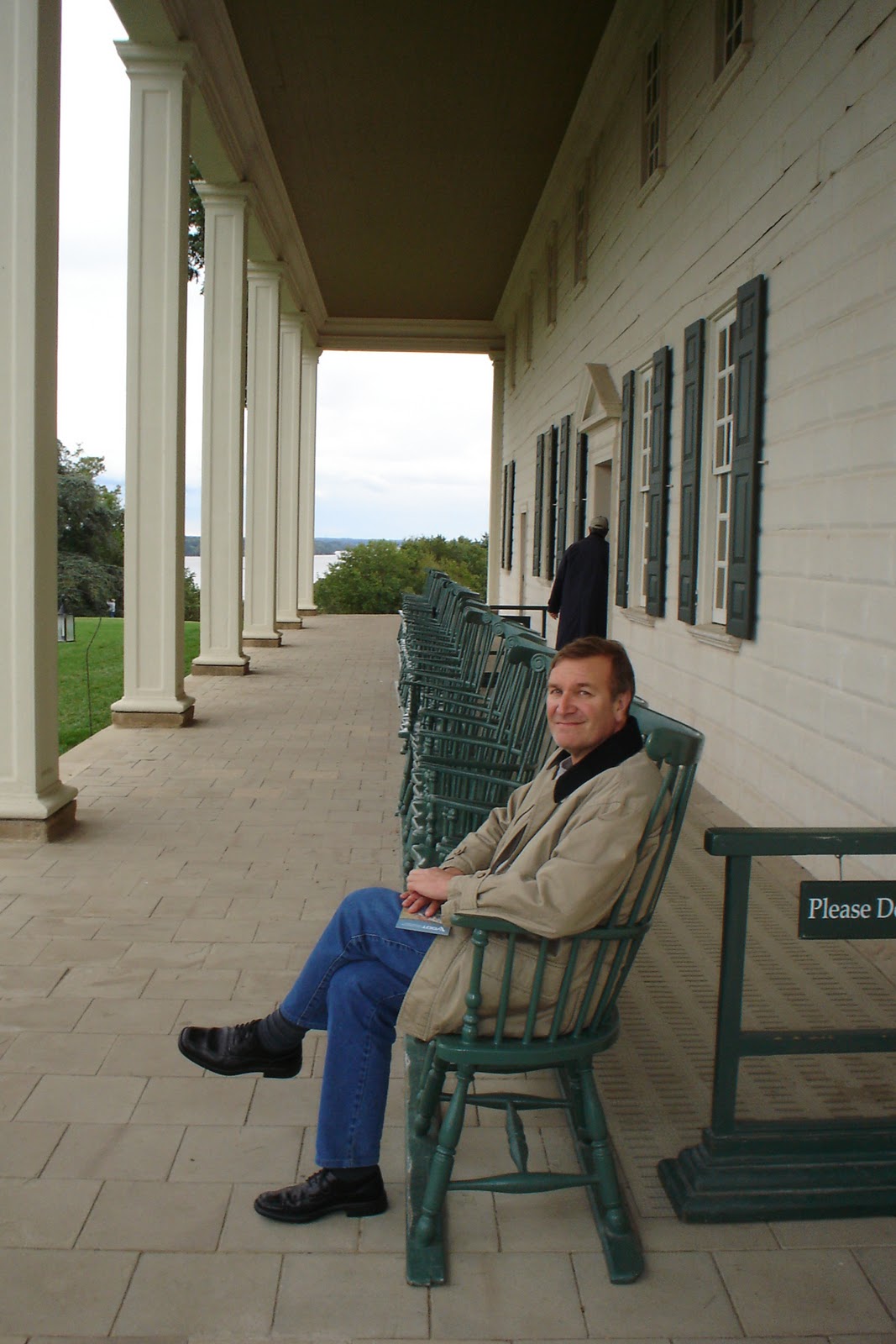
We went out to Mt Vernon (Washington's home), and I sat on the porch.


In 1798 Washington wanted John Marshall (the future Secretary of State and future Chief Justice) to run for congress. Marshall was unenthusiastic; he had just begun his law practice. Washington worked on him at Mt Vernon for several days to no avail. On the final morning of Marshall's stay, he came to say goodbye to the general on this porch. Washington, who had a great sense of theatre, had put on his full dress uniform. It instantly said to Marshall, I could have stayed here in my favourite place on earth, but I have always put service of the nation first. It worked. Marshall ran for election.

The view you see from here today is essentially what Marshall and Washington would have seen.


The Maryland shore is virtually untouched. You can see it through the colonnade. The swamp oak in the foreground below dates from 1770.


According to one of the guides, in the 1950s, Maryland wanted to put an oil refinery opposite; it was Maryland, their land. But the Ladies Committee of Mt Vernon lobbied the federal government and the government acquired the land. Today it is a federal reserve. Because of that you can just about see what Washington and Marshall saw on the opposite bank for the entire turns of your heads. Just as well for tourists these days that the 1950s federal government took Washington's more continental view.