In Savannah, I was often fascinated by the after-effects of the Civil War - the house where General Joe Johnston lived for example:
(Out in North Carolina, we had seen the farm where Johnston had surrendered his army to General Sherman in April 1865)
Whenever we walked down Bull Street, I would also stop and take a look at Comer House, where ex-Confederate president Davis was entertained when he visited Savannah in 1886.
I was always fascinated by the way the vanquished Southern leadership was feted in after-years.
I asked a friend from Georgia how this could be, and the best explanation he could come up with (with a shrug) was: 'Family'. Of course, some family members would bristle at my word 'vanquished'. At a lecture we attended, the president of the Georgia Historical Society, W. Todd Groce, warned his audience beforehand that they might find he has some complimentary things to say about General Sherman, the Union general who occupied Savannah from December 1865 to February 1865. And there was an audible shuffle (of discomfort?) when he mentioned that actually, prior to the war, Sherman had been first president of LSU (Louisiana State University).
I admit I, too, wonder to what extent the Southern leadership was vanquished. To a large extent they were incorporated. The stars and stripes flies outside Johnstone's house.
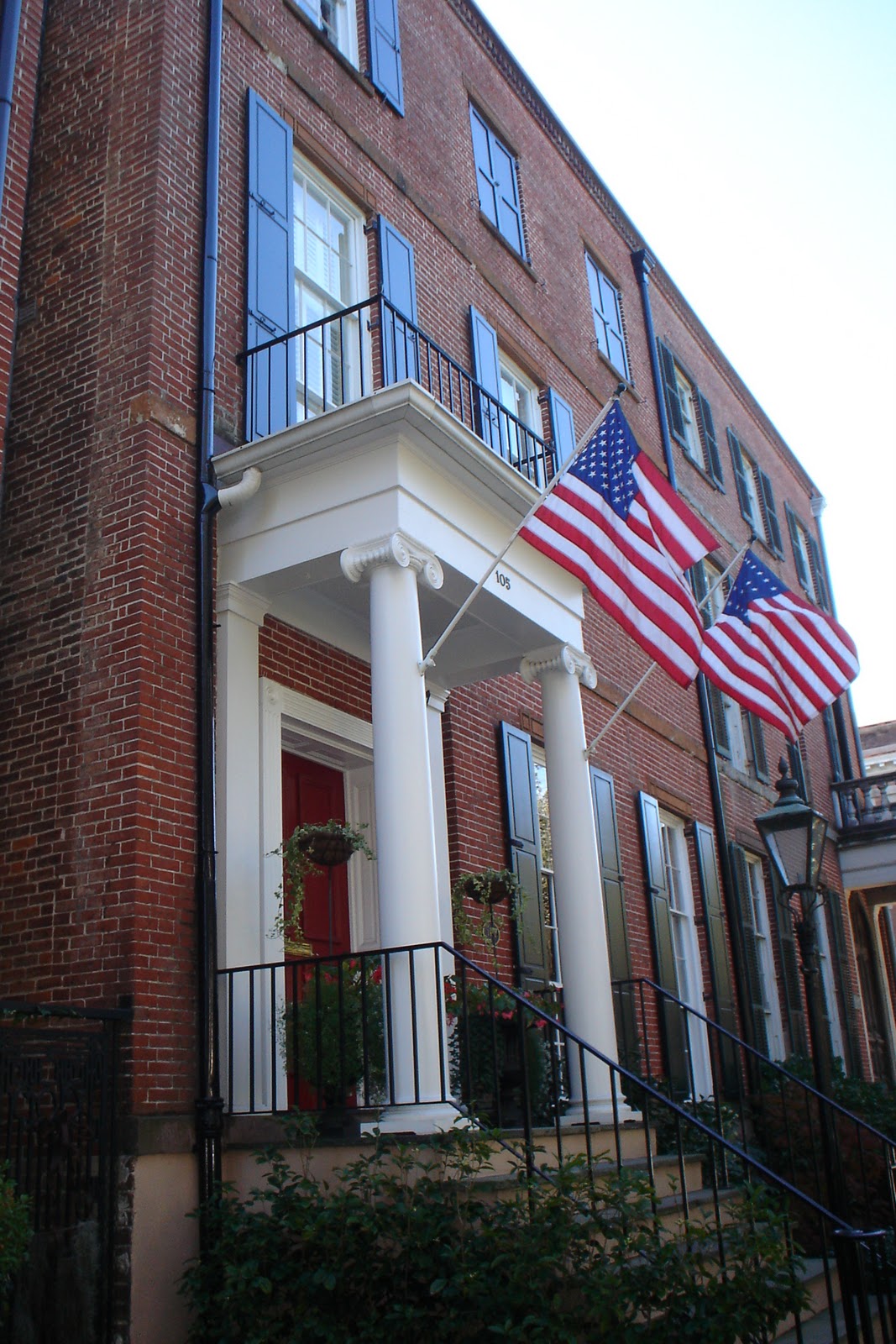
(Of course, Johnston later served in federal administrations.) But I wonder if this approbation is an example of Lincoln's 'let 'em up easy'?
Or is this process of lauding Confederate leaders a way of legitimizing States' Rights as an authentic strand of American life? In the movie Gettysburg, 'General Longstreet' says, 'We should have freed the slaves and then fired on Fort Sumter.' That would have focussed the issue. Fact is, though, they didn't [free the slaves], and they couldn't keep it [the issue of slavery] 'in the family'.
Which, given that Americans live with this oppositional view in their midst, got me thinking about the place of contrary views in American society. Because, as another example, if you think about it, the major American political parties have become their polar opposites over the years. I know I was dismayed to learn, some years ago, that the 'big government' Democratic Party traces its origins back to Jefferson who was a proponent of States' Rights and 'government is best which governs least'. On the other hand, the greatest presidents from the small government, States' Rightist Republican Party were Lincoln and Teddy Roosevelt, who enlarged the federal government, enforcing its authority and regulating industry respectively. Do the supporters of either party recognise these flips? Or recognise them as flips? As someone said on the morning chat show Morning Joe the other day the debate between state and federal government and Strict Construction vs Hamiltonian interpretation (the federal government is empowered to do whatever is necessary to achieve its ends under the constitution) is 200 years old. Is embodiment of this debate, without any requirement to be consistent, enough to register authentic Americanness?
On Monday we left Savannah and took the bus to Atlanta (reversing the path of Sherman's march to the sea. I can see why it would have taken him so long to cover the distance.)
In Atlanta, ninth-largest metropolitan area of these united States, we found the following sign proudly displayed on the corner of Spring and Peachtree Streets:
Here were the outer defences of Atlanta in 1864.
Showing posts with label slavery. Show all posts
Friday, December 16, 2011
Friday, October 7, 2011
Let's not forget they were farmers
Of course, the founding fathers were also - a lot of them - slaveowners, but I have always appreciated the fact that they understood harvests, tides, seasons, flowerings. Most were farmers.
I find it moving that there are still native trees on Mt Vernon that were planted by George Washington himself.
And I've always been touched by the passages in the founders' letters where they discuss farming and husbandry among affairs of state: a new crop rotation method, a new form of plough, Jefferson discussing the form of government in a letter to Washington and then informing his fellow Virginian that 'asparagus has just come to table' (out west, in the Piedmont).
The fact that the founders were farmers tells us a lot about the country they envisaged. They managed little fiefdoms. Washington was so traumatised (not too strong a word I would suggest) by the inability of the individual states to reliably finance the continental army during the Revolution that he urged a strong central government, but should we temper that knowledge by acknowledging also that they probably saw life on this broad continent as a series of little settlements?
And as for Jefferson's ideal of agrarian democracy (a piece of land for each man to work - as he scribbled on a piece of paper that is now in the Library of Congress), if people had actually achieved it, might we have continued to adhere closer to a remembrance of the natural world? On the other hand, could every individual in today's 300 million-strong population have 'a little farm to work'? And did Native Americans appreciate the idea that they should be taught agriculture in order to be able to work smaller plots of land, surrendering their vast domains for Europe's starving thousands?
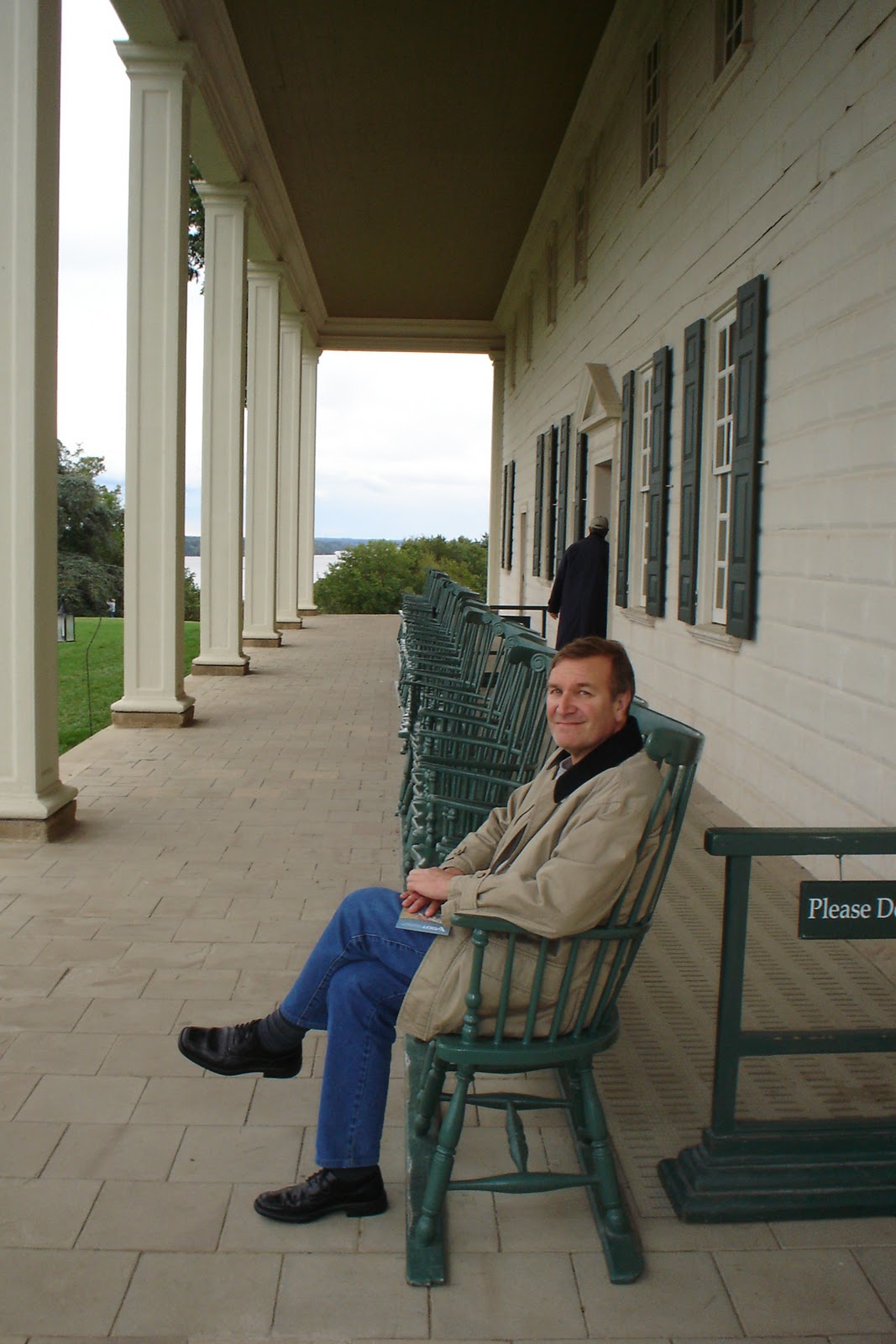
We went out to Mt Vernon (Washington's home), and I sat on the porch.
In 1798 Washington wanted John Marshall (the future Secretary of State and future Chief Justice) to run for congress. Marshall was unenthusiastic; he had just begun his law practice. Washington worked on him at Mt Vernon for several days to no avail. On the final morning of Marshall's stay, he came to say goodbye to the general on this porch. Washington, who had a great sense of theatre, had put on his full dress uniform. It instantly said to Marshall, I could have stayed here in my favourite place on earth, but I have always put service of the nation first. It worked. Marshall ran for election.
The view you see from here today is essentially what Marshall and Washington would have seen.
The Maryland shore is virtually untouched. You can see it through the colonnade. The swamp oak in the foreground below dates from 1770.
According to one of the guides, in the 1950s, Maryland wanted to put an oil refinery opposite; it was Maryland, their land. But the Ladies Committee of Mt Vernon lobbied the federal government and the government acquired the land. Today it is a federal reserve. Because of that you can just about see what Washington and Marshall saw on the opposite bank for the entire turns of your heads. Just as well for tourists these days that the 1950s federal government took Washington's more continental view.
Subscribe to:
Posts (Atom)