Showing posts with label Australia. Show all posts

Saturday, June 29, 2013

The Colours of Australia?

...or more precisely the colours of southern Australia?


But this is outside the School of Dentistry at UCLA, and I've also been told that it could be a Rainbow Gum (Eucalyptus deglupta), in which case it's the only eucalypt found naturally in the northern hemisphere - Mindanao (the Philippines) - and not in Australia, though close to home - New Guinea and New Britain. 

I had to come here to learn this...!


Wednesday, April 10, 2013

A walk down Wilshire


We walked to Western Avenue along Wilshire, LA's grand boulevard, starting out in Westlake,


to the other side of Macarthur Park;


passing past deja-vus of Australia;


and grand old buildings along the way


(with more grandeur in the distance).


Some old buildings - thank God - have new uses (Bullocks Wilshire department store now the Southwestern Law School),


but some have been demolished and all that remains is a vague tribute to the building footprint, a poster on a lamp-post,


or old direction to the carpark.


Yes, tragedy struck here, as the poster above says, Senator Robert Kennedy shot on the night of the California Primary, in 1968. Schoenberg's Kol nidre was premiered here too, in 1938, in the Coconut Grove nightclub.


In some places, the charm is provided by 1960s architecture


or echoes of what was there before.

On the site of the old Wilshire Colonnade

At least we can be be grateful that in this movie town, many old cinemas remain standing (if not showing films).


Tuesday, March 26, 2013

That great Australia on the other side of the sphere

"That great America on the other side of the sphere, Australia..." 
- Herman Melville, Moby Dick chap.24


I have been assured that this a southeast Queensland Bunya Pine (Araucaria bidwillii)  - growing just under the Hollywood Hills on the way up to the Hollywood Bowl.


So, not just eucalypts here. And the air is full at the moment of Australian fragrances - wattle and sweet pittosporum. Boy, you mightn't know it was America - except they drive on the other side of the road, signs are bilingual in English and Spanish, and, er, well...there's a sense of the unlimitedness of possibilities...


Wednesday, March 20, 2013

Los Feliz


As an Australian in Los Angeles, I actually feel as if I'm only over the other side of the drink. Admittedly that's got a lot to do with the gum trees everywhere. But I also love the fact that Los Angeles is a similar age to Sydney. The Pueblo de Nuestra Señora la Reina de los Ángeles was founded in 1781, in the decade which saw the First Fleet sail into Sydney Harbour.

And a lot of the Spanish land grants date around the same time as land was being granted to soldiers of the Crown in New South Wales. Part of Newtown in Sydney's inner west, the area lying south of King Street, was granted to the Superintendent of Convicts, Nicholas Devine, by Governor Phillip in 1794 and 1799. Part of the area lying to the north of King Street, was granted in 1806 to Governor William Bligh (yes, the Bligh of Mutiny on the Bounty fame), who named it Camperdown and passed it to his daughter and son-in-law on his return to England in 1810. This marker at Montrose commemorates the Rancho San Rafael, the first of California's Spanish land grants made to Don Jose Maria Verdugo in 1784.


The rancho covered what is, these days, Glendale, Eagle Rock,La Cañada, Montrose and Verdugo City. From the south one of its boundaries went north along the east bank of the Los Angeles River and wrapped around the western side of Griffith Park. On the southern side of Griffith Park is Los Feliz, which was once a Spanish land concession made out to Cpl Jose Vicente Feliz in 1795 (See? Similar period). I've even seen a street directory which showed the borders of these old ranches.

I enjoy Los Feliz. It's one of those areas in Los Angeles that is described as 'walkable'.


You come out of the Metro Underground at Vermont and Sunset and, looking up Vermont, get a good sense of where you are in relation to the rest of the city.

Looking up Vermont Ave, the Hollywood sign in the west and Griffith Park with its observatory to the right
Los Feliz has bookshops, restaurants, street life...


and in the distance, glimpses of Frank Lloyd Wright houses
Or at least buildings in the style of Frank Lloyd Wright, because the museum up here, in Barnsdall Park, is in keeping with the actual house, Hollyhock, further back on the hill
But this house, up in the hills, is the actual Wright, Ennis House, known by some as 'the Bladerunner house'


Monday, March 18, 2013

Welcome and unwelcome things at once

Such welcome and unwelcome things at once
'Tis hard to reconcile.
Shakespeare, Macbeth: Act IV sc.iii


Some Americans I've spoken to have expressed amazement when I've told them how safe I feel wandering Australian city streets at night; when I say that I can walk just about anywhere in downtown Sydney 99% sure that no-one else in the street is armed with a gun.

A police officer I met at a party here in the Valley told me that he is always armed - "I'm carrying now". I told him Australia has quite a different gun culture. He knew that, he said, almost wistfully, but he's seen too much. I know Australia has bikie shootouts and there's been an increase in violence with the growing amphetamine trade. But I get a sense here, in the US, that even the small-time criminals might be armed and I have a theory that Australian petty crims tend not to be, because even they don't want to raise the stakes.

On the other hand, you see some paradoxes here. The coppers standing by the roadblock at the end of a suburban street in Reseda were quite happy to casually tell me what they were doing as the chopper choppered overhead; a security guard in a baking carpark laughed and patted me on the shoulder when I told him he had the right idea, carrying an umbrella to guard against the sun (a gunman with a parasol). I saw a very grumpy woman at the end of her tether in a laundromat not only laugh when the owner came over and helped her, but rub him on the back!
  
This is a country where one state has recently backed the idea of teachers bringing guns into class:

http://www.nytimes.com/2013/03/09/us/south-dakota-gun-law-classrooms.html?_r=0

But there's incredible courtesy and even affection between strangers here, of a sweetness and poignancy you don't get in Oz, and I wonder if that's the compensating factor.


Friday, February 22, 2013

Cultural conjunctions III


To the right, gum trees and a copy of Houdon's statue of George Washington, Los Angeles City Hall in the background. But we're a long way from Washington's America, not to mention Australia...

Monday, January 7, 2013

A lot to not sing about

The United States has made genuine contributions to world thought. In 'their' Revolution and Civil War and  in the documents associated with those conflicts, the players in American history have refined the concepts of liberty and freedom and civil rights. Even more... if William Jennings Bryan had won the 1900 presidential election, his address to the Democratic National Convention - The Perils of Imperialism - might forever have spelt out the difference between a republic and an empire. ("A republic can have no subjects. A subject is possible only in a government resting upon force; he is unknown in a government deriving its just powers from the consent of the governed.")       

I often wonder what Australia has contributed to world progress. Women got the vote in South Australia before most of the rest of the world, the High Court's MABO decision of 1992 knocked for six any idea that a country is uninhabited ("terra nullius") just because it's not inhabited by the conquerors.

The other day, in Carlton, I realised that Australia played perhaps the major role in implementing the 8-hour day. Yes, the 8-hour day movement started in Britain. The British socialist and factory owner Robert Owen may have coined the slogan "Eight hours labour, eight hours rest, eight hours recreation", but the movement's biggest splash was made in Victoria, Australia. In April 1856, stonemasons working on the University of Melbourne downed tools and marched on parliament, also under construction. As a result of their protest parliament decided that they could work eight hours a day with no loss of pay. Stonemasons celebrated with a holiday and procession on 12 May 1856.

Just outside the Melbourne CBD (Downtown), in Carlton across the road from the Trades Hall Council, is the 8-hour day monument. The triple-eight symbol later became decoration on many union buildings.


How many Australians are proud of this, or even know anything about it? We don't make much of a song and dance. (If Dr. Martin Luther King Jr had addressed an Australian audience in his 'I Have a Dream' speech and rung out: "No, no, we are not satisfied and will not be satisfied until justice rolls down like water and righteousness like a mighty stream", some prosaic Australian up the back would have called out, "Oh, turn it up!" )

And yet, Australia has a democracy to be jingoistically proud of; a democracy with a slightly more liberal nuance to the idea of freedom. Because it isn't just personal liberty, which can easily be perverted into exploitative behaviour by successful individuals; it's real practical rights across the board. And it could be argued that we have greater real liberty because Australian workers were able to form themselves, as unions, into more exact counterweights to the controllers of capital. At any rate, the fact that we don't trumpet our achievements too loudly is also perhaps a sign of a non-intrusive humility.


Friday, December 7, 2012

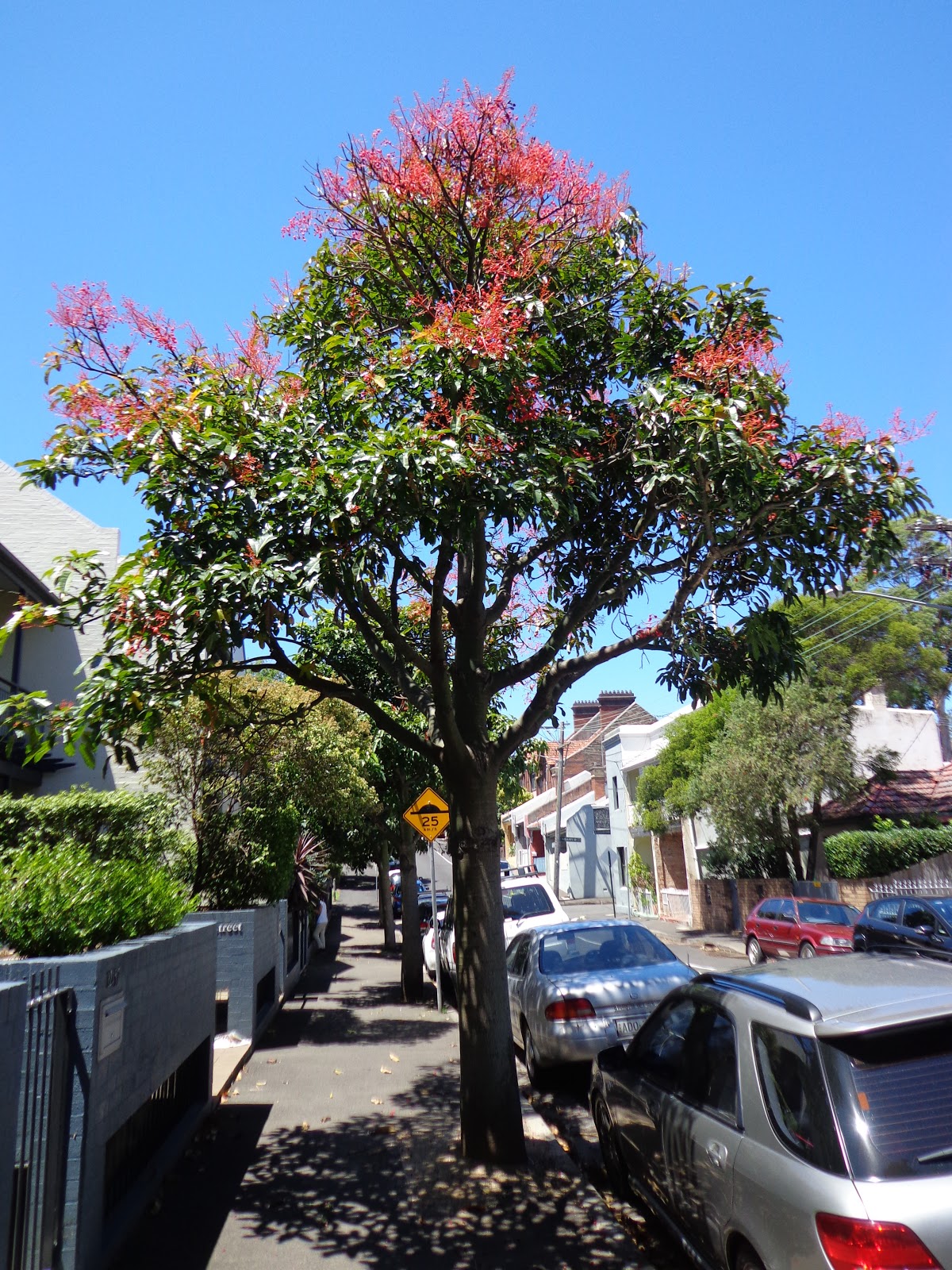
Australian flora is the dead give-away

Just a couple of photographs today:

People rave about the Fall colours in the US or complain about the drabness of the Australian bush. Doubtless when they talk of the bush they're talking of the gun-metal greys and off-yellows of a eucalyptus forest, not the rainforest of New South Wales. For, let's face it, how rivetting is this? An Illawarra Flame Tree  (Brachychiton acerifolius), native of the NSW coast, spectacular at this time of year (summer) here in an inner-Sydney street.


Another flame tree from the adjacent street, prior to losing all its leaves. You may also see the dark brown, boat-shaped 10cm-long fruits if you look close enough.
Flame Tree in Hyde Park, CBD
We also saw a tree I'd never noticed before in Randwick yesterday - a Native Hibiscus, endemic to our coast, and I think the Randwick municipality's coast.


There is a certain sameness to Australian cities. I'm not talking of the glass and steel towers which make CBDs and downtowns all over the world 'samey', but that suburban architecture which means an Australian from just about anywhere in the country can recognise the caricatured suburbia of a Howard Arkley painting. But when you look at our flora you see regional difference. The banksias of the West are not like the banksias of the Sydney eastern suburbs. Jarrahs are different from Mountain Ash or Angophorae costatae or Ghost Gums (Eucalyptus papuana). You've got to look to our flora and not our accents or our architecture to really locate yourself in this country.