Showing posts with label Melbourne. Show all posts

Saturday, November 2, 2013

A clockwise trip around the southeast

On our recent trip back to Australia, we were knocked out by the contrasting beauty of the cities and regions. Here's an affectionate photo tribute,

from Sydney:

A Saturday morning's stroll in Northbridge, looking across to Castlecrag, Middle Harbour

Kirribilli, directly across from the Opera House


The view from one of my favourite pools, North Sydney
 from Melbourne

Melbourne from the air, coming into Tullamarine

Melbourne's completely other feel


from Adelaide:
The Old Telegraph Station at Port Adelaide, a link to the inland in the old days

Victorian architecture in Port Adelaide. Note Adelaide's distinctive stone.


 from North Coast, NSW

The distinctive domestic architecture of tropical and sub-tropical areas


such as Ballina, an hour's flight north of Sydney


Monday, January 7, 2013

A lot to not sing about

The United States has made genuine contributions to world thought. In 'their' Revolution and Civil War and  in the documents associated with those conflicts, the players in American history have refined the concepts of liberty and freedom and civil rights. Even more... if William Jennings Bryan had won the 1900 presidential election, his address to the Democratic National Convention - The Perils of Imperialism - might forever have spelt out the difference between a republic and an empire. ("A republic can have no subjects. A subject is possible only in a government resting upon force; he is unknown in a government deriving its just powers from the consent of the governed.")       

I often wonder what Australia has contributed to world progress. Women got the vote in South Australia before most of the rest of the world, the High Court's MABO decision of 1992 knocked for six any idea that a country is uninhabited ("terra nullius") just because it's not inhabited by the conquerors.

The other day, in Carlton, I realised that Australia played perhaps the major role in implementing the 8-hour day. Yes, the 8-hour day movement started in Britain. The British socialist and factory owner Robert Owen may have coined the slogan "Eight hours labour, eight hours rest, eight hours recreation", but the movement's biggest splash was made in Victoria, Australia. In April 1856, stonemasons working on the University of Melbourne downed tools and marched on parliament, also under construction. As a result of their protest parliament decided that they could work eight hours a day with no loss of pay. Stonemasons celebrated with a holiday and procession on 12 May 1856.

Just outside the Melbourne CBD (Downtown), in Carlton across the road from the Trades Hall Council, is the 8-hour day monument. The triple-eight symbol later became decoration on many union buildings.


How many Australians are proud of this, or even know anything about it? We don't make much of a song and dance. (If Dr. Martin Luther King Jr had addressed an Australian audience in his 'I Have a Dream' speech and rung out: "No, no, we are not satisfied and will not be satisfied until justice rolls down like water and righteousness like a mighty stream", some prosaic Australian up the back would have called out, "Oh, turn it up!" )

And yet, Australia has a democracy to be jingoistically proud of; a democracy with a slightly more liberal nuance to the idea of freedom. Because it isn't just personal liberty, which can easily be perverted into exploitative behaviour by successful individuals; it's real practical rights across the board. And it could be argued that we have greater real liberty because Australian workers were able to form themselves, as unions, into more exact counterweights to the controllers of capital. At any rate, the fact that we don't trumpet our achievements too loudly is also perhaps a sign of a non-intrusive humility.


Sunday, January 6, 2013

A trip through the yellow inland

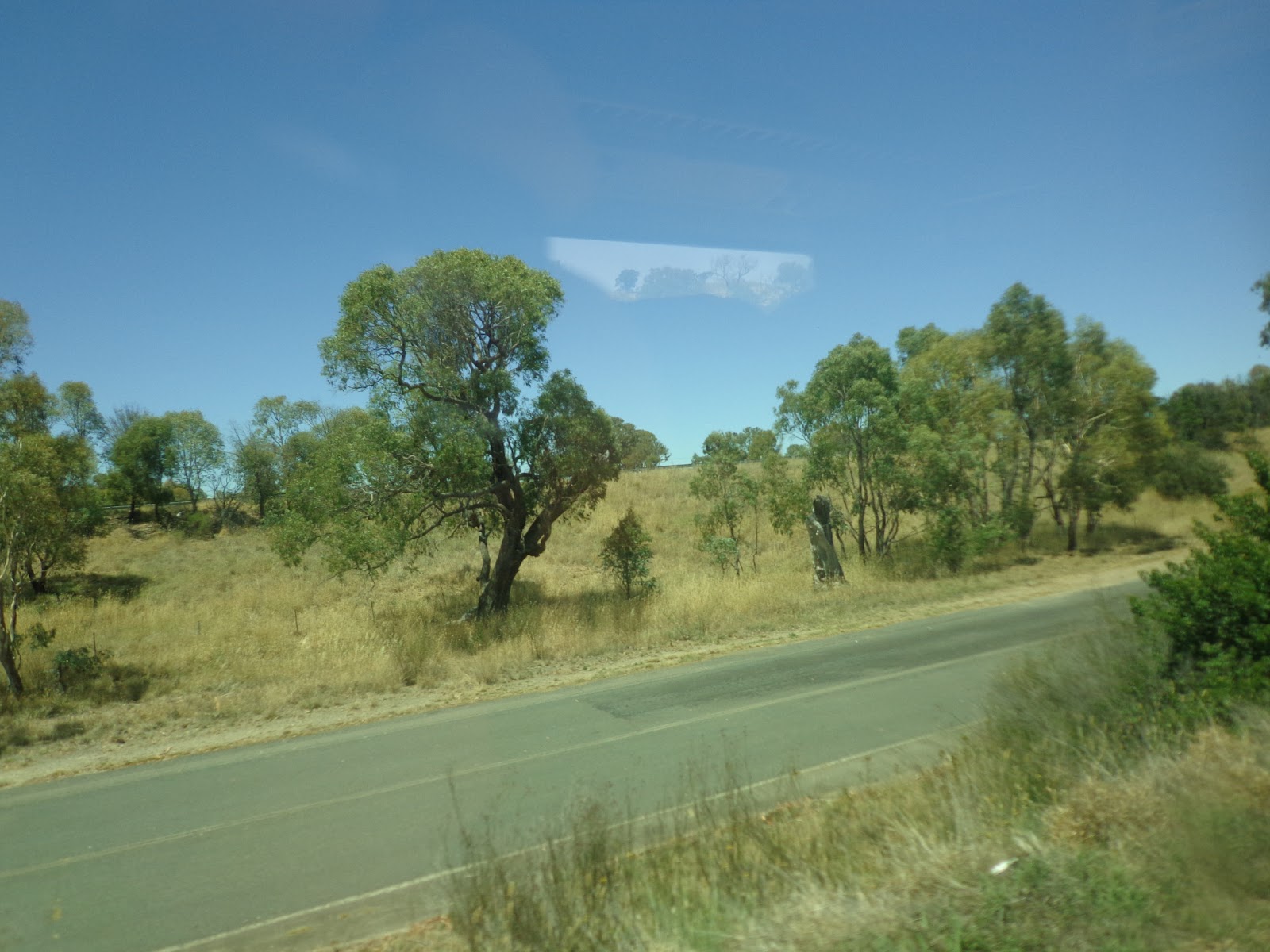
Australians often complain that the country between Sydney and Melbourne is boring. I don't find it so. Once you get past the sandstone of the Highlands and the scribbly gum country of Goulburn the country is essentially, for about 8 hours, that expanse of yellow and blue that was celebrated by the Australian Impressionists in the 1890s. However, I'm reminded of the statement by Tchaikovsky to Mme von Meck after he came back to Russia from Switzerland: "Mountains are fine, but I'm dying for a plain."

I took some shots from the window as we travelled by XPT between Harden-Murrumburrah (NSW) and Seymour (Victoria) on Thursday.


Getting into the foothills of the Australian Alps around Albury
On this journey you see typically Australian country towns:


and it's not all plain:

Back through the Southern Highlands going the other way

Some might say this is boring country, but I disagree and I don't think I'm anticipating a future nostalgia because I don't know when I'll be coming this way again.


Saturday, October 6, 2012

True blues

Flying out of Sydney I think as usual of how interesting it would be to see this coast from the sea and imagine how it appeared to the first white visitors.


This is Port Hacking, just north of the Royal National Park. North of here, Captain Cook sailed straight past Sydney Harbour in 1770. From the sea, he thought the south, middle and north heads of Port Jackson simply defined the circumference of a short bay, not that Middle Head was the tongue dividing two separate harbours, one quite massive.

In Melbourne I constantly revise my impressions of my birthplace. This time I noticed just how much Sydney and Melbourne are differentiated by their native stone.

Whereas Sydney's is a golden honey colour,


Melbourne's is a dark blue


Blue is the colour of mountains in southeastern Australia. In Box Hill, near where the Australian Impressionist painters (Frederick McCubbin, Tom Roberts) taught us that the natural colours of southeastern Australia are blue and yellow,


I looked out at the Dandenong Ranges in the distance:


In 1930, the great soprano Dame Nellie Melba retired out near where those distant blue hills rise. When I see them I remember how the Australian (Melbourne) composer Percy Grainger (claimed by Americans) described Melba: "Her voice always made me mindsee Australia's landscapes, her voice having some kind of a peach-fur-like nap on it that made me think of the deep blue that forms on any Australian hill if seen a mile or more off."