Showing posts with label Ntaria. Show all posts

Tuesday, May 28, 2013

Journey to Horseshoe Bend - ten years on


Today marks the 10th anniversary of the first performance of Journey to Horseshoe Bend. I republish this article from that time. Another article on the involvement of the Ntaria community and other black and white Territorians is on my website under Singing Chorales: Aranda Way

Broadening experiences in Central Australia

How well has classical music represented Central Australia over the years? John Antill obviously read Spencer and Gillen’s classic text, The Arunta before writing his ballet Corroboree, the young Peter Sculthorpe portrayed a ‘sunburnt country’ in his various tone poems. There’s one long note in Barry Conyngham’s opera Edward John Eyre which says heaps to me about horizon.

The musical work that Andrew Schultz and I have written for Symphony Australia and the Sydney Symphony is based on T.G.H. Strehlow’s 1969 novel Journey to Horseshoe Bend,  which tells of Strehlow’s mortally-ill father’s last journey down the dry bed of the Finke River, Central Australia in search of medical help in 1922. Pastor Strehlow examined his faith, as his son Theo (the young T.G.H. Strehlow) travelled behind his parents’ buggy, learning about the country from Aboriginal guides, pastoralists, cameleers and a host of other characters they met along the way.

Cover of the CD of Journey to Horseshoe Bend, released 2004. Photo of Horseshoe Bend: Paul Carter
 To create our musical version of Journey to Horseshoe Bend, the novel’s 220 pages may have been edited, but in developing this work over a four-year period we have had a broadening experience, not out of keeping with the ‘coming of age’ of young Theo in the book.

In the introduction to his monumental Songs of Central Australia, T.G.H. Strehlow acknowledged the old Aranda men who provided him with the words of the chants he had transcribed. Their birthdates stretched back as far as 1842, before McDouall Stuart’s epic crossing of this continent. Uniquely for an anthropological writer in the 1950s, and one occasionally remembered for the controversy over his handling of sensitive Aboriginal material, Strehlow credited his informants. It’s a nice point to bear in mind as I reflect on the broad community of support which has buttressed our creation of this work; of a large history against which we pitch our piece.

We present Journey to Horseshoe Bend as a cantata, that form of unstaged mini-opera which the Lutheran J.S. Bach used to reflect the scriptural message in Sunday services at St.Thomas Church Leipzig where he served in the 1720s. Why? Early in the novel Pastor Strehlow is brought from his house at Hermannsburg Mission (now called Ntaria) for the last time. As he is lifted into the buggy the mission people gather round and sing Kaarrerrai worlamparinyai, Pastor Strehlow’s translation of Wachet auf, the great Lutheran hymn set by Bach and used by him in Cantata 140. But by presenting the work as a cantata we pay homage to the Lutheran background of people out at Ntaria – a Lutheranism held in tandem with traditional belief – as well as our own Europeanness. We employ an effective medium for a story which in many respects is as deep and as anguished as a Passion. Our version of Journey to Horseshoe Bend is cast in eight scenes, broken up into arias, duets, choruses. Andrew’s orchestral layout reflects the 275–kilometre river valley through which the party travels. Winds and brass on either side of a central pool of strings and other instruments, resemble a river gorge, but you could also regard the layout as similar to the chancel of a church. Andrew even borrowed a refrain from the Ntaria Lutheran service – the words Kaartai, nurnanha wurlathanai (Lord, hear our prayer) - to frame Pastor Carl’s death.

I make use of a narrator, as well as another actor, to tell the story, and this is outside the cantata tradition. But our purpose is to create a bond with a broader audience beyond the normal concert-going public, the sort of people to whom and for whom the story of Journey to Horseshoe Bend is meant to speak. I make use also of the three languages of the region as well as the dialectical differences between Western Arrarnta, Southern Arrernte, and Eastern Arrernte (and even the orthographical differences between the different dialects of Arrernte; the differences are unsettled - until the 20th century, Arrernte was an oral language). Travelling through the Brittania Sandhills one of those nights in 1922, young Theo was rebuked by his guide Njitiaka for using the Western Arrarnta word for moon in Southern Arrernte country. In an exchange which echoed this episode in the novel, Alice Springs resident Doug Abbott, chided me for casting his great-grandfather’s dialogue in the Eastern Arrernte I had reconstructed from a dictionary: ‘That old bloke would turn in his grave [if you had him talking in anything other than Southern Arrernte.],’ he said. Casting a story of Central Australia in cantata form, replete with narration and Aranda interjections (to use the Strehlows spelling), acknowledges the hybrid forms that are a mark of post-contact Aranda life. Aranda people out at Ntaria practise Two Ways, a blend of Aranda and European traditions

T.G.H. Strehlow began Journey to Horseshoe Bend in May 1966 while recovering from peritonitis. It was published at a time of crisis in his life. Strehlow’s novel has been described as an attempt to posit himself as central in Aranda life, particularly at a time when a rising generation of Aboriginal activists rebelled against a white man who spoke of their ceremonial life for them. The book tells stories of the Altjira, translated imperfectly for the past century as ‘the Dreamtime’, while recounting stories of Pastor Carl Strehlow’s struggles with God. We get a sense of the eternal mythology underpinning the landscape but also details of the pastoral history of the region; the sequence of ownership of Henbury Station, for example; or how Gus Elliott, owner of Horseshoe Bend hotel, where Pastor Strehlow died, first attempted to run cattle at Glen Helen but moved into an area where he would not face so much resistance from the original inhabitants. Working on this piece, helicoptering over its terrain, Andrew and I are possibly the first composer and librettist in Australian musical history to be asked to avoid disturbing a cattle muster while doing our research.

T.G.H. Strehlow does not favour one strand – black or white – as more relevant than the other in his book. My libretto juxtaposes and perhaps prioritises elements for the sake of dramatic vividness, and space. But ours is still a story of reconciliation. Andrew sets Strehlow’s translation of the Song of Mborawatna to a chorale fugue at the end. The point is not ‘neither-nor’, nor ‘yes, but’ but ‘both-and’. We’re embracing the life of the country, like Strehlow, in all its historical and mythical currents, cross-currents and substrata.

Journey to Horseshoe Bend, the novel, is out of print and hard to find these days. When I began work on this project it was as if T.G.H. Strehlow had disappeared from the face of literary Australia. I often went into second-hand bookshops looking for the title, only to find myself spelling ‘Strehlow’. Once upon a time governments turned to only three white men for ‘technical advice’ when making ‘aboriginal policy’: A.P. Elkin, W.E.H. Stanner and T.G.H. Strehlow. It was as if, in spite of the incredible controversy in 1978, when Strehlow’s photographs of secret ceremonies turned up in the German photo-magazine Stern, Strehlow had ‘disappeared from the map.’ Of course he was not forgotten in Central Australia. People remember not only that ‘he shouldn’t have sold those pictures’ but still confirm family relationships that Strehlow recorded on genealogies drawn up with devotion and a Teutonic thoroughness.

Andrew and I are responsible for the artistic decisions involved in making a musical version of this novel: telling the story in 1st person, rather than Strehlow’s more impersonal 3rd person; having Njitiaka actually speak in Aranda. Andrew decided the orchestral layout, musical language, orchestration, and musical weighting for each section. We’ve no doubt cut out someone’s favourite bit. But in making this version of Journey to Horseshoe Bend we have consulted widely, drawing upon the family lore and reminiscence of people still living in the Centre. Much of T.G.H. Strehlow’s material – manuscripts, objects given to him by the old men - is now housed in the Strehlow Research Centre, Alice Springs. I would have rung the Centre’s Brett Galt-Smith and Shane Hersey several times a week over the past four years. Andrew, the Sydney Symphony’s Alexandra Cameron and I have all been out to Hermannsburg; Symphony Australia has made sure we could fly and drive the length of the journey to Carl Strehlow’s grave. We gained a greater sense of the reality of the story by meeting descendants of characters in the novel, and seeing the pride for example with which Kunmanara Breaden, current chairman of the Central Lands Council, told of his grandfather Johnson showing Theo over Idracowra station on the fifth day of the journey. In the cantata, this is represented by Theo singing Andrew’s evocative ditty of what he sees: harnesses, bridles, hobble straps, while his father heaves through a text wrought with the question of suffering as described in Job. We didn’t have the time and ‘space’ however to show Theo embarrassing the agnostic station people by saying grace out loud on the Sunday, but Mrs Murphy at Idracowra showed us the still–extant blockhouse where he said it.

This work was not conceived by a lonely isolate starving in a garret. Part of my confidence in this work lies in the level of consultation and immersion in Territorian experience we have undergone with the assistance of a large number of people, and which echoes, however faintly, the original encounters of the Strehlows’ trip. If we’re to pay homage to all the people who helped in the creation of this work, we end up with a web of relationships that is not as complex as the genealogies prepared by T.G.H. Strehlow and still consulted by Aboriginal families 25 years after his death. But which has contributed to a work which we think speaks profoundly to an audience wider than the usual cognoscenti.

Gordon Kalton Williams © 2003
This article first appeared in The Australian Financial Review, May 2003

Other blogs of mine on Central Australia are:

Life-changing statements, 16 December 2012
Ah, Nathanael, 29 November 2012
Victory over death and despair in a bygone age (thoughts on John Strehlow's The Tale of Frieda Keysser), 5 Nov 2012
Virginia in the Desert, 10 Sep 2012
Drowned Man in a Dry Creekbed - Happy New Year 1993, 6 August 2012
Opera in a land of Song, 29 July 2012
Considering the aboriginal land of Altjira, 20 May 2012

Monday, August 6, 2012

Drowned man in a dry creek bed - Happy New Year 1993


My friends, Neil and David Bell, and I were out on the path of the Kungka kutjara, a Central Australian travelling songline  – one of those epic Central Australian chants that are meant to have come into being in the Tjukurpa (eternity), or Altjira as the Aranda call it. We were hoping, perhaps too blithely, to make a radio program about it for ABC Classic FM.

We had got some recordings down at Mutitjulu, had just dropped N and B off at the Loritja camp at Hermannsburg and were heading back towards Alice Springs. We sang some of the chant as we rattled over the corrugations of the dirt road, a bit of the song that stuck in our memories – ‘Yulatji luma, Kunpatji luma...’ – not so much as to ‘bring the country up’ as Bruce Chatwin observed aboriginal travellers doing, as to make the time go faster.

As we turned a corner near Ellery Creek we came across a burning car. A Western Desert man was standing beside the car trying to beat out the flames which had already spread, quickly in this heat, to the grass by the side of the road.

Ellery Gorge, photograph: courtesy Andrew Schultz
Neil pulled up and spoke to him. ‘Nyaa palyanin?’ and they had a conversation. As we pulled away, David, Neil’s son, said, ‘Did he say someone’s dead down there?’

We descended to the creek and saw two women stripped to their waists, wailing and hurling dirt in the air. In the dry creek bed we saw a man cradling another in his arms.

A carload of people had been driving from Alice Springs to Kaltukatjara (Docker River). They’d been drinking. At Ellery Creek they jumped into a waterhole and this fellow hadn’t come up.

‘How long has he been like this?’ we asked.

‘Half an hour’.

Back at Hermannsburg the police looked as if they’d hurriedly thrown their khaki uniform shirts over shorts and thongs. It was New Year’s holiday. We took the man’s body inside the station. Then there were a series of interviews. Neil translated, but there were still misunderstandings. ‘Name?’ the police asked one interviewee. ‘Stephen Bradshaw,’ he said (I use a fake name). ‘Well, if you’re Stephen Bradshaw, who’s he?’ they indicated the body bag and opened it. They had identified the deceased by the cicatrice scars on his shoulder. But distinguishing Central Australian aboriginal people by scarification on their shoulders will not get you far.

The police had to go back out to Ellery Creek and gave David and me a choice: sit outside in the 50 degree (122F) heat, or in here with the body. We chose the air-conditioning.

We sat in silence. But I was coming to understand what T.G.H. Strehlow had meant when he said that nowhere else in the world are death and eternity bound together so tightly as in Central Australia. The eternal myths, such as Kungka kutjara, are present in the daily lives of living people; death is out-in-the-open and an all-too-frequent occurrence.

At the end of the day, after five or six hours of witness statements, I was standing outside watching the sun set, waiting to finally get back on the road to Alice Springs. The driver of the Docker River people’s car came over, the car that I later learnt had been burnt in grief. I said, ‘Not a good way to spend New Year’s Day.’ He said, ‘Bad day for me.’ I wondered why him in particular, but was told later that as the driver of the car he could pay for this in a big way. In the past he might have been speared. How was it his fault? When the drowned man’s mother had been dropped off at the Loritja camp, the women had come over and struck her. I don’t know how they’d have known what happened. Something specific in the way she was wailing? But why strike her? These were graphic illustrations of the Central Australian concept of ‘duty of care’ and ‘tribal responsibility’. Awesome obligations of reciprocity necessary I suppose in an environment which will kill an isolated human if they’re not paying attention.

And all we had wanted to do really was make a radio program about an Australian form of music. To help Australians gain a bit more insight into the cultural riches of our land. ABC Classic FM never got that radio program on the Kungka kutjara, but we certainly got more than we had bargained for.


If you liked this blog, others of mine on Central Australia are:

Carving up the pie, 17 December 2012
Life-changing statements, 16 December 2012
Ah, Nathanael, 29 November 2012
Victory over death and despair in a bygone age (thoughts on John Strehlow's The Tale of Frieda Keysser), 5 Nov 2012
Virginia in the Desert, 10 Sep 2012
Opera in a land of Song, 29 July 2012
Considering the aboriginal land of Altjira, 20 May 2012

GW in 1993


Thursday, July 5, 2012

Conocotarius, George Washington - eventually

I don't live in Central Australia and haven't since the 1980s. It's been an important strand in my life though, given expression partly in our piece, Journey to Horseshoe Bend. And I guess I think of Central Australia every day. I see myself there. When I am there, visiting in person, I can still see the landscape in vivid detail when I shut my eyes of a night. It's as if it imprints itself on the inside of my eyelids. I sometimes wonder whether it's to do with the power of Central Australia's colours - yellow spinifex growing in red soil, the oranges and purples, the vapoury blue of distant peaks. Aldous Huxley once advanced a theory that stained glass is used in churches because bright colours penetrate deep into our spirit.
 
But it's also the languages I miss. In Sydney I'm not regularly hearing Aranda, the language of the area around Alice Springs and Hermannsburg (Ntaria) and Horseshoe Bend. I don't hear those four or so languages you might hear as you walk down the street in Alice Springs. As an exercise to keep in touch I often rewrite the different orthographies.

As an oral language Aranda, or Arrernte, has been written several ways in the past 100 or so years. When Spencer and Gillen were doing their researches at the remote Alice Springs Telegraph Station in the 1890s they wrote down what they heard by ear.

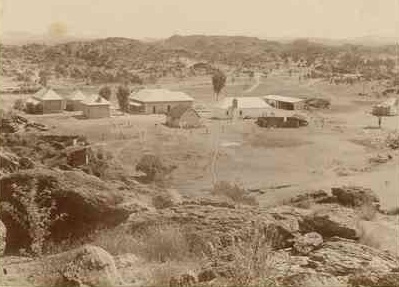
The Alice Springs Telegraph Station in the 1880s. Public domain

No linguists, they had no system for transcribing the words. And I found myself the other night rewriting sentences they'd quoted in 1899's Native Tribes of Central Australia into the more modern Eastern Arrernte script devised by the Institute for Aboriginal Development in the 1980s.

Arakutja wunka oknirra unta munja aritchika [Spencer and Gillen's translation: Plenty of young women, you look and go quickly.]

became

Arrweketye awenke akngerre unte mwenye aretyeke.

I've often found writing in different orthographies a good method for working out how unheard languages might sound. I like to think that since I know a bit of Pitjantjatjara, from northern South Australia, not far (relatively speaking) from Alice Springs, I might have a clue to how languages even further south, like Kaurna the Adelaide language, may have sounded when it was in regular use. I would imagine that all the Central and South Australian languages, those in the central strip extending even to the southern coast, emphasised the first syllable, since that is a common feature of languages around Australia (either first syllable or first syllable after a consonant).

I think you can play this comparison game with American languages. If you look to the US and compare 'Cherokee' with an alternative, preferred spelling 'Tsalagi' (first spelt as 'Chalaque' in De Soto's Portuguese narrative of 1557), you can imagine that originally the 'ch' of Cherokee was more 'hissy' like a 'ts', the 'r' was further back in the throat where 'l' sits, and the 'k' and the 'g' were not very distuinguishable.

My favourite example of this however, is the word: 'hanadahguyas'.

To this day, the Iroquois people of the US northeast address the president of the United States as Hanadahguyus. It means 'town destroyer'. When the Iroquois invited Bill Clinton to the 200th anniversary celebrations of the Treaty of Canandaigua in 1994, the letter to him was addressed to Hanadahguyus, President Bill Clinton, 'hanadahguyas' being a title that has been given to all 44 presidents because it was first given to Washington.

In 1753 young George Washington, then a colonel in the British Virginia militia, ventured into the Ohio country. He met the Seneca chief Tanacharison, or The Half-King. Tanacharison addressed Washington by the name the tribe had given Washington's grandfather. Washington wrote the word as 'Conocotarius'. They had given John Washington this name because he destroyed their villages. But 'conocotarius' doesn't look anything like 'hanadahguyus'. Could it  really be the same word? Well perhaps, if the initial 'c' in 'Conocotarius' is rasping like the 'ch' in the German 'hoch', and the 't' is between a 't' and a 'd', as in many languages. 'The 'r' might have been an indeterminable liquid, easily a 'y'. I can't explain the 'd' where 'Conocotarious has a second 'c'.

But if both words really do mean 'town destroyer' and they're just different ways of writing it, what I most like about the way Washington wrote it is that he gave it a Roman shape. 'Hanadahguyus' doesn't look like the name of a Roman hero. Conocotarius does. Was young Washington, in 1753, already monumentalising himself?

Houdon's statue of Washington in the Virginia State Capitol. Lifesize, it has been placed way above us by the pedestal.


Sunday, October 2, 2011

A European note

As an Australian who has worked in classical music, I have long been fascinated with the intersections of indigenous cultures with the European tradition. The meeting of German and Arrernte cultures at Hermannsburg in Central Australia is a case in point.

In North Carolina, I have been intrigued by Old Salem, just south of the Winston-Salem CBD in the Piedmont area.


The town was founded in the mid-1700s on land granted to followers of Jan Hus, who, several decades before Martin Luther tacked his petition to the door of a church, was burnt at the stake for rebelling against the Roman Catholic church. His followers, Moravians, had originally been offered sanctuary in Germany by a Count Zinzendorf. Hence, the people who turned up in America to take up land offered to them by Lord Granville, were German speakers. But what struck me as a familiar concordance was meeting the guy there at the Moravian Music Centre who has just finished co-editing the third volume (there will be four) of Records of the Moravians among the Cherokees. I dare say the Moravian missionaries could speak Cherokee, just as the German Lutheran missionaries at Ntaria (Hermannsburg) spoke Arrernte. As I say, this conjunction has a familiar ring to someone who has studied the history of Central Australia.


Even to this day, Old Salem, has a strong German flavour. The Moravians still own many of the buildings; there are plaques all over the place marking where people like Schober, Shultz, and Winkler once lived. (Very Meistersinger-ish, even the architecture in places).


Of course, I am always also in awe of people such as the Lutherans and Moravians who could live in remote places like this in those days. The green woods of North Carolina are seen as scenic and beautiful in these comfy air-conditioned and wi-fi days, but they would have been fearful wilderness then and Old Salem a cultivated patch hacked out of a new and alien world. I guess I must have a fascination with Europe off-centered.