Showing posts with label altjira. Show all posts

Monday, August 6, 2012

Drowned man in a dry creek bed - Happy New Year 1993


My friends, Neil and David Bell, and I were out on the path of the Kungka kutjara, a Central Australian travelling songline  – one of those epic Central Australian chants that are meant to have come into being in the Tjukurpa (eternity), or Altjira as the Aranda call it. We were hoping, perhaps too blithely, to make a radio program about it for ABC Classic FM.

We had got some recordings down at Mutitjulu, had just dropped N and B off at the Loritja camp at Hermannsburg and were heading back towards Alice Springs. We sang some of the chant as we rattled over the corrugations of the dirt road, a bit of the song that stuck in our memories – ‘Yulatji luma, Kunpatji luma...’ – not so much as to ‘bring the country up’ as Bruce Chatwin observed aboriginal travellers doing, as to make the time go faster.

As we turned a corner near Ellery Creek we came across a burning car. A Western Desert man was standing beside the car trying to beat out the flames which had already spread, quickly in this heat, to the grass by the side of the road.

Ellery Gorge, photograph: courtesy Andrew Schultz
Neil pulled up and spoke to him. ‘Nyaa palyanin?’ and they had a conversation. As we pulled away, David, Neil’s son, said, ‘Did he say someone’s dead down there?’

We descended to the creek and saw two women stripped to their waists, wailing and hurling dirt in the air. In the dry creek bed we saw a man cradling another in his arms.

A carload of people had been driving from Alice Springs to Kaltukatjara (Docker River). They’d been drinking. At Ellery Creek they jumped into a waterhole and this fellow hadn’t come up.

‘How long has he been like this?’ we asked.

‘Half an hour’.

Back at Hermannsburg the police looked as if they’d hurriedly thrown their khaki uniform shirts over shorts and thongs. It was New Year’s holiday. We took the man’s body inside the station. Then there were a series of interviews. Neil translated, but there were still misunderstandings. ‘Name?’ the police asked one interviewee. ‘Stephen Bradshaw,’ he said (I use a fake name). ‘Well, if you’re Stephen Bradshaw, who’s he?’ they indicated the body bag and opened it. They had identified the deceased by the cicatrice scars on his shoulder. But distinguishing Central Australian aboriginal people by scarification on their shoulders will not get you far.

The police had to go back out to Ellery Creek and gave David and me a choice: sit outside in the 50 degree (122F) heat, or in here with the body. We chose the air-conditioning.

We sat in silence. But I was coming to understand what T.G.H. Strehlow had meant when he said that nowhere else in the world are death and eternity bound together so tightly as in Central Australia. The eternal myths, such as Kungka kutjara, are present in the daily lives of living people; death is out-in-the-open and an all-too-frequent occurrence.

At the end of the day, after five or six hours of witness statements, I was standing outside watching the sun set, waiting to finally get back on the road to Alice Springs. The driver of the Docker River people’s car came over, the car that I later learnt had been burnt in grief. I said, ‘Not a good way to spend New Year’s Day.’ He said, ‘Bad day for me.’ I wondered why him in particular, but was told later that as the driver of the car he could pay for this in a big way. In the past he might have been speared. How was it his fault? When the drowned man’s mother had been dropped off at the Loritja camp, the women had come over and struck her. I don’t know how they’d have known what happened. Something specific in the way she was wailing? But why strike her? These were graphic illustrations of the Central Australian concept of ‘duty of care’ and ‘tribal responsibility’. Awesome obligations of reciprocity necessary I suppose in an environment which will kill an isolated human if they’re not paying attention.

And all we had wanted to do really was make a radio program about an Australian form of music. To help Australians gain a bit more insight into the cultural riches of our land. ABC Classic FM never got that radio program on the Kungka kutjara, but we certainly got more than we had bargained for.


If you liked this blog, others of mine on Central Australia are:

Carving up the pie, 17 December 2012
Life-changing statements, 16 December 2012
Ah, Nathanael, 29 November 2012
Victory over death and despair in a bygone age (thoughts on John Strehlow's The Tale of Frieda Keysser), 5 Nov 2012
Virginia in the Desert, 10 Sep 2012
Opera in a land of Song, 29 July 2012
Considering the aboriginal land of Altjira, 20 May 2012

GW in 1993


Friday, July 20, 2012

Opera in a land of song


As a new member of the California-based arts network museSalon [http://musesalon.org/] I wondered what contribution I could make to their blog. I decided I might be able to say something about opera in Australia that would excite Americans about opera where they least expect it. This is a version of that post.

Australia is very strongly defined by its visuals – clear blue oceans and pure-white sand on much of the coast, forests of tall, sometimes shaggy gun-metal grey eucalypts, ribbons of red and purple mountains in Central Australia vanishing into the distance and lightening in hue...

The MacDonnell Ranges near Alice Springs. Felix Dance, Public Domain
Our painters are probably (after our actors and some of our film directors) our best-known artists.

But there has been considerable operatic activity since Isaac Nathan wrote Australia’s first opera in 1847. Nathan’s Don John of Austria, written with Jacob Montefiore, told of a three-way love affair between Miriam a Jew, Philipp II of Spain and his half-brother Don John at the time of the Inquisition. 

CD cover for the Sydney Symphony's revival of the first Australian opera
It was an interesting plea for tolerance in that rough colony being hacked out of the turpentine-ironbark forest of Sydney Cove. Since Don John, notable operas have been Voss (Richard Meale and David Malouf’s opera based on Patrick White’s novel of a German explorer of our inland), Lindy (Moira Henderson and Judith Rodriguez’s opera about Lindy Chamberlain who was accused of the murder of her infant daughter Azaria, taken by a dingo near Uluru in 1980) Mills and Goldsworthy’s Batavia (about the massacre among shipwrecked survivors of the Batavia on the Abrolhos Islands off Western Australia in 1629), and Brett Dean and Amanda Holden's Bliss (based on Peter Carey's satirical novel). Andrew Schultz, and his sister Julianne, have dealt with contemporary issues such as terrorism in Going into Shadows and aboriginal deaths in custody in Black River (I collaborated with Andrew on the Central Australian concert drama, Journey to Horseshoe Bend). 

CD cover, Journey to Horseshoe Bend, photograph: Paul Carter
Gordon Kerry has written a number of operas including Medea, performed in Washington and Germany, and Richard Mills has become something of a specialist opera composer with works such as The Summer of the 17th Doll, Batavia, and The Love of the Nightingale. Mills was working on an opera about J. Edgar Hoover at one stage. But I’d have to ask him what happened to that.

Besides composers, performers have included conductor Sir Charles Mackerras, who could be credited with establishing Janacek’s operas in the English-speaking world (it was his great-great-great grandfather, Nathan, who wrote the first Australian opera); also singers Joan Sutherland and Nellie Melba. Most Australians these days probably haven’t a clue who ‘that sheila on our $100 bill is’, but Melba was one of the most famous persons in the world around the turn of the 20th century.

These are impressive enough statistics I guess. But what really impresses me is something else (and I have to say that I limit myself hereon to what happens in Central Australia because that is what I know best.)

In traditional aboriginal culture, Australia is criss-crossed with epic songs. These have become known as Songlines (after Bruce Chatwin’s novel about them, but the term was probably invented by Tonkinson in the 1970s). Songlines are basically accounts of the exploits of ancestors who travelled the country shaping its natural features in what the Pitjantjatjara call ‘tjurkurrpa’ or Arrernte call ‘altjira’ (usually, inaccurately, translated as Dreamtime). These songlines can stretch for hundreds of miles. No one individual or group owns the whole extent. A person might inherit a stretch of songline from his father or father’s father, and may speak only for (and authorise the performance of) that section. Somewhere further north or south, or east and west, others take over. In the course of a lifetime, a person may also gain access to and knowledge of (though not necessarily authority over) the songs of his own conception site (if he was born ‘out of country’); other travelling songs intersecting at his ‘clan’’s totemic centre; his mother’s father’s stretch of song (and country); etc... In this way, a repertoire also becomes a kind of map. Songs have been known to be sung when travelling to make the yearned-for country ‘come up faster’.

In a sense the owners of songs own them on behalf of the group because reiteration of the song on ceremonial occasions is thought to sustain the species and conditions which guarantee the groups’ continued existence. (The ancestors, even when in human shape, were often at the same time species of animals or plants.) Embodying essences of life, giving voice to the ancestors themselves (because their creations), a lot of these songs are secret-sacred and out of bounds for the uninitiated. Their texts are distorted in such ways as to be (in an oral/aural tradition) impenetrable to the non-initiate. If you happen to hear an 'open song' and know the underlying text, there is a great deal of pleasure to be had from the way the words are re-segmented or re-accented against what you know to be usually the case.

Europeans often can’t tell the difference between one chant and another. A common complaint in early settlers’ accounts was that aboriginal singing was ‘monotonous’. But aboriginal people in Central Australia can hear the differences in their chants. They would know which ancestor was being commemorated, which patch of country was being referred to, just as they do when they look at the iconography of a dot painting. There is something in Pitjantjatjara chant called ‘mayu’ - flavour (the Arrernte talk of ‘scent’.) And musicologists have speculated that the ‘flavour’ might reside in the exact shape of the middle terrace of the descending contour (for Central Australian chant is distinguished by a three stage melodic descent, called, colourfully, a ‘tumbling strain’), or in the segment of melody between two significant intakes of breath. Aboriginal people can hear it and know it straight away. And it is important that they do. Land Claims (titles to unalienated Crown Land in the outback) have been granted by the Federal Land Commissioner on the basis of applicants’ correct identification of a songline with a particular parcel of land (in closed session, if they’re secret chants).

All this probably makes you wonder how any of this could translate into contemporary opera, especially since the real secret-sacred stuff is out of bounds. At the very least, its value is inspirational. I get a thrill knowing that I was born in a country underpinned by song. And songlines suggest a certain Australian appropriateness, and reconciling usefulness of, the operatic form. I once went out west of Alice Springs to negotiate with an ingkata (ceremonial leader) over the potential inclusion of some chants in an opera I was then working on. In the end we were only allowed to use some verses from what is called ltata (entertainment songs, sometimes harmless extracts from larger cycles). We were not allowed to use any urumbula (‘men’s business’) or ilpintji (love magic; it might have been ‘dangerous’). But on the way out to the ingkata’s place I said to his nephew, ‘How are you going to explain opera to uncle?’ He said, ‘I’m going to tell him it’s white man’s ltata.’


If you liked this blog, others of mine on Central Australia are:

Considering the aboriginal land of Altjira, 20 May 2012

Drowned Man in a Dry Creekbed - Happy New Year 1993, 6 August 2012
Virginia in the Desert, 10 Sep 2012
Victory over death and despair in a bygone age (thoughts on John Strehlow’s The Tale of Frieda Keysser), 5 Nov 2012

Sunday, May 20, 2012

Considering the aboriginal land of Altjira

I haven't been blogging lately, almost as though I've felt inhibited about commenting on events or things seen here in Australia. Yet there are constant eye-openers.

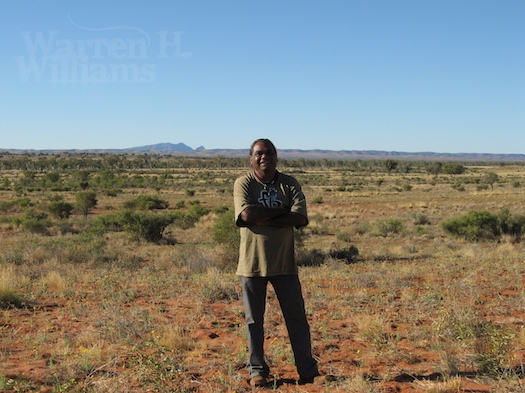
reproduced by courtesy Warren H. Williams

I met up with my mate, Warren Williams, down from Alice Springs a few weeks ago. He was here promoting his CD Winanjjara, his arrangement (orchestrations virtually) of traditional Warumungu Song, song material from the Tennant Creek area that he is entitled-to through his mother's father. One of Warren's geat-grandfathers, Hesekiel, was mentioned in Journey to Horseshoe Bend, the symphonic cantata Andrew Schultz and I wrote based on Ted Strehlow's novel. As usual, the conversation turned to the Arrernte worldview - who is related to whom, who can speak for what, whose country is whose...

I was reminded of this yesterday as I watched excerpts on YouTube from the Metropolitan Opera's Ring cycle. At the beginning of Act III of Siegfried, Wotan, king of the gods is now wandering the world. Still his voice is thunder (to borrow one of Homer's epithets for Wotan's Greek equivalent, Zeus). And in Robert Lepage's Met production, Wotan's staff actually flashes like lightning.

Warren told me that the great-grandfather of another great-grandfather, Johannes Ntjalka, was Kanjira, 'the thunder god'. I had read about Kanjira in Carl Strehlow's Die Aranda und Loritja-Stamme. 'But,' I said to Warren, 'you mean a reincarnation of Kanjira?' 'No', said Warren, 'the actual thunder god'. I was aware that people say that the Altjira (usually translated as Dreamtime) is maybe only a few generations back (or well, really, since I think of the 'altjira' as the eternally creative substratum of reality, it's ever-present). But commissioners in Aboriginal Land Claims have commented on their difficulty in working out sometimes whether a witness is citing a forebear or a mythological figure. Warren's information was a graphic example to me that Central Australia really is 'the land of Altjira', eternity, as Ted Strehlow once said.

And a graphic example to me also, that there really is a lot to comment on in Australia.


If you liked this blog, others of mine on Central Australia are:

Opera in a land of Song, 20 July 2012
Drowned Man in a Dry Creekbed - Happy New Year 1993, 6 August 2012
Virginia in the Desert, 10 Sep 2012
Victory over death and despair in a bygone age (thoughts on John Strehlow’s The Tale of Frieda Keysser), 5 Nov 2012