Tuesday, December 11, 2012

Words, words, words (Philippa, an opera - blog 11)

...continuing my series of blogs on the development of the opera Philippa, based on the life of Harlem-born concert pianist Philippa Duke Schuyler. Philippa was the daughter of African-American journalist George S. Schuyler and white Texan Josephine Cogdell who thought that if they combined their superior genes they could produce a genius. Philippa was, indeed, a prodigy. She played her own compositions with the New York Philharmonic when barely in her teens. She died in Vietnam in 1967 rescuing 'the orphans', the children of US servicemen and Vietnamese women...

"What languages should Philippa be in?" is one of the questions I've been asking myself during research into this opera. English should be there of course, since she was born in the US; Vietnamese because she died in Vietnam; French because French was still spoken in Vietnam at this time and it would also have been the language of some of her African boyfriends. Should Latin should be included? What language would Catholic services have been conducted in, in 1967, especially in Vietnam? The vernacular wasn't adopted instantly everywhere after Vatican II.

Huế Cathedral, Central Vietnam, photo: Luu Ly, 26 August 2008
We went to a Latin mass last week. I wanted to get a feel for how a Latin mass feels. I couldn't quite catch all the words (and I was listening for those I know from classical music). I was a little disappointed, wondering if the priest was mumbling, but later I figured that perhaps that rapid-fire and merged(?) delivery denoted a kind of familiarity with the text that was in itself moving. I remember reading Peter Brokenshaa's account of a Pitjantjatjara inma in his book, The Pitjantjatjara and Their Crafts and how one of the features that most convinced him of the heartfelt-ness of the ceremony was the casual familiarity with which the men sang their lines, acted their parts, handled their objects...

And there was something 'down-home-y' and casual about the service that was endearing. "Remember," said the priest during the sermon, "how John the Baptist pointed out Christ with the beautiful words, 'Behold the Lamb of God who takes away the sins of the world'?" "Remember?" Were we there? He spoke of the childhoods of John the Baptist and Jesus looked after by their mothers St. Elizabeth and 'our Lady' ("Remember?") and told us that, "The pope has talked about this in a beautiful book which hasn't been published but when it's been published you'll be able to buy it" - all one sentence.

We talked to some women afterwards and asked why they made a point of coming to a Latin mass. It's what they grew up with; they like it. They gave me another word to add to my Philippa glossary of words that are not and have never been part of my everyday conversation - 'indult'. Of course, with Philippa the list of words that I don't include in everyday conversation includes military terms like MACV (Military Assistance Command, Vietnam) or TAOR (Tactical Area of Responsibility) or addresses like 409 Edgecombe Avenue (the 13-storey apartment block in Harlem which was once home to Julius Bledsoe who sang 'Ol' Man River' in the 1927 premiere of Show Boat and NAACP luminaries such as W.E.G. DuBois or Walter White or Thurgood Marshall), but I had to stop and think how much there is to learn in life when I looked into the term 'indult'.

If I was to sum up 'indult' it's a permitted Latin mass or permitted portions of mass in Latin. According to Wikipedia the word is "a term from Catholic canon law referring to a permission to do something that would otherwise be forbidden".

Then I found that there is such a thing as 'the "Agatha Christie" indult'. Apparently after the introduction of the Mass of Paul VI in 1969-70, several British intellectuals wrote to the pope requesting permission for continued use of the Tridentine mass by those who wished to continue using it in England and Wales. The signatories talked of the mass's cultural significance; for many British catholics the Latin mass was also a symbol of the suffering of martyrs during the Reformation. Among the signatories were Vladimir Ashkenazy, Kenneth Clarke, Joan Sutherland, Cecil Day-Lewis, Robert Graves, Yehudi Menuhin...

But the story goes that when the pope was considering the plea, he scanned down the list of names on the petition and came across 'Agatha Christie'. "Ah, Agatha Christie", he apparently said, and signed the indult.

Nice story, lovely character detail. What I love mostly, though, is the knowledge that there is no end to what I can learn.

"Not a blade of grass grows uninteresting to me" - Thomas Jefferson


Other blogs in this series

1. - 16 Sep 2012 - an account of my initial thoughts on Philippa, when I was attempting to convey a more comprehensive trajectory of her life
2. - 18 Sep 2012 - containing Act I of a revised scenario, beginning the action in Vietnam
3. - 25 Sep 2012 - containing my revised scenario
4. - 7 Oct 2012 - one-page synopsis, to make sure such a story can fit into "two hours' traffic on the stage"
5. - Becoming a Harlemite, Vietnamese and Catholic 10 Oct, 2012 - detailing some of the research I'll be doing
6. - A Harlem Tradition? 20 Oct 2012 - detailing Harlem interest in white culture
7. - Sacrifice? 21 Oct 2012 - considering the nature of Philippa's death and whether it was self-sacrifice
8. - Classical aspirations 30 Oct 2012 - looking at Harlem's attitude to classical music in the age of Philippa
9. - Montagnards and Lowlanders 1 Nov 2012 - looking at some of Philippa's writing from Vietnam
10. - A sobering thought, 13 Nov 2012 - recognising the prevalence of lynching in the US until well into the 20th century

Friday, December 7, 2012

Australian flora is the dead give-away

Just a couple of photographs today:

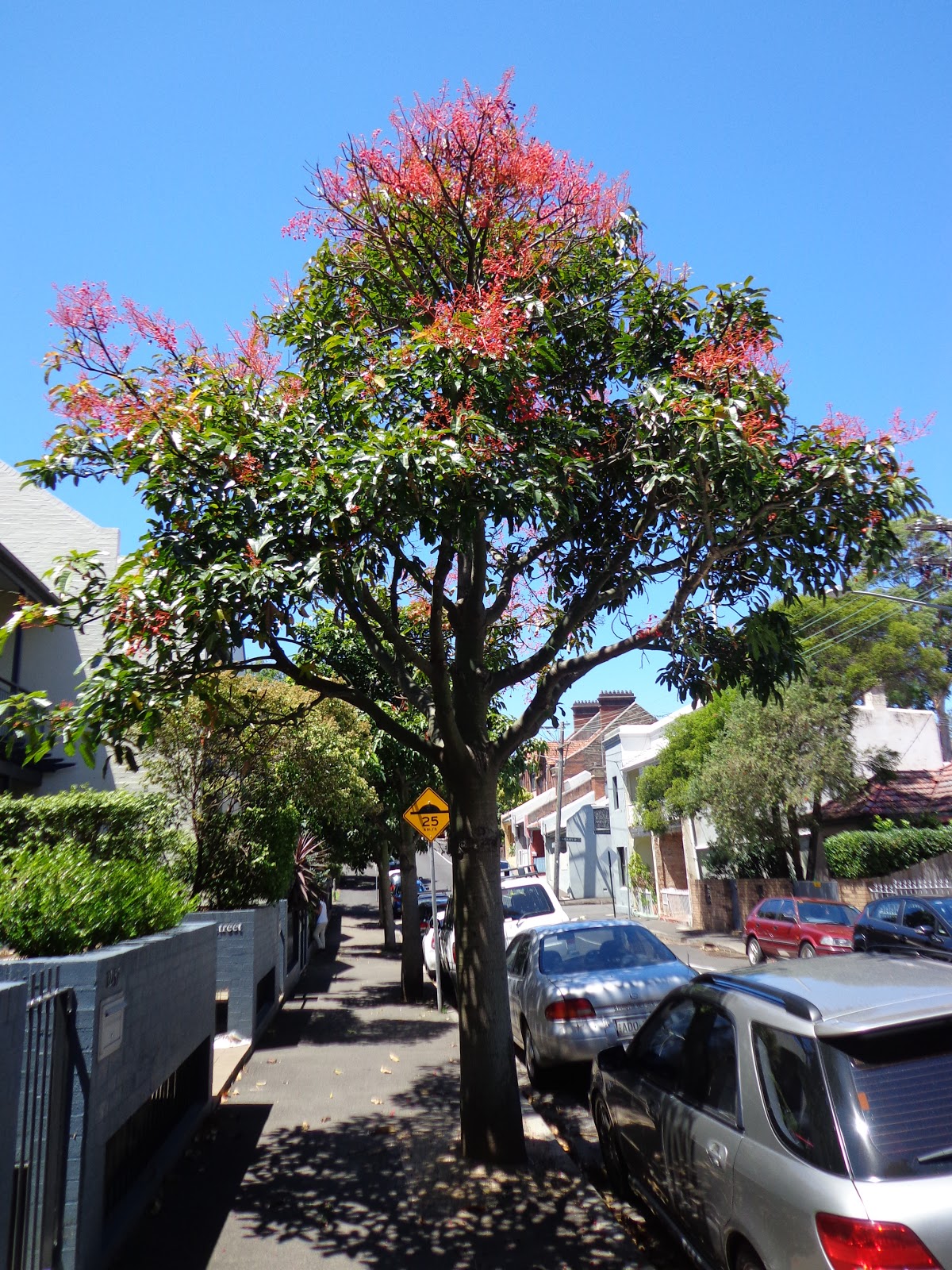
People rave about the Fall colours in the US or complain about the drabness of the Australian bush. Doubtless when they talk of the bush they're talking of the gun-metal greys and off-yellows of a eucalyptus forest, not the rainforest of New South Wales. For, let's face it, how rivetting is this? An Illawarra Flame Tree  (Brachychiton acerifolius), native of the NSW coast, spectacular at this time of year (summer) here in an inner-Sydney street.


Another flame tree from the adjacent street, prior to losing all its leaves. You may also see the dark brown, boat-shaped 10cm-long fruits if you look close enough.
Flame Tree in Hyde Park, CBD
We also saw a tree I'd never noticed before in Randwick yesterday - a Native Hibiscus, endemic to our coast, and I think the Randwick municipality's coast.


There is a certain sameness to Australian cities. I'm not talking of the glass and steel towers which make CBDs and downtowns all over the world 'samey', but that suburban architecture which means an Australian from just about anywhere in the country can recognise the caricatured suburbia of a Howard Arkley painting. But when you look at our flora you see regional difference. The banksias of the West are not like the banksias of the Sydney eastern suburbs. Jarrahs are different from Mountain Ash or Angophorae costatae or Ghost Gums (Eucalyptus papuana). You've got to look to our flora and not our accents or our architecture to really locate yourself in this country.


Sunday, December 2, 2012

The Assignation, DRAFT 3

1.INT. KITCHEN. DAY
The kettle is whistling loudly on the stove. LEYLA heavily pregnant, goes to the fridge, but finds no milk. She goes to her purse but it's empty. She turns off the kettle.

LEYLA
(calling out)
          I haven't got any change, hon. Where's your wallet?

2. INT. A BABY'S BEDROOM. DAY
This room is brightly painted on three sides with a feature wall of playful children's wallpaper on one side. It is as yet devoid of furniture, except for a baby's basinette (empty) alongside the wall-papered wall. MITCHELL (in his early 30s) is on a step-ladder hanging a mobile from the ceiling.

MITCHELL
          On the side table.

Humming happily, he steps down to admire his handiwork. Leyla comes in.

LEYLA
(holding a packet of condoms)
          Why would you need these?

MITCHELL
          I... [wouldn't]. Where did you get them?

Leyla rushes at him and starts beating him.

LEYLA
          You bastard. How could you do this to me?

Mitchell skilfully restrains her.

MITCHELL
          Where did you get them?

LEYLA
          From your gym bag, you bastard!

Mitchell runs from the room.

LEYLA
          Don't run away from me!

She collapses in a welter of tears.

3. INT. ADULT BEDROOM. DAY
Mitchell bursts into his and Leyla's room and finds a green gym bag sitting open on the bed. He rummages through it and pulls out gym gear he doesn't recognize.

MITCHELL
          Shit!

4. INT. BABY'S BEDROOM. DAY
Leyla, still on the floor, has the handsfree in her hand.

LEYLA
          Mum? He's cheating on me.

We hear a heavy door slam in the background.

5. EXT. STREET/IN. CAR. DAY
Mitchell drives. As he approaches the gym he sees CHRISTOPHER and BILL walking away. Christopher carries an identical green gym bag. Mitchell speeds up toward them from behind.

6. EXT. STREET DAY
The screech of Mitchell's braking makes Christopher and Bill turn around. Mitchell jumps out of the car. Mitchell has the original green gym bag. He is waving the packet of condoms.

MITCHELL
          Mate, you just got me into a shitload of trouble with my wife.

Christopher barely has time to look down at the green gym bag he is carrying before Mitchell has snatched it out of his hand and swapped his with Christopher's.

MITCHELL
          Didn't you notice it wasn't yours?

BILL
          Didn't you?

Mitchell clenches his fist. Christopher steps between him and Bill, but Mitchell turns instead and storms off.

BILL
(brushing off Christopher's concern)
          Oh, what could he do?

7. EXT. ROAD/INT. CAR. DAY
Mitchell on the phone while driving.

MITCHELL
(anxiously and placatingly)
          No, still on time. I stepped out to get some milk. For Leyla.

8. EXT. STREET. DAY
Mitchell's car momentarily swings out of control, crossing over to the other side of the road, forcing oncoming traffic to slam on brakes and evade, before correcting itself and getting back on the correct side.

9. INT. A BABY'S BEDROOM. DAY
Leyla's face is now muddied with tears and snot. MUM comes into the room.

MUM
(brandishing a photo)
          Who's this?

Leyla immediately stops crying, grabs the photo.

MUM
          We never liked him, Leyla - your father and I.

Mum leaves the room. Leyla jumps up to follow.

10. INT. EMBASSY. DAY
Inside the embassy, an attractive dark-haired YOUNG WOMAN is shaking hands with two suited EXECUTIVES while a number of hangers-on stand around. At back is the final slide of a Powerpoint presentation depicting a giant pipeline through Asia Minor. An INTERPRETER stands to the far side of the Young Woman and the OGLING EXECUTIVE.

OGLING EXECUTIVE
          If only more negotiations were this easy.

As the young woman turns for the translation, the OGLING EXECUTIVE drops his eyes to her breasts.

INTERPRETER
(translating for the young woman)
          "Yalnız daha danışıqlar bu asan olsaydı."

11. EXT. EMBASSY/INT. CAR. DAY
Mitchell pulls into a kerb. Across the road is a modern embassy building with a wide stairway leading up to glassed front doors. He turns off the engine and waits. We can hear what he's been listening to.

VOICE ON TAPE
          ...For generations, Kuşköy villagers have conversed using a unique form of whistled         communication       they call “kuş dili,” or “bird language”...

Mitchell pulls a photo of the young woman out of his gym bag.

VOICE ON TAPE
          The name Kuşköy itself means “bird village.”

MITCHELL
(looking at photo)
          Phoar!

12. EXT. STEPS. DAY
The embassy's glass front doors open. The young woman emerges with her translators and the two executives.

YOUNG WOMAN
          ...iş görmək sonra, unutmaq olacaq.

INTERPRETER
(translating for the executives)
          "And don't worry about the Kuşköy. Once they see the jobs this project will create, they'll forget about      being relocated."

13. EXT. STREET. DAY
Mitchell jumps from his car carrying the green gym bag. As he crosses to the other side of the road, a car speeding toward him, screeches to a halt. Mitchell freezes in its path and sees Leyla and Mum inside the car.

14. EXT. EMBASSY/ INT. CAR. DAY

LEYLA
          Mitch?

15. EXT. STEPS. DAY

YOUNG WOMAN
(Looking at Mitchell's lucky escape, laughing)
          Uğurlu!

Mitchell bounds up the steps toward her, pulls a gun from his gym bag - screaming starts from bystanders - and shoots her. She falls to the ground. The executives try to help, while guards appear from everywhere.

GUARDS
          Dur, qatil!

Mitchell tries to run back down the steps, but is quickly surrounded by guards. Guns have appeared from everywhere and are pointing at Mitchell. He drops his weapon.

16. EXT. STREET. DAY
Mum and Leyla are standing on the footpath back from the embassy watching as more guards surround Mitchell and medics arrive from inside the building to form another cluster around the young woman.

GUARDS
          Qatil!

LEYLA
(To mum)
          They're saying 'assassin'!

They watch as Mitchell is picked up, handcuffed, and led away. Mitchell tries to look back at Leyla as he is hustled away.

MITCHELL
          It wasn't my bag!

Leyla looks at the photograph of the young woman she has held in her hand. It is clear now that it is a surveillance photo taken with a telephoto lens.
Back up the road, even as Mitchell is being led away police cars arrive with flashing lights. We hear an ambulance siren in the distance.
The crowd around the young woman parts slightly and we see medics cutting open her bloodied blouse. The Ogling Executive kneels by her head looking on, powerlessly.

MUM
          Well, perhaps he isn't a cheat.

ROLL CREDITS

17. EXT. CROSS STREET. DAY
At their ambling pace Christopher and Bill have by now reached the cross street where the shooting took place. As they walk and talk, A POLICEMAN approaches them both carrying Mitchell's green gym bag inside a plastic forensic bag. As the policeman goes to his vehicle to stow the evidence, he notices Christopher's green gym bag and, momentarily suspicious, watches them pass.
They stiffen up as he peers at them, and slow down as they approach the scene of pandemonium.

END.

Gordon Kalton Williams, 2012
Please let me know if you're interested in producing this.


Thursday, November 29, 2012

'Ah Nathanael' - another note on The Tale of Frieda Keysser


I have already noted (Victory over death and despair in a bygone age, 5 November 2012) that John Strehlow's epic, The Tale of Frieda Keysser ranges from 16th century Germany to present-day Australia and covers a wide swathe of Central Australian history. I am most affected, though, by its juxtaposition of the 'epic' with the 'personal'. Much of the book seems like John's personal exploration. And there are aspects of the story that touch me too. Another of my favourite passages reads:

"Not long after Carl's trip to Palm Valley with Gillen, he took Frieda there. Nathanael drove them.

Livistona mariae palms (also known as Red Cabbage Palms), Palm Valley, NT, Photo: C Goodwin 2004
Nathanael - Naemi's son - was a most charming man and even (I suspect) something of a lady-killer. He was at that stage about 23 and had been among the first boys to be baptised on 20 May 1887 by Kempe, who estimated his age then as about 14. Like many young aboriginal men he was dashing, well-spoken, carried himself well, was always well-mannered, witty, pleasant to get on with - and gallant with the ladies. Carl and Frieda were both very taken with him - and despite some ups and downs in their relationship, remained so for the rest of their lives. 'Ah Nathanael,' Frieda wrote to my father in the 1950s when sent a photograph of him in old age, 'and he was so young when I first set eyes on him. Now he looks so old'."

I really love that second-last sentence, finding it possibly the most moving sentence in the whole book. The paragraph itself sums up the book's epic sweep perfectly. It reaches back across the 1880s to the 1950s to me now (I'll say how in a minute), but consider also the backgrounds of the dramatis personae packed into this brief paragraph:

Carl - Pastor Carl Strehlow: missionary at Hermannsburg in Western Aranda country from 1894-1922, he also managed the mission as a working cattle station; author of Die Aranda-und-Loritja Staemme (five volumes); co-author of the Dieri New Testament;
Frieda - wife of Carl Strehlow, but effectively mistress of the Hermannsburg mission community. She married Carl and moved to remote Central Australia from Germany, having only met him once. Through her diligence and observation infant mortality was reversed at Hermannsburg just as everyone else in Australia assumed that aboriginal people were dying out; 
Gillen - telegraph master and Justice of the Peace at Alice Springs, he issued the warrant for the arrest of Mounted Constable Willshire on a charge of murdering aborigines; he was Baldwin Spencer's collaborator (supplier of the raw information) on their seminal books of Australian anthropology, The Native Tribes of Central Australia and The Northern Tribes of Central Australia. He and Spencer's focus was on the Eastern and Central Aranda. The trip to Palm Valley was an infrequent foray into Western Aranda country.
Kempe - Hermann Kempe was one of the three founding missionaries of Hermannsburg (1877). He played a key role in ending police persecution of the aboriginal population and reconciling traditional clan enmities. He supplied plants to Baron von Mueller (founder of Melbourne's Botanic Gardens), who named several plants after him. He also wrote the first Aranda grammar and prepared a wordlist which Gillen used in his researches. Descendants of Kempe find themselves respected at Hermannsburg to this day.
Naemi -Nathanael's mother; widowed young, she became the partner of Eraminta who was shot by Mounted Constable Willshire. She was also Willshire's lover, and John suspects sexual jealousy among Willshire's motives for shooting Eraminta. She was brought down to Port Augusta for Willshire's murder trial but not called to give evidence on the grounds that she couldn't speak English. (I lived in Willshire Street, Alice Springs in 1981!) 
Palm Valley - a narrow valley in the Krichauff Range 123 km southwest of Alice Springs. It is noted for its population of Livistona mariae (Red Cabbage Palms), unique survivors of central Australia’s tropical past.

You see, this paragraph is packed with significance. Then you have John's personal touch - not T.G.H. Strehlow, the great transcriber of Aranda myths, but 'my father'.

And 'Nathanael'? And this is where Frieda's recognition really grabbed me. Because I had a recognition moment too. In 2007 I was driving from Alice Springs with a couple of Aranda friends out to Ipolera, west of Hermannsburg. We were going to do the big circuit, leave Ipolera, go past Gosse's Bluff (Tnorula)

Gosse's Bluff, the meteorite crater, from Tyler Pass
over Tyler Pass and back to Alice via Glen Helen Gorge (Mangama). As we approached Ntaria (Hermannsburg) on the way out, B. pointed out to me the Ellery floodplain. "Over there," he said, "is a place called 'Mirrulantharrakala' [as I transcribed it]." It meant "where the woomeras were exchanged". "All this", he said, "was Rauriwaka's country."

Rauriwaka! I had read about him in T.G.H. Strehlow's books. He was the Honey Ant Chief of Ljaba, who provided T.G.H. Strehlow "with no fewer than 33 myths and traditions, and 569 song verses'" (Songs of Central Australia, page xxxvi). I had experienced a moment of recognition with my previous reading.

But recently I read the above passage in John's book. I knew also that Rauriwaka had been one of the assistants on T.G.H.'s translation of the New Testament into Aranda. His Christian name? Nathanael. 

If you liked this blog, others of mine on Central Australia are:

Victory over death and despair in a bygone age (thoughts on John Strehlow's The Tale of Frieda Keysser), 5 Nov 2012
Considering the aboriginal land of Altjira, 20 May 2012
Opera in a land of Song, 29 July 2012
Drowned Man in a Dry Creekbed - Happy New Year 1993, 6 August 2012
Virginia in the Desert, 10 Sep 2012

Tuesday, November 27, 2012

The 370 bus (Mise-en-scene 2)

Seen on the 370 bus going into Broadway:

A girl in an Anglican Girls' School uniform (that is the navy blue jacket and blue-checked skirt) with earphones in and sucking on a Slurpee gets up from her seat and goes to the exit door.

There she says something to a 20-something male. I can't hear it, but she points at her empty seat with her Slurpee straw and he turns, smiles ('Me?') and takes her seat. She has already pressed the bell and gets off at the next stop on City Road.

Perhaps she likes the look of him (he was not the only person standing around the exit), but for a split second it occurs to me: 'respect for elders?' and I feel strangely touched. He wasn't old by my rating but older than her (maybe she was in Year 10) and she gave him her seat. Perhaps it was both.


My other mise-en-scene was 26 June 2012.

Friday, November 23, 2012

One for the historical record

Not so many words today. I thought I'd share our Sydney view across the former Harold Park to Chatswood on the North Shore (see the towers, faint towards the upper left). Balmain is in the foreground. There is a great reach of Harbour in the middle of this somewhere.


This is a view that has always surprised people who entered our house from the street. We expect it will disappear once 6-storey apartments go up in front of us, so this is 'one for the archives'.


Tuesday, November 20, 2012

The Dream of the Red Chamber

One of my little projects last year was to put together some thoughts on the dramatic adaptability of the Chinese classic, The Dream of the Red Chamber [紅樓夢] * & see below

A painting from a series of brush paintings by Qing Dynasty artist Sun Wen (1818-1904), depicting scenes from the novel Dream of the Red Chamber. Public domain

The original five-volume novel is like a Chinese Remembrance of Things Past, as if the author, Cao Xue-chin, tried to get down his entire life and the life of his family. Actually, the novel's family has a son who was born with a piece of jade from the roof of heaven in his mouth, so the book is also allegory, but it also more: a portrayal of  the decline of a feudal family, an account of the customs and manners of an 18th century Chinese mansion, an expression of the long-term workings of fate...


Thinking dramatically and operatically (since that was the scenario put to me) and looking for a principal storyline for an opera, I first latched onto the love story of Bao-yu (Precious Jade) and Dai-yu (Black Jade) and the triangle that is formed by the arrival of Bao-chai (Precious Virtue). That gives you your emphasis on emotions. But then I thought that a truly unique work would cover the influence on the central plot of the wheeling of greater external events. My western temperament cut the story so that it progressed through conflict. But the novel moves in a quite leisurely fashion, with outcomes slowly unfolding, especially novel 2, The Crab-Flower Club, which is taken up to a great extent with description of poetry games and so forth. I've included side-plots which convey the dark underside of the mansion - possible reasons for the Jias' decline - and the cruel foundations on which some of the surface brilliance of their household is built. But if the whole book is too big to be digested into a western stage form, there are shorter, more dramatically-succinct episodes in the novel which could serve as a stage work in their own right.

Why would this would need to be an opera rather than a very ornate play? There would be an interesting challenge for a composer in pitting together music which fulfils two different functions: music which punctuates the cycles of life and the structure and procedures of the society (funerals, weddings, celebrations, festivities, arrivals, departures) as opposed to music (the outpouring of song) which expresses emotion.

I’ve roughed out the sort of plot I could see emerging from what I’ve read so far. It’s built around certain ceremonial events. I’ve tried to convey some of the bigger revolutions happening outside the love story. Further reading might provide better illustrations of ‘something rotten in the Jung houses’ or better tableaux of decline or suggest more skilful ways to enfold information and ‘fast-forward’. On a smaller note, perhaps the chorus could be used to convey the size of the servant body – maybe even assigning a body of chorus to each principal. I was always intrigued by the pecking order among the servants - inside and outside servants (inside is more prestigious), chamber wives (servants who are concubines)...It reminded me of the complicated hypocritical world of slavery in antebellum America where the inside servants were sometimes siblings...

Below is a cast list and a rough synopsis. I’ve conflated some of the characters (without being completely aware of whether this cuts across a Chinese sense of relations) and changed some sequencing, such as the early flogging, the ransacking of the servants' quarter...

A page from the "Jimao manuscript" (one of the Rouge versions) of the novel, c. 1759. Public domain, due to expiry of the copyright.


The Dream of the Red Chamber – an opera based on Cao Xue-qin’s classic Chinese novel

Characters:
Jia Bao-yu (treble)
Lin Dai-yu (treble)
Xue Bao-chai (soprano)
Wang Xi-feng (soprano)
Cousin Zhen (tenor)
Grandmother Jia (alto)
Jia Zheng (tenor)
Aunt Xue (alto)
Xue Pan (baritone)
Aroma (soprano)
Snowgoose (mezzo)
Jia Yu-cun (tenor)
Priest (bass)
The Prince of Beijing (baritone)
Goddess of Disenchantment (sop?)
Servants


Plot
Act One
i
In a country tavern, a poor scholar, Jia Yu-cun, meets a priest, who tells him about the Jia family of the Jung Mansion, to whom Yu-cun is distantly related. In particular, he tells Yu-cun about Jia Bao-yu (Precious Jade), a special boy in the latest generation who was born with a piece of jade in his mouth. The boy has some strange predilections; not only is he lazy (he neglects his studies), he prefers the company of girls and says he finds men unclean. But he is said to be descended from a piece of jade left unused by the Goddess Nu-gua after she repaired the dome of heaven, and is hoped to be a pivotal figure in restoring the fortunes of the Jia family. Jia Yu-cun sees an opportunity to advance himself through ‘family connections’, though the currently-powerful family is supposedly in decline.
ii
The Jia family is burying Qin-shi, a daughter in-law from their Ning mansion, and Cousin Zhen (her father-in-law) has gone to suspiciously disproportionate lengths to make her funeral as sumptuous as possible (much to the resentment of servants who have had their rations further cut). On this 35th day of the 49-day(!) funeral, even the Prince of Beijing has come to express his condolences. As he is leaving, the Prince asks to meet Bao-yu, the fabled ‘boy with the jade’ whose presence is considered very auspicious for the Jias, from whom much is hoped by the royal family. We meet Bao-yu and his constant companion, his cousin Lin Dai-yu  (Black Jade) who has been living with the Jias for some time.

Scenes from Dream of the Red Chamber. Public domain artwork by Xu Baozhuan (1810-1873).
After the Prince has left, Wang Xi-feng, a sister-in-law of the Jung mansion who was been in charge of the funeral, orders 20 strokes of the cane for one of the resentful servants who was late for work. She believes it is even more important than ever now to maintain discipline and ignores the servant’s pleas for mercy for all the good work she has done the family throughout her life.
Into this scene of punishment, Aunt Xue (Wang Xi-feng’s aunt) and Aunt Xue’s children, the brutish Xue Pan and the beautiful but conventional Bao-chai (Precious Virtue), arrive at the Jung mansion. Wang Xi-feng is overjoyed. Her cousin, Xue Pan has just gotten off a murder charge when his case was brought before Yu-cun, the new prefect sponsored by the Jias. (Interestingly, the man Xue Pan had murdered, Feng Yuan, had been trying to steal Lotus, the daughter of the man who became Scene I’s priest when his daughter (Lotus) was kidnapped by Xue Pan several years ago.) After the elders have retired, Bao-chai meets Bao-yu and Dai-yu, and after Bao-chai retires to clean up after her journey, Bao-yu and Dai-yu renew their sense of destined compatibility. Even though it has been disturbed by Bao-chai’s arrival, they dare to think of it blooming into love and marriage.

Act Two
i
In a dream, Bao-yu is led by his heavenly relative the Goddess of Disenchantment to the Illusory ‘Land of the Great Void’, where she teaches him about sex and he dreams he has made love to Qin-shi, his recently-departed niece. Upon waking, Bao-yu tells Aroma, his maid, that he should teach her what the Goddess has taught him. After some pro-forma resistance from Aroma, which includes three conditions: (1) apply yourself to your studies, (2) stop saying the first thing that comes into your head: think first, and (3) forget your fascination with girls’ cosmetics, she agrees to let him have sex with her. As she explains, she fully accepts that she was given to Bao-yu “to be used to the fullest extent”; that is the way things are.
ii
Outside her Bamboo Lodge in the Mansion’s garden Dai-yu is thinking of Bao-yu, and sentimentally gives voice to a line from The Western Chamber: “Day after day a drowsy dream of love”. On his morning stroll, Bao-yu overhears her and playfully teases her, but she resents his making fun of her (feeling that the other girls of the mansion have already teased her enough because of her attraction to him). Before he can make amends, Bao-chai interrupts them. She is interested in seeing Bao-yu’s jade with its famous inscription: “Never Lose, Never Forget, Eternal Life, Lasting Prosperity”. She shows him her golden locket. On it is inscribed: “Never Leave, Never Abandon, Fresh Youth, Eternally Lasting”. The lines match. All three know that, according to the feudalistic concept of marriage, Bao-yu and Bao-chai are therefore destined to marry. Fragile Dai-yu bursts into tears as her own dreams of marrying Bao-yu seem shattered. At a loss over her emotional excess, Bao-yu cannot look for sympathy from Bao-chai who supports the feudal way of doing things.
Alone, he begins reading the book he should have been studying: Zhuaang Zu (one of the most important works of Taoism), and is especially moved by the concept of letting things take their own course; that people cannot go against their nature.
iii
Because he is jealous that Bao-yu is heir to the Jia fortune, Xue Pan tells Jia Zheng (Bao-yu’s father) that a servant girl drowned herself because Bao-yu tried to rape her. Already tired of Bao-yu’s ‘idiosyncracies’ and to assert his authority, Jia Zheng beats the boy mercilessly until Grandmother Jia (Lady Dowager) intervenes. She is against using force to discipline the boy, and hopes that a carrot-rather-than-stick approach will help him mature into the sort of household head that the family will eventually need. Jia Zheng, however, already worried about the precariousness of the family’s position, despairs of Bao-yu ever devoting himself to serious things.
iv
Aroma, Bao-yu’s servant, tells Wang Xi-feng that she agrees with Bao-chai that Bao-yu’s flogging would never have occurred if Bao-yu had paid more attention to his position in a family that needs to restore its fortunes. Wang Xi-feng is impressed by this servant. Flattered, Aroma tells Wang Xi-feng about Bao-yu’s and Bao-chai’s matching amulets.
v
More trouble for the family: Bao-yu’s old wet nurse, Nanny Li, comes to petition the Jias for financial assistance. Her family has fallen on hard times. But the Jias say they cannot help. Nanni Li is resentful of the Jias’rejection of her, a loyal old retainer, even though Jia Zheng explains, “Our fortunes are not as they were. All this is just for appearances”.
Yet, during sumptuous and elaborate celebrations for her birthday, Grandmother Jia raises with Jia Zheng, her son, the question of Bao-yu’s marriage. When Wang Xi-feng suggests an auspicious match between ‘precious jade’ and ‘gold locket’ - that is, between Bao-yu and Bao-chai - Grandmother Jia nods her consent; Jia Zheng assents. Wang Xi-feng and Aunt Xi choose an auspicious day for Bao-yu and Bao-chai to marry.
vi
After Grandmother Jia’s birthday celebrations, Bao-yu goes to see Dai-yu. For his part he continues to feel undying devotion to her, but she feels that something is awry.
vii
In the eleventh month, the withered crab-apple trees in Happy Red Court suddenly blossom, and people rush to see. Nanny Li and Xi-feng take the unseasonal flowering to be an evil omen, while Dai-yu is secretly thrilled when Snowgoose, her maid, interprets the flowering as predicting a happy occurrence soon in Bao-yu’s life (could it be their marriage?)...For some reason, Bao-yu himself feels sad. He is not wearing his jade; nor does he find it on returning home! He becomes more and more distraught, alarming Aroma as he bemoans the realm of human suffering and longs for Dai-yu’s consoling companionship.
viii
Since the jade has not been found in Bao-yu’s house, Xi-feng supervises the ransacking of the servants’ quarters. The family are grateful to ‘Fengy’ for her energetic prosecution of their interests, and she takes the opportunity to outline a scheme by which Bao-yu can be married to Bao-chai. The family’s gratitude to her for continuing to devise strategies that will ensure the “most propitious turns of events”, overshadows the news that a couple of old servants have suicided out of shame for being accused of theft.
ix
Having been informed of the secret marriage plans by Snowgoose, Dai-yu has collapsed and vomited blood. Snowgoose hurries to report Dai-yu’s condition to Grandmother Jia, and Wang Xi-feng. The old lady is furious. If Dai-yu’s illness is caused by love for Bao-yu, she has no sympathy for her. “Parents organise marriages,” she says. The old lady has no time for this talk of ‘Free love’ and ‘free marriage’.
x
Dai-yu burns her manuscript book as well as Bao-yu’s mementoes. Recognizing Dai-yu’s critical condition, Snowgoose orders Dai-yu’s other maids to get her after-life things ready.
The wedding ceremony begins. The family remarks that Bao-yu now seems better and more rational, but he believes he is marrying Dai-yu. Lifting the bride’s veil he finds that it is Bao-chai and collapses. At the same time news is brought in that Dai-yu has died, “in admirable obedience to her love”. But Grandmother Jia extols Bao-chai and proclaims that the family’s fortune depends on them obeying the precepts of society. After the wedding guests have left, Bao-yu learns that the Prince of Beijing has made him a replica of his missing jade, but, unconsoled about mounting losses, he tells Bao-chai that he will continue to mourn for Dai-yu.

Act Three
i
Walking through the mansion’s Grand View Garden, Wang Xi-feng sees the ghost of Qin-shi who makes it clear she was the object of her father-in-law’s incestuous desires and warns Wang Xi-feng of the Jia family’s pending doom. In horror, Wang Xi-feng goes to the temple to pray. She draws some divination lots, and [Aroma] interprets the oracle as a good omen: Wang Xi-feng will ‘return home in splendor’. Snowgoose, Dai-yu’s maid however, thinks that the oracle could mean something else.
ii
The Jias receive news that their family is now under imperial scrutiny and on top of that comes news that Xue Pan has killed a waiter by smashing a bowl over his head. Despite the family’s troubles, Aunt Xue is not particularly worried because Yu-cun the magistrate can always be leaned on. A priest turns up with what he claims to be Bao-yu’s jade, but the family ask him to come back when they have raised the money he demands for its return.
iii
Hearing from Aroma that Wang Xi-feng is ill, Bao-yu and Bao-chai hurry to her quarters to find she is already dead and laid out for her funeral. Jia Zheng explains that her funeral cannot be arranged as ‘sumptuously’ as the funeral Wang Xi-feng arranged for Qin-shi because the Jias have less money now. Bao-yu says the priest can keep the jade of spiritual understanding.
iv
Back in their quarters, Bao-yu asks Bao-chai’s permission to sleep outside; he claims it will help him sleep; in reality he wants to dream of Dai-yu.
v
The emperor grants the Jias a slight reprieve; Jia Zheng will be forgiven his shortfalls but will have to take up a governorship in the provinces; Xue Pan will probably get off but the district governor, suspicious of Jia Yu-cun, must first look into his case, and Bao-chai is finally pregnant, but Bao-yu, who has become more and more impressed by Taiost philosophy, has disappeared.
vi
One day in the provinces, Jia Zheng comes across a figure with a shaved head. It is none other than Bao-yu, but before Zheng can tell the young man he is returning from the funeral of Grandmother Jia, a priest urges Bao-yu to hurry away. They both vanish without a trace.
Epilogue:
Travelling once more through the countryside, Jia Yu-cun meets up once again with the priest he met in a tavern in Act 1. He tells him that The Board of Punishment (sufficiently paid) exonerated Xue Pan, who agreed to turn over a new leaf by marrying his concubine, Lotus (the priest’s kidnapped daughter). Meanwhile, Yu-cun himself has been ordered home and stripped of his rank. The priest tells Yu-cun that the Illusory Land of the Great Voids is the Blessed Land of Truth. There, the good people are favored by fortune, while the dissolute people meet with calamity. But Yu-cun has begun to feel that out in the world the wheel continues to turn, each living thing has within itself the seeds of its own improvement, the seeds of its own dissolution.

END

For an updated brief synopsis, please see my blog of 12 April, 2015