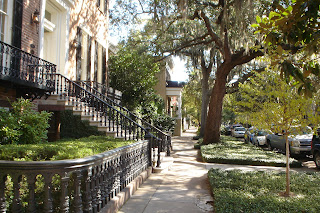
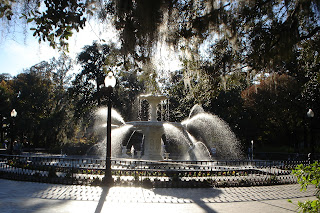
Elegant Victorian villas and
gaslit streets lined with Live Oaks draped with Spanish Moss – downtown
Savannah is as beautiful as the travel literature leads you to expect.
Savannah, established by philanthropist
Sir James Oglethorpe in 1733, was intended to be safe up on its bluff, a functional
British bulwark against Spanish Florida and French Louisiana, and downtown is
still shaped by Oglethorpe’s grid pattern around squares. Echoes of Savannah’s
history rebound. It’s in the Deep South (Georgia) so there are memorials ‘to
our Confederate dead’, houses where Confederate heroes, like Jefferson Davis
(the Confederate president), or Robert E. Lee, once slept.
Savannah is a smallish city
– 130,000 in the downtown, 300,000 in the metro area. 55% of the metro
population is African-American. There are not many Hispanics, even so close to
Florida (only about two hours away by car). But there’s a significant Jewish
population, which goes back to the idealistic Oglethorpe who permitted Jews,
Lutheran Salzburgers and other persecuted groups to settle in the colony.
It is atmospheric - in
summer the city languishes in the humidity - and haunted. I was told that the
CVS downtown is the only one of these pharmacies in the US to close at sundown
because the staff won’t work after dark. But Savannah is mostly celebrated for
its visual beauty. Like most amenable US cities it’s a university town, but
SCAD, the Savannah College of Art and Design (which seems to own and to have
renovated a building on every block) specializes in visual arts, illustration,
photography, fashion, web design…
How does Savannah sound? Church
bells constantly ring. In December the streets pop to the sounds of acorns
dropping on pavements or crunching underfoot. But despite the fact that Lowell
Mason (whose hymn ‘Watchman’ is quoted in Charles Ives’ Fourth Symphony) spent
his early adulthood in Savannah, or that Savannah is the birthplace of lyricist
Johnny Mercer, until recently you wouldn’t have gone to Savannah for the
performing arts. In
two weeks I spent in the city in March, however, I got a pretty impressive
sense of how much musical activity there can be in even a small US city.
First
of all, Savannah is one community that has gone to the trouble of
re-establishing an orchestra after a pretty spectacular collapse. I spoke to David Pratt, the Executive Director, an
Australian who formerly worked at the Sydney Symphony.
‘The Symphony
falling over [in 2003] rocked the city to its core,’ he says. ‘Every business
was involved. And they lost a lot.’ David
explains that the new Philharmonic grew out of the chorus that had been part of
the Symphony when it went under.’ After the dust settled, the singers who
were formerly attached to the Symphony wanted to keep singing. They found an
artistic director in Peter Shannon, an Irishman who had spent ten years
conducting the Collegium Musicum orchestra in Heidelberg Germany, and in late
2007, Peter decided the singers would do a concert with orchestra. So he drew musicians
from all over the southeast (Jacksonville, Charleston, Atlanta, Columbia South
Carolina) and got such a good response that they did it again, and then the
board of the choral society said, ‘Maybe it’s time to look at forming a new
orchestra,’ So they formed the Philharmonic, got their 501(c)(3) status, and
were incorporated in August of 2008.’ The orchestra still functions on a per
call basis, but players are kept in their chairs as much as possible to foster
the sense of regular ensemble.
But how hard is it to
re-establish an orchestra where government support is ‘zip’. How do you bring
the donors back?
‘Show
them the financials. The 990 tax forms that we have to send in,’ says David, who
was brought in as Executive Director, once the orchestra was put on a more
permanent footing. ‘And they can see them online. It’s also getting potential
donors into a performance and seeing a 1200-seat theatre that’s full. Then we
can at least get them to start coming again. They’ll buy tickets or they’ll
start at a very low level, but these are people who used to give you know
$50,000, $25,000, $10,000. Some will never ever come back. They’ve said to my
face: “Absolutely not interested in giving to an orchestra ever again.” I
accept that.’
With Savannah’s demography,
a population that is 55% African-American, does the Savannah Philharmonic worry
about outreach?
‘You
know, it’s an interesting mix of people. Savannah’s changed a lot over the
years. Once upon a time, pre-SCAD, Savannah was a very closed community. If you
came here as an outsider, you would never break in.’ This is the Savannah John
Berendt described in his best-seller, Midnight
in the Garden of Good and Evil. ‘And
there’s still, to some degree, a little of that. If I was a Yankee, it could be
a problem, but two things have had an influence. The movie of Midnight put Savannah on the map for
tourism, the film more than the book. Two: SCAD has revitalized downtown. You
talk to people who were here in the 80s, this entire street was boarded up.’
As
for outreach, ‘We’ve done bits and pieces. We’ve done this initiative with the Anderson
Cancer Institute. And that’s come out of Peter’s love for music and its role in
integrated medicine. I did some other
things with what are called under-served communities here. Second Harvest runs
an incredible program, 44 kids’ cafes, essentially after-school programs that
run for two or three hours. It’s the only meal these kids get every day. The
director of the program said to me, “Most of these kids have never even eaten a
McDonalds because their families can’t afford it.” And Second Harvest has a
cultural component. So we had musicians come in and play and interact with
these kids - a presence every week. And that starts to build a profile with the
community.’
David
also lists co-pros with Savannah State University, a predominantly African-American
institution and participation in ‘two great programs in city’: Bravo. It’s an
acronym standing for Black youth Reaching out Vocal and Orchestral music. And
then there’s Sonata. ‘They fund private music lessons for African-American kids
who cannot afford otherwise afford them.’
‘But most of my focus is to build financial stability.
And the only way I can do that is to make sure all our concerts are sold out,
that we are raising money, and that we’re focused on funding our season, with
building a reserve.’ David talks about two areas where there may be potential
for philanthropic support - Skidaway Island,
a
gated community which has attracted successful people from the Midwest and
Northeast who retired to Savannah to live in a warmer climate, people who
supported the orchestras in their own cities. Also Bluffton,
30 minutes away in South Carolina, halfway between Savannah and Hilton Head
where there’s another orchestra. ‘Most of my time goes into researching and
cultivating individuals and looking for these sorts of pockets of communities,’
he concludes.
In Midnight in the Garden of Good and Evil much was made of voodoo.
There were scenes of the sorceress Minerva paddling through ‘gator infested
swamps to sprinkle rooster blood on a grave and pacify its dead resident. And I
realize that here on the Atlantic seaboard there can be quite a profound sense
of Africa to the southeast. It’s a counterbalance to the Confederate ‘whiteness’.
Given that, it’s worth
noting that Savannah hosts one of the best world music festivals anywhere in
the world. The Festival’s main focus is on the 17 days each Spring where you
can catch a smorgasbord of music ranging from some of the very best jazz,
Malian musicians from Africa, Iranians, chamber music – all compressed into the
small space of walkable downtown Savannah.
I went to Savannah in March
deliberately to catch this festival. On one typical day I heard the Sweet
Singing Harmony Harmoneers, followed by the Takacs Quartet playing Beethoven
and Schubert, and Bela Fleck and the Flecktones at the Trustees Theater. Two
days later I squeezed in the McIntosh County shouters, Menachem Pressler
playing Dvořàk with Daniel Hope and Friends, and Ruthie Foster and The Campbell
Brothers.
The Festival is run by Rob
Gibson, a native Georgian. I spoke to him and Communications and Operations Director,
Ryan McMaken after coming back from a concert of the McIntosh County Shouters,
a group that still practises a form of communal singing and dancing that harks
back to slave days on the Georgia coast and predates gospel.
Gibson reckons he’s not doing anything
different than he did 32 years ago when he programmed the radio station at
University of Georgia. ‘On WUOG we had the Chicago Symphony, the Boston
Camerata, the Metropolitan Opera. We had punk rock because it was the height of
the Sex Pistols. We had Bob Marley and the Wailers. I had an African music
program, then an avant-garde classical program called A Year from Monday after John Cage’s book. So I’ve always had a
broad interest in what I would call the musical arts. It’s just not very often that
you get to put that inside of a festival.’
The Festival’s got an impressive
chamber music component curated by violinist, Daniel Hope. One of the great
advantages of hearing chamber music in Savannah is sitting in the 250-seat
Telfair Academy (deeded to the city by philanthropist, Mary Telfair) listening
to the Dumky Trio and sitting close enough
to enjoy the drama of eye contact between players; then walking to the next
concert through streets that look essentially unchanged since Dvořàk was composing.
(When
Robert Redford filmed The Conspirator,
all they did was take the parking meters out of Barnard Street and fill it with
dirt and, hey presto!, it was Washington, 1865.)
But it’s the mix of programs that really makes the
Savannah Music Festival stand out. Gibson is renowned for ‘double bills’,
combinations of music that you wouldn’t normally expect to hear together and
which make converts of people who would not formerly have listened to an
unfamiliar genre. Says Ryan McMaken: Rob put ngoni (lute) player
Bassekou Kouyate on a double bill with Bill Frisell an American jazz
player. A lot of people knew Bill and came out for that and were floored the
first night by Bassekou Kouyate.’
I myself was impressed by a joint concert given by the
Preservation Hall Jazz Band from New Orleans and the Dell McCoury Band, a
bluegrass group. This wasn’t just a double bill. It was a collaboration, and,
on paper, you mightn’t expect it to work. Except that it did. Half the
listeners clapped on the beat, the other half off, but even McCoury now prefers
some of his songs ‘with horns’.
Quality
and the fact that it has to be ‘live’ music, are Gibson’s non-negotiables. He mentions
that if you go to the Spoleto Festival up the road in Charleston, South
Carolina, you might see the Shen Wei Dance Company ‘comin’ out of New York but
they’re doing the tape and I don’t do tape.’
The SMF is marketed consciously to both locals and ‘out-of-towners’,
two different campaigns. With 36% of the people in 2011 coming from more than 200
miles away, staying an average of four and a half days and spending an average
of $452 per day, it’s important to reach the non-locals. But locals also love
the Festival. ‘Now there is a level of trust with our audience. They might say,
“Well I never heard of this African guy, but the last time we went to hear a
African guy he was great, so we’ll go and hear this one - and that kind of
thing.’ There is also huge element of local pride in presenting
music of the South. ‘Gospel grew up in Georgia’, said Gibson before one of the
concerts, and later, to me: ‘the indigenous musics that come out of the United
States, Blues, Gospel, Country and Western, Zydeco, Cajun and Tex-Mex, all of
them are Southern.’
They’re also highly involving. At the McIntosh County
Shouters concert I attended, one of the singers stepped forward and sang , ‘Good Lord in Heaven, I know I’ve been
changed,’ and the woman at the next table joined in, the guy behind me joined
in hands raised. I thought, ‘This is music that gets people where they live. They believe they’re going
to be raptured up.’
But
opera, too, deals with the basics of life – with love, death... How does opera
fare in Savannah? There is no resident company. Once again, I was happy to
have found myself in Savannah this March.
Since 2001, the legendary
Verdi baritone, Sherrill Milnes has run a singer development program called the
VOICExperience (Vocal and Operatic Intensive Creative Experience) with his
wife, Maria Zouves. It’s based in Tampa Florida where Milnes retired to, but
does workshops in New York City and Chicago. The purpose of the ‘Experience’,
in the words of its website, is to advance singers in their careers by
giving them the highest level of educators while creating outreach of opera and
musical theatre to the communities of the world. Programs include ‘Opera as
Drama’, working on operas from the perspective of the text, ‘Generation X’, an
intensive week of classes, private coaching, masterclasses and audition
preparation for the young singer, and the ‘Voice Workshop’ to help career
beginners refine their craft. This year, Milnes and Zouves brought the Voice
Workshop to Savannah and Georgia Southern University in Statesboro, 50 miles
inland. Over a week, 17 young professionals singers had the opportunity to
study with Milnes, Zouves and former Metropolitan star, Diana Soviero before
presenting their accomplishments in two public concerts at the end of the week.
Milnes and Zouves have been
considering moving to Savannah, and this was a test run to see if the community
support was there for operatic activity. The idea in locating the workshop and
presentations in Savannah and Statesboro, was to place the results in front of
Savannahians who have the wherewithal to support opera, in the hope that they
might be inspired to grab the opportunity. As was explained to me, you have to
be careful in launching anything in Savannah. Savannahians have a profound
sense of place and do not need to be told what they lack. Savannah even
rejected the composer Gian-Carlo Menotti when he was looking for a home for his
Spoleto Festival, and he went instead to Charleston.
Milnes and Zouves were
therefore approaching this prospect with the hope that someone (that is
sufficient donors), would come forward at the end of their week and say, ‘Hey,
let’s do more of this,’ Nothing big deal, just an incremental step towards
having more regular operatic activity.
At the end of the week the
VOICExperience put on a concert in Christ Church, followed by a repeat out at
Georgia Southern. In a sense the concert was a showcase of arias and ensembles
that the particpants had worked on in the previous week, but Zouves has a
background as an opera director, and the excerpts were shaped and staged in
such a way as to give the emotional impression of an operatic trajectory. The
audience in Christ Church loved it, and there was the prospect of some
donations.
The VOICExperience has since
put on another concert, in June, and Zouves and Milnes have sunk a considerable
amount of money into the project. They intend to bring South Carolina-born
composer Carlisle Floyd [composer of Of
Mice and Men and Susannah] to
Savannah in August. Now is crunch time to know if the city is ready for
operatic activity that permanent.
Will Savannah end up with an
opera company anytime soon? Is it big enough? That is still an open question
but a Savannahian company’s catchment would be three or four states wide and vocal
music is a seedbed for other musical activity in the community. The orchestra was
resurrected by people who wanted to keep singing.
I went with VOICExperience
singers, Rebecca Flaherty and Jessica Best to a demonstration they gave at the Savannah
Arts Academy, a high school dedicated to the arts, on Washington Avenue. What
struck me most was student response at the end of the session. Four boys jumped
up to reciprocate and what did they sing? Barbershop quartets.
‘There’s a real resurgence
of a capella male singing in
America,’ whispered the guy standing next to me, David Starkey, General and
Artistic Director of Asheville Lyric Opera in North Carolina, who had driven
the five hours from the mountains of North Carolina to attend the
VOICExperience concerts and see if there were any synergies here for other
opera companies in the South. Then all the students gathered
around us in a circle and sang the Lutkin Benediction: ‘the Lord bless you and keep
you’. It was a moving moment. ‘That’s America for you,’ said Starkey. ‘We don’t
just do some of it; we do all of it.’
That kind of explains how a city
of 130,000 can have so much going on. Savannah can tout Midnight in the Garden of Good and Evil, Treasure Island (yes, it figures in Robert Louis Stevenson's classic novel) and Forrest Gump. Of course, it can’t boast Porgy and Bess – that’s rival city Charleston’s honour – but
perhaps that doesn’t matter. Look how much was going on in the two weeks I was there
in March – and that in a city not noted for its performing arts.
Gordon
Kalton Williams © 2012
This article was first published in The Podium, the e-newsletter of Symphony Services International
http://symphonyinternational.net/


