Friday, April 13, 2012

Re-entry

I've lived away from Melbourne so long now that when I come back, I'm a visitor and notice things I'd taken for granted in the 27-odd years I lived there.

For example, on St. Kilda Road is a tall monument, opposite the Shrine, dedicated to those who fell...in the Boer War. The inscription tells how far Australia has 'travelled' since the turn of the 20th century:


IN HONOUR
Erected by the people of Victoria in memory of the Australians who fell in the South African War 1899-1902.
Fighting for the unity of the Empire which is our strength and common heritage.


'Fighting for the unity of Empire'!? No-one sheds a tear for Empire now, and few even think of the Commonwealth, its successor (except for every fourth year, when some Commonwealth nation hosts the Commonwealth Games). I compare this to similar monuments in the American South, keeping alive the spirit of the Confederacy. 1902? - Australians have long since gone to the beach.

Judge Kirby, formerly of the High Court, wants to bring out a document, a charter which can be used in schools to promote Commonwealth values - a commitment to universal peace and tolerance, a commitment to democracy... (He remembers how the Universal Declaration of Human Rights, sponsored by Mrs Roosevelt, was handed out to him and his mates at school some 60 years ago, and the effect this had on him.) I like the idea. When you realise that the Crown couldn't get rid of primogeniture without the permission of all Commonwealth nations in Perth last year, you realise there is influence in belonging to the Commonwealth. The great majority of Commonwealth countries are parliamentary democracies. Why would you want to be ignorant of that?

Other things I noticed in Melbourne are the shopping strips that look like 'Western' towns,


distinctive Victorian terraces, quite a deal of beauty in the built landscape:


and public art that I saw all through my childhood and never noticed until now.


Of course, Melbourne doesn't have Sydney's spectacular natural beauty as I once again had the opportunity to appreciate as we flew back in over Port Jackson from the southeast.


I found myself trying to imagine what it must have been like arriving at ground level, by sea, that first day, January 26th in 1788. I admire the courage of those people coming halfway round the world back then. Most of them didn't want to be here. There were dreadful problems in the establishment of this nation, many of which continue still. It was an incursion, a usurpation of the aborigines of course. But we could be proud of some of the features of our Commonwealth.


Tuesday, April 10, 2012

Walking with Stars


I spent Christmas/New Year in Los Angeles. It’s my other favourite city. Perhaps I should say why. 

I don’t focus on the cars and freeways. I notice coyotes in the hills, snow-capped peaks, citrus, sun and birdsong. I see the boundaries of old ranches on the street maps. Mostly, I see the movies.

I walked around Hollywood and admired the mural on the eastern wall of Hollywood High School. It depicted alumni – Laurence Fishburne, Judy Garland, Carol Burnett...You can’t blame Hollywood for celebrating movie actors. But then, on Hollywood Boulevard, I stopped dead in my tracks. 


There, memorialised in the pavement, was the name of Joseph Szigeti, cited for his work in the recording industry. I’d had no idea that classical musicians were honoured with stars on the Walk of Fame. But then I saw more of them – Lotte Lehmann, Pierre Monteux, Igor Stravinsky, Jascha Heifetz.


I remembered then that classical music was once mainstream. I guess I’m talking about the 1940s, the 50s at a pinch. Bugs Bunny could put a mop on his head and everyone knew he was mocking Leopold Stokowski. The Three Stooges could murder ‘the Sextet from Lucy’, and the sextet from Lucia di Lammermoor was familiar enough for the joke to float.

What went wrong? Could you do that now? Could Jay Leno include Gustavo Dudamel in his nightly spiel and raise a laugh?


Two recent articles got me thinking about this even more. The first was a story in Hawaii Magazine (29 Feb, 2012) about the resurrection of a symphony orchestra on Oahu. The Hawaii Symphony Orchestra has risen to replace the Honolulu Symphony which collapsed last year after operating under Chapter 11 bankruptcy protection for almost a year. They gave their debut performance on 4 March, and have announced their calendar until May. What struck me most however was the program they’re offering – Beethoven, Brahms, Brahms, Beethoven, Brahms, Mozart... Fair enough, they don’t want to scare away an audience, but is Sibelius, Rachmaninov and Rodrigo as much of the 20th century as an audience can take? Arutunian, represented by his trumpet concerto, is still alive, and they’ve scheduled Tan Dun’s Internet Symphony, but the common language dates back to the middle of last century. The mid century, I suppose, after which there was a dreadful disconnect between orchestral repertoire and most of the modern world.

Then I opened up the 29 February Toronto Globe and Mail, which was carrying an interview with Peter Eötvös. ‘Never give what the public asks’ it was headed, and the story talks about how little it matters to Eötvös whether the hard-edged contemporary music he champions has achieved widespread popularity.

These two stories portray a gulf. You’ve got sticking (mostly) with what’s safe on one hand, and a perfectly contented lack of concern about public response on the other. I wonder how far Hollywood would have come with such attitudes? ‘Who cares if you watch?’ Can you imagine a film executive echoing Milton Babbitt’s ‘Who cares if you listen?’

Yet Hollywood keeps pumping out new films all the time. Not all of them are brilliant, sure. But most Hollywood films are okay. Some are very good. A few each year ‘push the envelope’ (to use that ‘cutting edge’ term). It’s probably about the same proportion of enduring excellence that you got in mid 19th-century Italy, where Verdi, Ponchielli and Boito stood above the ruck. And all Hollywood movies play to audiences that classical music would kill for.

What does Hollywood do that’s different, I wondered. I stopped in a bookstore and browsed through a screenwriting magazine. ‘A lot of the cuts are from the first act,’ said screenwriter Dustin Lance Black in an interview about the Clint Eastwood film, J. Edgar. ‘Some of it was in the Bruno Hauptmann story....at a certain point it was clear enough and we didn’t want the audience to be ahead of it.’ What! ‘We didn’t want the audience to be ahead of it’? They’re conscious of where the audience is in relation to their storytelling? I wondered if this might offer a clue. It seems to be completely the opposite of what Eötvös seems to be saying. Is this the sensitivity that disappeared in classical music sometime in the 20th century?

I wondered if Rachmaninov and Sibelius thought this way. As I went back through Beverly Hills, Rachmaninov’s old suburb, I thought, ‘Nah, probably not. They would have been expressing themselves too, and if it happened to gain them an audience, all the better.’ But then, they and their audience shared a common language.

Gordon Kalton Williams © 2012

Reprinted from The Podium, the e-newsletter of Symphony Services International, Sydney

Sunday, April 1, 2012

Encountering the unexpected

Savannah, Georgia is renowned for its visual beauty and ambience - Live Oaks dripping with Spanish moss, gaslit streets, beautiful squares...

 
But what is its sound? Rob Gibson, director of the annual Savannah Music Festival, spoke inspiringly of the music of the South as he introduced the Sweet-Singing Harmony Harmoneers at the festival last week. 'We believe gospel grew up in Georgia,' he said. I'll write more on the festival later in The Podium. But for now, let me just note that anyone interested in the history of music in the past 100 years could do worse than immerse themselves in the aural ambience, too, of the South.

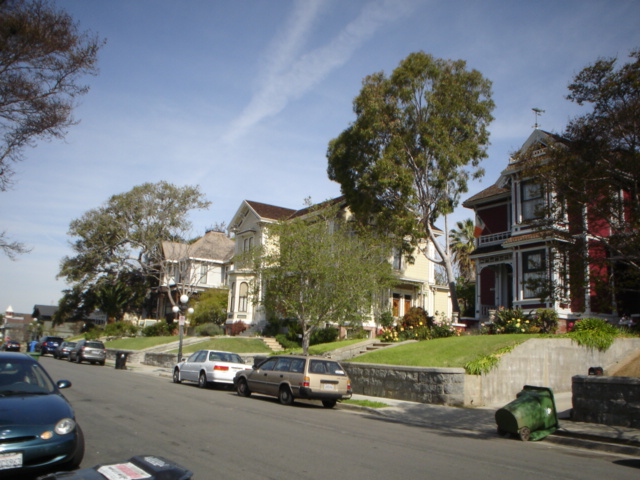
I flew from Savannah to California, the 'left coast' according to some Georgians. I think it's part of the wonderful kaleidoscope that is America. And even here, there are details you don't expect, such as the Victorian district of LA, only minutes from downtown.


I can't help thinking of the people who frequented these streets in the years before freeways and movies, some of them having ventured across the Wild West from the East, well before that great flowering of the music of the South.

Thursday, March 22, 2012

Back to reality

The Washington Post contributor Jonathan Capehart was on Morning Joe this morning when the discussion turned to the Trayvon Martin shooting in Florida. Here are the things I was told not to do as a young black man, he said, adding the preamble, 'Now this is America': 1. Don't run. 2. Don't run in public. 3. Don't run with something in your hand.

Maybe you now see mixed-race couples on TV advertisements here or on Home Buyers International, something that wouldn't have been seen, say, 30 years ago. But maybe there's still a ways to go.

Wednesday, March 21, 2012

Back to Savannah

I caught Greyhound back to Savannah this afternoon.


and loved the driver's spiel:

We got seatbelts. You can use them if you wish. I can't force you. Aint no drinkin'. Your profane language? Keep it in your head. We have decent men, women and children riding with us today, thank you sir, thank you ma'am.

After all that, there were only about four people on the bus, but I got here.


Monday, March 19, 2012

The King Street

Scene in King Street Charleston last night

A man stops me and says, 'I'm X. I'm XX years old. I'm homeless. This all I got.' (He indicates the pack on his back). He says, 'I don't want to beg and I'm not begging. I hope you will listen to me without laughing as the people down the road did. Like I said, I'm not begging. But I'll polish your car, wash your windscreen, clean out the interior, but please - I'm not begging - for a few dollars.'


(Above is King Street.)
I said, 'I don't have a car, but I'll give you a couple of dollars.' He stands back and explains, 'Now, let me explain why I'm standing over here - so you won't think I'm going to snatch your wallet.' I give him the money. And then he says, 'Thank you. Now may I ask, did I offend you in any way by asking you for money?' I said no. And he said thank you again. I said 'good luck' and he was gone.

This evening as I was walking back up King Street, a fiddler busking in a doorway stopped playing and asked me about the book I was carrying under my arm. I said, 'It's The Dream of the Red Chamber. It's the greatest Chinese novel.' 'How old?' he asked. I said, 'Around 1760.' He asked if I was English. I said no. He said, 'I know folksongs in a number of languages. I can sing you something in Swedish.' I said I was hurrying back to do some work. He asked what I do, and I told him I write words for music. He then asked if I'd heard of Alfredo Le Pera, the greatest writer of tango lyrics (wrote lyrics for Carlos Gardel), and then he recited from memory a poem about a man returning to a village where his first love lived. I was quite taken by the idea of this guy giving me a one-man recital in King Street at night. Mind you, he then said, 'You don't often meet Australian writers.'

Little things I have learned:

- You don't need to wear sunglasses here, even though it's bright.
- They have rocking chairs in the waiting areas at Savannah airport.
- Stephen Sondheim is a lingua franca. When I was at a Savannah high school with some opera singers last Thursday, and they announced that they were going to sing some Sweeney Todd, the kids all cheered.
- This is a land of whole hog. This high school I'm talking of is a public performing-arts high school. You have to audition to get in. After the opera singers had finished their recital, the kids offered their wares in exchange. A quartet of teenage boys got up and sang some barbershop quartet numbers they'd been rehearsing. Then the entire choir sang us the Lutkin Benediction - 'The Lord bless you and keep you...' They encircled us. The guests on either side of me wiped away tears. The opera company director who sat next to me said, 'That's America for you. We don't just do some of it; we do all of it.'

Wednesday, March 14, 2012

Hundreds and thousands.

We have enjoyed catching the train across the United States - that way you get a sense of the scale of the country. I noticed last night though, as I stepped out of the Savannah airport terminal, that what you get flying is an immediate fragrance of a place. As I walked out at Savannah, I noticed a fruity, salty odour.

I also noticed, travelling down from Chicago to Savannah at midnight, that America is brightly lit.


This is Chicago. In the distance, Lake Michigan. But it's bright lights all the way down, with occasional little puddles. It's not like Australia where there is an ocean of black either way you look. I couldn't think of a more graphic illustration of the size of the country and its population. They remind me of the 'hundreds and thousands' we used to sprinkle on cake.