Friday, December 16, 2011

The 200 year-old debate

In Savannah, I was often fascinated by the after-effects of the Civil War - the house where General Joe Johnston lived for example:


(Out in North Carolina, we had seen the farm where Johnston had surrendered his army to General Sherman in April 1865)


Whenever we walked down Bull Street, I would also stop and take a look at Comer House, where ex-Confederate president Davis was entertained when he visited Savannah in 1886.


I was always fascinated by the way the vanquished Southern leadership was feted in after-years.

I asked a friend from Georgia how this could be, and the best explanation he could come up with (with a shrug) was: 'Family'. Of course, some family members would bristle at my word 'vanquished'. At a lecture we attended, the president of the Georgia Historical Society, W. Todd Groce, warned his audience beforehand that they might find he has some complimentary things to say about General Sherman, the Union general who occupied Savannah from December 1865 to February 1865. And there was an audible shuffle (of discomfort?) when he mentioned that actually, prior to the war, Sherman had been first president of LSU (Louisiana State University).

I admit I, too, wonder to what extent the Southern leadership was vanquished. To a large extent they were incorporated. The stars and stripes flies outside Johnstone's house.
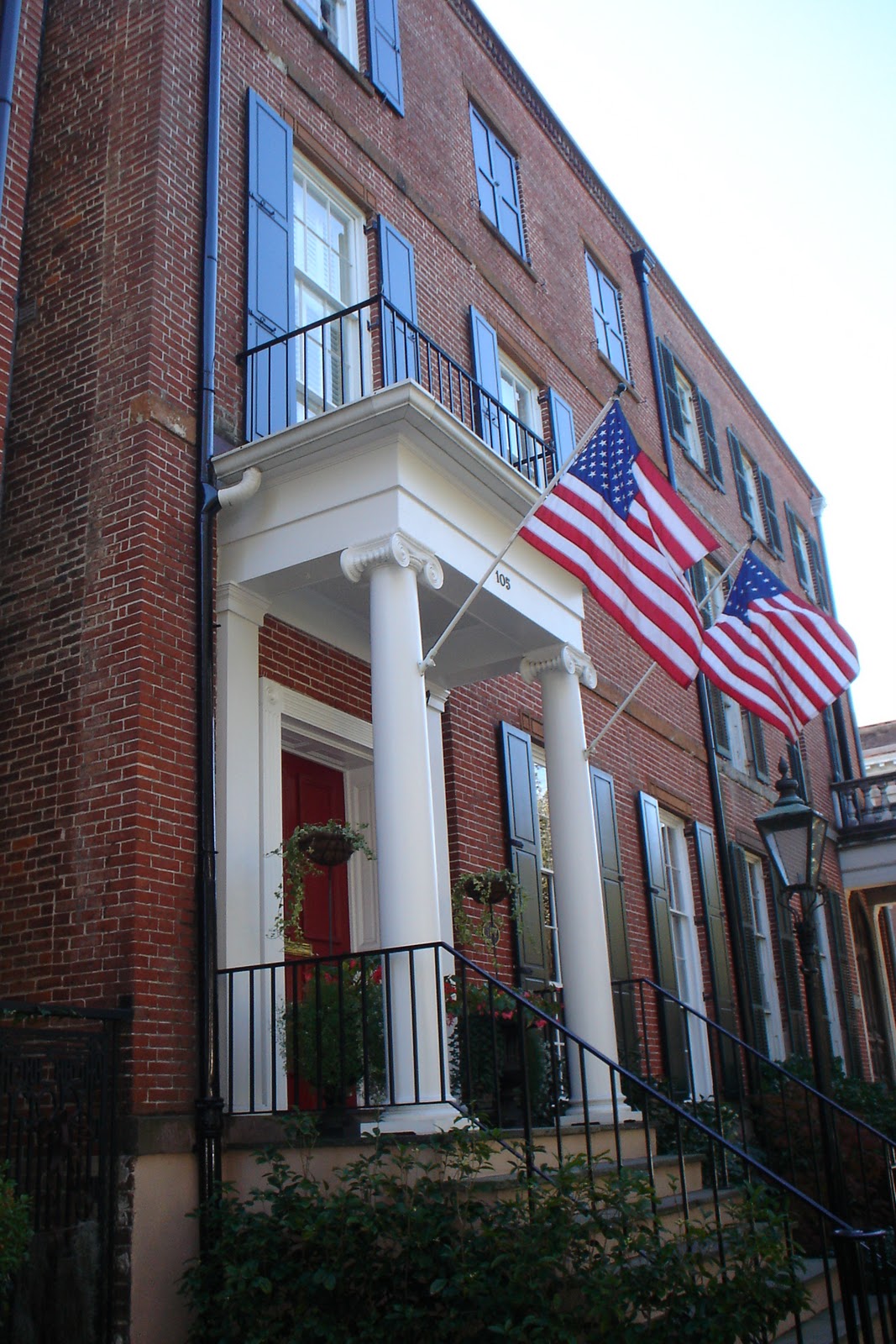

(Of course, Johnston later served in federal administrations.) But I wonder if this approbation is an example of Lincoln's 'let 'em up easy'?


Or is this process of lauding Confederate leaders a way of legitimizing States' Rights as an authentic strand of American life? In the movie Gettysburg, 'General Longstreet' says, 'We should have freed the slaves and then fired on Fort Sumter.' That would have focussed the issue. Fact is, though, they didn't [free the slaves], and they couldn't keep it [the issue of slavery] 'in the family'.

Which, given that Americans live with this oppositional view in their midst, got me thinking about the place of contrary views in American society. Because, as another example, if you think about it, the major American political parties have become their polar opposites over the years. I know I was dismayed to learn, some years ago, that the 'big government' Democratic Party traces its origins back to Jefferson who was a proponent of States' Rights and 'government is best which governs least'. On the other hand, the greatest presidents from the small government, States' Rightist Republican Party were Lincoln and Teddy Roosevelt, who enlarged the federal government, enforcing its authority and regulating industry respectively. Do the supporters of either party recognise these flips? Or recognise them as flips? As someone said on the morning chat show Morning Joe the other day the debate between state and federal government and Strict Construction vs Hamiltonian interpretation (the federal government is empowered to do whatever is necessary to achieve its ends under the constitution) is 200 years old. Is embodiment of this debate, without any requirement to be consistent, enough to register authentic Americanness?

On Monday we left Savannah and took the bus to Atlanta (reversing the path of Sherman's march to the sea. I can see why it would have taken him so long to cover the distance.)


In Atlanta, ninth-largest metropolitan area of these united States, we found the following sign proudly displayed on the corner of Spring and Peachtree Streets:


Here were the outer defences of Atlanta in 1864.

Tuesday, December 6, 2011

The size of the contribution?


A number of musicians have lived in Savannah. Lowell Mason was here for a time. I know him mostly for the hymn, Watchman, which is one of the themes of Charles Ives' Fourth Symphony. So too was the composer of Jingle Bells, who, I see here, served for a time in the Confederate Army.


Leaving aside the pros and cons of having fought for the South, I am always intrigued by musicians who move out of their studio, so to speak. 

I remember reading once that 19th century military men and diplomats who met the virtuoso Franz Liszt would regret that such a brilliant man was wasted on music. When I read that, as a music student, I resented such oaf-headedness. But now I look at the stories that fascinate me.


I am trying to produce an opera on Philippa Duke Schuyler, the Harlem-born concert pianist, who died ferrying schoolchildren to safety during an attack on Hue in the Vietnam War. I have always admired the fact that Faubion Bowers, Scriabin's biographer, was General MacArthur's aide-de-camp in occupied Japan, and is credited with saving Kabuki theater. The other day I read that the actress Hedy Lamarr worked with the composer George Antheil on a radio navigation system for anti-submarine torpedoes during World War II.


What is my fascination with these stories? Am I somehow concerned about classical music's relevance to life? I also remember reading Richard Taruskin’s account of how, in the era of Soviet oppression, his Russian friends would hang out for the latest Shostakovich. Do we do that for any classical composer now? Yet, it wouldn’t be true to say that music is not important. People get very het up over their favourite music. It’s so much an issue of who we are. 

I do get concerned though when I see orchestral seasons simply re-combining the same 75 or so works.

Monday, November 21, 2011

Sightseeing and Soundhearing

I love the sight of Live Oaks here in Savannah. They're not purely native to the area, but they come from hereabouts; huge pines were the original vegetation up here on the bluff.

Last night we heard a choral service by candlelight at Christ Church, and walked back through darkened streets made even more atmospheric, if not spooky, by the sight of Live Oaks hung with Spanish Moss.

But what I notice most, and what I will always now associate with Savannah, is the sound of acorns dropping on pavements and other hard surfaces and the crunch of them underfoot. America is a country rich in sound.

Monday, November 14, 2011

Sister cities?

I'm fascinated by the contrasts and similarities between Savannah and Charleston, southern cities only two hours apart. Both are immensely walkable. People walk the battery in Charleston or sunbathe in Marion Park. Yet Savannah's broader footpaths are easier to walk abreast on and their 22 squares draw the neighbours in. We've noticed people meeting in the middle for a glass of wine of an evening, weddings taking place, the odd strolling guitar player, and then, on Saturday morning, of course there are the exercise classes...


These squares, whether they were designed by Oglethorpe in 1733 as rallying points for militia or not, really invite 'use'.

In many respects both cities support our contention that university towns are best. Charleston has the Medical University of South Carolina, College of Charleston (est.1770), Charleston School of Law and Virginia College of Charleston. In Savannah, SCAD, the Savannah College of Art and Design is the big juggernaut, owning a building on just about every street it seems, and certainly the old movie houses, which it operates as live theaters. We saw Audra McDonald at the SCAD Theater last Wednesday night and she was a revelation, not only for what she revealed of a repertoire I thought I knew well (songs from shows like Fiorello and Do-Re-Mi, for example), but for the way she could 'tell' a song. And then when we thought she couldn't be any more talented she sat down and accompanied herself on the piano in a song by Adam Guettel, Richard Rodgers' grandson...

But Charleston and Savannah's charms are longstanding. They were lovely towns 15 years ago, before we noticed any university presence. They both have interesting similarities - their share of Revolutionary history (patriots died over by what you can see over your left shoulder if you turn around), their respective chapters in the history of slavery, their own memorials to 'our Confederate dead', the presence of voodoo. I notice a little more Savannah's association with piracy. Well, Treasure Island's Captain Flint is supposed to have died in Savannah. Charleston has Porgy and Bess of course (how fantastic to have an iconic show associated with your town). But I notice here a slightly higher historical presence of the Creek Indians. Tomochichi's grave is in town. And Samuel Wesley spent two years here in the 1730s and credited Savannah as being the locale of one of two revelations which led to his creation of Methodism (the other revelation took place in Oxford).

But what I notice here also is the fullness of cultural life that exists in a city this size. It doesn't have a first-run cinema downtown (it's miles away in the malls), I really feel the lack of a nearby pool, and it doesn't have an opera company (though somebody is working on that). But it has that sense of 'something on every night if you want it' which I've noticed in similar sized towns before. Let's see: last Monday if we had wanted to we could have gone to hear Tim Drake of Clemson University talk about Death and Burial Customs in the 19th Century at the Kennedy Pharmacy. On Wednesday, Dr Martha Keber spoke at the Savannah History Museum about The burning of 'La Francaise' and 'La Vengeance' by a Savannah mob in Nov 1811 as part of 'The War of 1812 Lecture Series', and the next night Prof. Christopher Baker at First Baptist Church talked on The King James Bible: Four Centuries of Influence. There's no excuse to be bored.

You can also dig endlessly into the architectural history of both cities too. But it looks to me that Savannah's architectural periods extended later. There was a real extension of prosperity into the Victorian era (after the Civil War?). There is even a Victorian District. Forsythe Park sits in it.


My strongest impression of Charleston architecture I suppose is of wood. Savannah is to a far greater extent built of brick.

Saturday, November 5, 2011

Multiple threads

Charleston, SC - Not just monumental shifts like the Fall colours but small details tell me when I'm somewhere different - the septuplet click of the wait signal at Richmond Virginia pedestrian lights; the acronyms in various places (like CARTA for Charleston Area Regional Transportation Authority); the names of people I wouldn't have heard of if I hadn't visited a place, like Ravenel or Manigault, big family names down here in Charleston, or artists like the blacksmith Philip Simmons whose work was so fine it's ended up in the Smithsonian.


Note here the rattlesnake motif in the gates he designed for the mansion that belonged to Gadsden who designed the 'Don't Tread on Me' flag from the War of Independence. Look close. Simmons prided himself on how he tapered the ends.

Then there is also Antwon Ford the master sweetgrass basket maker or 'spinner', or Charleston's early women artists like Henrietta de Beaulieu Dering Johnston.

You notice sounds too, not necessarily the chuck-chuck-chuck of woodpeckers such as you would hear around Falls Church, but the constant sound of fire engines in this wooden city - and their really ugly horns. You hear them several times a day.

Then there are the incredible sloping porches. Why? Do they get torrential rain here?


I notice little differences because I compare the swimming pools in the various places. They often have their own rules, which you don't know about until you've broken them. At the YMCA in Greenpoint (New York), the attendant yelled at me because I was keeping a circular motion around the centre line (as you would in Australia). 'No, no, no, straight up and down,' he yelled as if I was an idiot for not knowing. I also found out, after I'd arrived, that I was meant to have my own bathing cap. The public pools in NYC are free but they won't let you in without a padlock. The pool here at the Medical University of South Carolina is excellent, nice, clean, new, with a great weekly rate. There's an indoor running track above your head. It even has a spin drier for your swimmers. I could possibly write a book Pools I Have Known. It is definitely a theme running through my life.

Monday, October 31, 2011

The feeling in the streets

Going to see Dracula at the Dock Street Theatre and then walking back through the darkened, gaslit streets kind of gives a flavour to Charleston.


I was more impressed, however, by the fact that the first play produced here, at America's oldest theatre, was George Farquhar's The Recruiting Officer. I read this on a sign further up Church Street the next day.


It says here (second paragraph) that one of the earliest occupants of this house had written the prologue for that Dock Street Theatre production.

Coincidentally, The Recruiting Officer was the first play produced (by a cast of convicts and guards) at Sydney Cove in 1789. How interesting that this play, a satire on authority, was such a favourite in both early colonies.

Does it say something about our common attitudes to authority? In both countries I think people would agree we have a common disrespect for power. But the circumstances suggest subtle differences too. Australia's production took place in the context of a penal colony, arguably a precarious situation for those in charge. Yet the governor, Capt. Phillip, was comfortable enough to let it take place. And to this day, Australia's leaders tolerate a very knockabout sort of, well, 'knocking'. Perhaps while Americans fear government (you get the impression sometimes that tyranny is only a president away; despotism always a possiblity; gotta keep a hold on our guns), Australians have a rougher, more familial disrespect for their leaders. Australian politicians will never be tyrants; but they'll always be 'slackarses who don't do what we pay 'em to do'.