Showing posts with label Hollywood. Show all posts

Thursday, May 21, 2015

'Think like Thalberg': lessons from Hollywood for classical music


When I moved to Sydney in 1987 I got to know the city by memorizing its coves and bays. In Los Angeles since 2013, I’ve memorized where the studios are located. After all, locals often think of Los Angeles and Hollywood synonymously. Paramount is only a $10 cab fare away; Warner Bros is in the Valley. But in another sense I’ve learned a different geography. What I would call ‘classical music’s verities’ stand out more vividly now.

'Where the studios are located'. Fox and Paramount lie in this direction; Warner Bros and Universal are over the first hill. 
I had at first considered writing an article entitled ‘What Classical Music can learn from Hollywood; what Hollywood can learn from Classical Music’. I was going to include such ‘pearls’ as: ‘You’re never finished’. Film scripts, for example, are multi-coloured documents inserting rewrites way beyond the first day of shooting; how does that compare with classical music’s sketch, short score, orchestration..?

‘It Takes a Village’ (apologies to Hillary Clinton) occurred to me while sitting in our local cinema, the Vista, at the junction of Sunset and Hollywood Boulevards (where D.W. Griffith filmed the silent epic Intolerance in 1915 before the roads were paved) and realizing that the audience was sitting through 15 minutes of end-credits. Such appreciation for everyone’s work! Classical music may have gotten over the idea of the lone genius starving in the garret. But in Hollywood you find the ‘sort of collaboration that once yielded cathedrals’, says Billy Mernit, a story-analyst whose classes on dialogue I’ve taken.

The distance I’ve travelled through this landscape also makes me sensitive to arguments about ‘New Music’. I’m reminded of a former piano teacher who said that when he came back to the piano after a long spell at the harpsichord all he could hear were the piano’s hammers. These days I notice the ‘shoulds’ in the programming debates. Companies should program New Music; people should listen to it.

Maybe it’s a worry that our classical music scene doesn’t seem to have a big-enough audience for the most future-bound music of our tradition but I wonder if there is another way of looking at this. Los Angeles suggests to me there is. ‘Should’ just isn’t in the vocabulary of anyone in the Green Room of ten million people that is Los Angeles County.

I guess people have been worrying about the decline in audience-appreciation for our modern repertoire since Henry Pleasants bemoaned the loss of singable themes in The Agony of Modern Music. Oliver Rudland wrote in a recent edition of Standpoint that composers stopped writing tunes because they lost their Christian faith. I don’t even think they have to write tunes (!).

But my favourite analysis is that of Richard Taruskin who, in a 2004 edition of The Musical Times, focussed on the idea (fallacious in his mind) that all that matters in a piece of music is the artist’s making of it (their ‘poiesis’), regardless of the audience’s capacity to hear. Taruskin traced what he called ‘the poietic fallacy’ back to 19th century critics like Alexander Serov or Franz Brendel (remember them?), but in Schoenberg’s atonality and 12-tone music he felt that the audience had really been abandoned.

I know Schoenberg tried to help audiences comprehend his new music by emulating classical forms. But the classical forms couldn’t serve their previous clarifying purpose once a composer’s means of punctuating them (Tonality) was lost. That’s not a catastrophe, except that at some point after 1910 you could often detect an idea that composers didn’t have to worry themselves if the audience was left behind. The composer’s principal, if not sole, job was to extend the musical language; it was the audience’s problem if they were bewildered.

‘Most of the cuts were in the First Act’ says screenwriter Dustin Lance Black, of the Clint Eastwood film J. Edgar, ‘because we didn’t want the audience to get ahead of it.’ [italics added] ‘Subtext helps your audience to participate. It’s fantastic if your audience knows a bit more than your characters,’ [italics again] says Billy Mernit. What do these seemingly contradictory statements suggest? A filmmaker is constantly shifting their audience’s understanding, and the audience is granted enough of the basics to play along? I decided to collar Mernit, since I know him, and put some questions to him.

Billy Mernit is a former songwriter who has had his songs covered by people like Judy Collins and Carly Simon. These days he’s a story analyst for Universal Pictures, and is best known for his textbook, Writing the Romantic Comedy. Mernit gets to see and comment on each of the seemingly interminable drafts a screenplay goes through before the cameras roll. How important is consideration of audience to the film work?

‘The general rule of thumb is that with most writers, first draft is for you. Second draft is where you start to take into consideration who it’s for and who might respond to it,’ he says, when I catch up with him in the sculpture garden at UCLA, where he does some teaching. ‘In the Hollywood studio system it is almost scientific. One of the first questions any executive asks of a project is “what’s the demographic?” “who’s the intended audience?” “how do we expect to sell this thing?” because it’s in the studio system that you’re dealing with major money.

‘And by the way, back in the Silent Era, in the early days of Hollywood, a lot of the stuff that is now sort of codified, in its nascent form was responding to audience. In some of the earliest Silent Movies, like Chaplin two-reelers, audiences were going “give us more of that. We love that.” And only when the audience created the demand for things, did Hollywood say, “Hmm, if we put a woman in the picture with that comedian we’ll expand our audience” - things like that.’

So, could I take another Clintonian expression and turn it into one of my ‘lessons’ - ‘It’s the Audience, Stupid’?

‘Well, the slight confusion in the question, the thing that’s being conflated is ...it’s creator versus producer, meaning a creator may not be thinking of the audience; a screenplay might be a very personal endeavour. But the producers of a screenplay are thinking audience first and foremost.

‘I don’t want to be too glib about this because if you’re a story analyst who’s worth what they pay you, on a certain level there’s this naive, fundamental “does this get me excited?” You have to have a personal response to it. And that, by the way, goes with producers as well. You don’t necessarily get into producing unless you have a great love for movies, like a good story and want to be involved. So I’m responding as a human being, that’s the litmus test. If it grabs me and I’m thinking “I’ve gotta keep turning these pages”, I am the audience; with the producer’s hat on. I don’t think of things in terms of what’s commercial or not. It’s more “is there something in the story that speaks to some kind of audience beyond myself?” Everything should be personal, of course, and the most personal projects are quite often the most impassioned and unique, right? but it’s a communicative medium.’

A producer like 1930s whizkid Irving Thalberg (the model for F. Scott Fitzgerald’s ‘last tycoon’) thought that the success of a movie was arbitrated solely by the audience, director Billy Wilder’s ‘wonderful people out there in the dark’. I wonder if the classical music fear of giving so much consideration to audience response is that we would lose out on masterpieces?

Says Mernit: ‘Well, it’s not like Mozart or Verdi or Vivaldi were writing extremely esoteric masterpieces that were being foisted on an unsuspecting public; they were using the popular vernacular. But the crucial difference is that Hollywood is not attempting to make the general public watch a Godard movie. You can have a Best Picture winner like 12 Years a Slave and it’s something that people can relate to, whereas much modern classical music - unless it’s Minimalist - is very difficult for most audience members to even hear. It’s as if you were making a movie with a strange lens on the projector.’

I find myself wondering if classical music would ever get to this level of deference to the public. After all A Composer’s Cohort, an article on the Opera America website, says, ‘...try not to worry about the reception....Whether the audience likes your piece is arbitrary but informative.’ I can’t help feeling that not only would this be a strange abdication of skill in the movie world which is premised on predicting hits (and often does), school teachers wouldn’t say, ‘I have no idea at what point I lose my students’ nor would sales personnel concede, ‘I have no idea when I’ve lost the buyer.’

And it’s not as if classical music was always in such an unknowing position. A classical composer knew that if you put an A minor chord after a G while you were in the key of C, an audience would experience interruption. Wagner knew that if he kept withholding resolution of the ‘Tristan chord’ we in the audience would lean in with yearning. And I’m convinced Tchaikovsky set his audience up so that they would burst into applause at the end of the march in the ‘Pathétique’ and feel all the more excruciatingly the wrench into the Adagio lamentoso which in fact ends the symphony.

Do classical music writers want to second-guess the audience? Do they want positive reinforcement of their vision that badly? I wonder what would happen for contemporary repertoire if the practitioners began to ‘Think like Thalberg’; if classical music had its equivalents of film producers, people in orchestras who could stand between a CEO and a Director of Artistic Planning, a CAO (Chief Artistic Officer) if you like, with the authority to say, ‘Look, the audience feels you’ve got ten minutes more music than thematic material. I saw them fidgeting at the preview we set up to test their responses.’

These are just some of the thoughts that have come to me from immersing myself in a different artistic milieu. But to come back to an earlier promise, what can Hollywood learn from classical music? I said above I was thinking of writing about each artform’s lessons for the other.

So far I only have one, but it’s big, and fairly reaffirming. Paradoxically it’s something about form. In Save the Cat, probably the most popular screenwriting text of today, the book that every second aspiring screenwriter working on WiFi in Starbucks has sitting by their elbow, the author Blake Snyder says ‘Act II begins on page 25. No, please. Don’t argue’. Yes, but I will. (By the way, since screenplays are formatted so that one page equals one minute of running time, this is even more restrictive than it sounds.)


Every second person working on a script. Actor Joey Marino studies a screenplay while working  in Bru Coffeehouse, Los Angeles
Classical music wouldn’t buy this. Classical Sonata Form, for example, is a 3-Act structure. It was a screenwriting teacher, Sydney’s Linda Aronson, who made me think about this. Classical Sonata Form contains exposition, development, and recapitulation. There are certain goals it must satisfy but look, there is a world of variation in the way Haydn, Beethoven, Mahler, Shostakovich and others even closer to our time went about it. Classical music proves you don’t have to be rigidly formulaic.

But screenwriting may not be as schematic as I think. I put this to Billy Mernit. ‘It gets moved around a lot,’ he says. ‘The A-teamers are not slaves to those kinds of restrictive formulas really.’ And then I think of Pulp Fiction - three acts functioning traditionally but out of real-life chronological order, containing enough that’s familiar for an audience to appreciate what’s fresh. Yes, even as I continue to try to learn from classical music, Quentin Tarantino (Pulp Fiction’s screenwriter/director) proves you can create an innovative masterpiece that is also popular.

Gordon Kalton Williams
© 2015

This article first appeared in the 7 May edition of Symphony Australia’s The Podium under the title: A Different Geography: how LA has affected my musical thinking


Wednesday, March 5, 2014

One musical lesson for Hollywood

At the end of an email exchange I had with Linda Aronson, author of The 21st Century Screenplay, Linda asked, "BTW, since you're a musician, have you ever noticed that three act structure resembles classical sonata form?"

In fact, I had. Linda was referring to the musical form most often used in the symphonic first movements of composers like Haydn, Mozart, Beethoven and Brahms. It's in three distinct sequences, which could be related to Acts. More than that, though, Classical Sonata Form describes the sort of rising conflict we expect in drama. It can be shown diagrametically, like this:
"Early examples of sonata form resemble two-reprise continuous ternary form." Posted on Wikipedia by Hyacinth
The conflict is expressed not really in themes (which I suppose could be likened to characters), but in the 'play of tonality', the movement of keys away from and around the tonic, or home key.

Let me see if I can explain: The form's First Act, or 'Exposition' in musical terminology, sees what Linda would call 'the disturbance', the first sign of conflict as the music modulates for the first time. If you started in C, say, you would normally end up in G. In really intense music, like Beethoven's 'Eroica', this disturbance occurs, or is at least foreshadowed, before the end of the first phrase. A composer like Haydn might use one theme to express this disturbance; others might mark the change of key with a new theme. (Would it be stretching things to think of this secondary theme as an antagonist? Perhaps, since further disturbances can be carried by any other sub-theme, even the principal theme itself; but you get my point?)    

Once this principal disturbance is introduced and cannot be dislodged (and the principal themes have been sounded), the Exposition comes to an end and we are into the Development section, the musical equivalent of the 'barriers, reversals and complications' Linda describes the protagonist of a drama facing, until they reach a point of maximum danger to their goal and decide to fight back. In music, the Development is turbulent, the themes are tossed around through changing keys getting further and further from the tonic and heightening the listener's anxiety for 'home'. In a symphony in C, the furthest 'out' would be the key of F-sharp. In a symphony in G, D-sharp the most alien. (Classical composers rarely went this far out of bounds, but Beethoven's E minor in the middle of the Eroica's first movement is a long way from home.) 

Finally, at a moment that often sounds like 'seizing the sword' (screeenwriting students will be familiar with the term), the music returns to the principal theme in the tonic key (home base). Thus begins the Recapitulation, our Third Act wrap-up. The themes first sounded in the Exposition will now be re-stated, but all in the tonic key. Unlike drama perhaps, this 'return' compounds the sense of home by the repeat of the secondary subject matter in the home key but there are composers, like Schubert, who leave this sense of return till quite late by approaching the Recapitulation under the tonic and only getting home close to the end. (Beethoven extended Classical Sonata Form, in music like the Eroica, by suddenly launching into another Development just at this point where the listener thought s/he was safely back. It's no wonder he often had to ground his first movements at the end with such forceful, if not brutal, strokes.)

But why mention any of this? Is it any more than a parlour game? Yes, I think it is. If there is any criticism I would make of Hollywood (and I haven't many) it's that screenwriting technique has become too prescriptive. I totally agree we're hard-wired to appreciate Three-Act Structures (or Five Acts, if you want to elongate the drama's wave). But must we always reach the end of Act I at page 30 or make Act II last 60 pages...? If not, Classical Sonata Form could stand as a model of the fluidity that's possible. Haydn and Mozart sometimes wrote quite short Developments with no lessening of tension; Beethoven could launch another Development just when the listener thought s/he'd gotten to the end. Shostakovich and Prokofiev in the 20th Century rethought Sonata Form. Stravinsky wrote 'symphonies' where, in Robert Craft's analogy, Mozart's squares and rectangles became trapezoids and rhomboids.

This, then, is a lesson that I reckon Hollywood might learn from classical music. But before anyone at the philharmonic breaks out the champagne, I honestly think classical music in its present state has more to learn from Hollywood. And that will be the subject of a future piece of writing.

Thinking of readily-available examples, the first movements of Beethoven's 3rd and 5th symphonies would fit. The first movement of his Eighth is a nice, nuggety example.  


For more of my blogs on classical music, you might like to visit:

Sousa and the Sioux, 19 August 2011
@ http://gordonkaltonwilliams.blogspot.com/2011/08/sousa-and-sioux-i-am-reminded.html

Doors slamming shut - where to for American opera, published 23 Oct 2012
@ http://gordonkaltonwilliams.blogspot.com/2012/10/doors-slamming-shut-where-to-for.html


Noblesse oblige - arts philanthropy in the US,  published 26 October 2012
@ http://gordonkaltonwilliams.blogspot.com/2012/10/noblesse-oblige-arts-philanthropy-in-us.html

Walking with Stars, published 10 Apr 2012
@ http://gordonkaltonwilliams.blogspot.com/2012/04/walking-with.html

A Culture in Exile - European classical musicians in Hollywood in the 1930s and 40s, 25 Apr 2013 
@ http://gordonkaltonwilliams.blogspot.com/2013/04/a-culture-in-exile.html

'Traditional terms?' - an interview with John Adams, published 5 Sep 2013
@ http://gordonkaltonwilliams.blogspot.com/2013/09/traditional-terms-interview-with-john.html 

Experimental city - Los Angeles' operatic dimensions, published 22 Sep 2013
 @ http://gordonkaltonwilliams.blogspot.com/2013/09/experimental-city-los-angeles.html


On my website, you could also click on "USA blog" to scroll down the full range.

Tuesday, December 10, 2013

Coffee ii

I posted a blog some time ago (13 September) listing a number of places where I'd found good coffee in the States. Australians are big snobs, or shall we say more particular, about this, and it's multi million dollar business in the Australian cities. For some reason there seems to be good coffee in this area (the broad circle that takes in East, West and the main part of Hollywood.)

In the interests of occasionally having a trivial post, I continue with my list:

Javavista, 6707 Sunset Boulevard, Hollywood CA 90027;
Groundworks on the corner of Cahuenga and Sunset in Hollywood;
the Gelato Bar, 1936 Hillhurst Ave, 90027.

And I forgot the place we used to go to in Greenpoint in New York - Milk and Roses. I often used to work there back in 2011.


 A more substantial blog next time...


Friday, June 21, 2013

A mirror held up to its nature

I have some serious things to say about the influence of the movies on Los Angeles. I think, for starters, "the arts" (what Sir Les Patterson dismissively calls "the yartz") and, notably, contemporary classical music could learn a thing or two from the attitudes of film-makers, particularly their concern and sensitivity to the responses of audiences. This Hollywood film-makers have almost naturally without having to read The Poietic Fallacy, Richard Taruskin's critique of New Music's insistence on the importance of the artist's urge to speak regardless of the audience's ability to hear it.

But I'll come to that another time, suffice to say that I love the sense of film-making going on all around me, the fact you might overhear someone in Starbucks in Reseda say into his cellphone: "I'm just off to Burbank to meet the guy who produced my film," or (as I heard in Tampa Ave today) "The reason I used a long shot was....", or overhear people practising pitches. I've come across these Notices of Filming a few times now.


Apart from warning the passing pedestrian that there will be cables across the pavement, there's also a line here 'warning' the reader that there will be 'interior and exterior dialogue'. How much of LA's interior and exterior dialogue ends up in films too, I wonder?


Thursday, June 13, 2013

Enfolded in its vastness

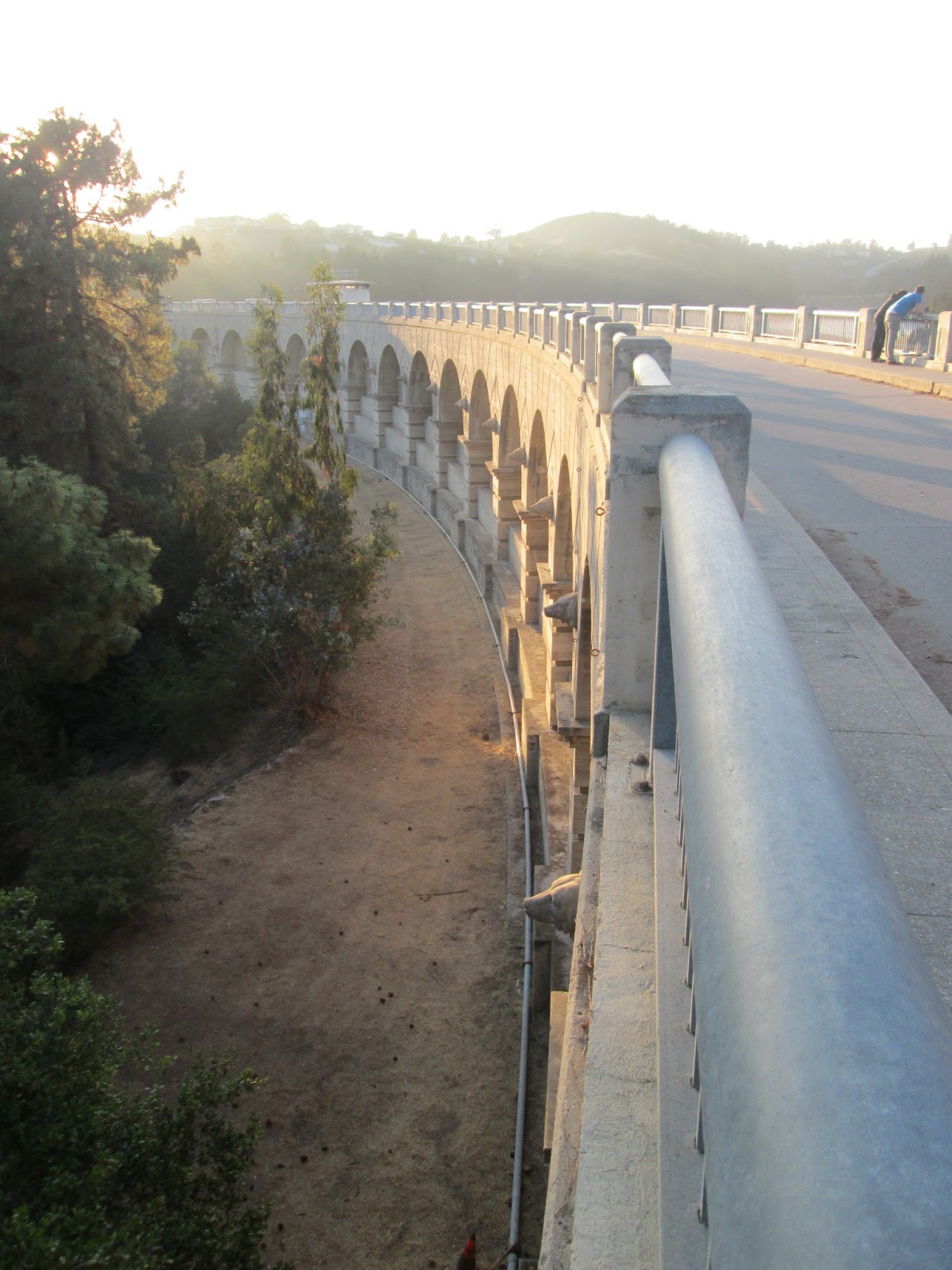
I never knew there was a lake up here under the Hollywood sign. But this city's vast spaces clearly enfold many many secrets.


It wasn't until I turned around and looked at the dam wall that holds back this body of water that I realised that this was where they filmed the first scene of Seven Psychopaths.


Monday, April 29, 2013

An antipodean's change of view


For some reason, these scenes out at Santa Clarita reminded me of the kngwelye (Wild Dog Dreaming) side of Alice Springs


and then the hills rising up back of Hollywood do the same thing for me.


In a sense Los Angeles is my antipodes.


Thursday, April 25, 2013

A Culture in Exile


A Culture in Exile - Classical musicians in Hollywood in the 1930s and 40s

A number of times over the past few years, the contemporary German film director Werner Herzog has described Los Angeles as the most culturally substantial city in the United States. It’s why he and his wife decided to move here he will say, often citing the number of writers, philosophers, and mathematicians who are also in residence. 

Los Angeles skyline, photo: Navid Serrano
To anyone in classical music, Los Angeles has a further claim to cultural substance: in the 1930s and 40s, mostly because of Hitler, Los Angeles ended up with the highest concentration of great composers, writers and performers per square mile of any other place on the planet, probably at any time. Just think who lived here – Schoenberg, Stravinsky, Otto Klemperer, Bruno Walter, Thomas and Heinrich Mann, Bertolt Brecht, singers like Lotte Lehmann and instrumentalists such as Jascha Heifitz. Nearly all of them lived walking distance from Sunset Boulevard’s arc to the sea at Santa Monica. People ask whether Angelenos have profited from the time these greats spent among them, but it’s certainly inspired me as a newcomer. I’ve walked the streets with a copy of Dorothy Lamb Crawford’s A Windfall of Composers in hand and Carol Merrill-Mirsky’s Exiles in Paradise 1991 exhibition catalogue tucked under my arm. I’ve shared the same initial experience as the Stravinskys who marvelled at ‘the sun, the climate, the beautiful countryside, the charming homes...’

An Australian who wants to retrace the steps of a world-famous composer can walk up Caroline Street, South Yarra and know that that’s where Percy Grainger lived. Here, you can see the houses owned by even bigger names and meet their children, grandchildren and students. Phil Azelton, a music copyist I met, studied under Ingolf Dahl and remembers the day Dahl came in and told the class how sad he was that his good friend, Paul Hindemith, had died. I love the everyday-ness of it. I’ve shopped at the farmers’ market at the corner of Fairfax Ave and Third Street where Vera Stravinsky met Natalia Rachmaninov and invited her and her husband to tea with Igor and her and the Rubinsteins; where the Stravinskys took W.H. Auden to shop while he was working with Igor on The Rake’s Progress. Getting around the county on the Rapid Transit, around that huge amphitheatre which is the coastal plain backed by the Hollywood Hills, I know exactly what Otto Klemperer meant when he came here to conduct the Los Angeles Philharmonic from 1933 and spoke of ‘distances such as we can hardly conceive of’. Even now, it takes on average two hours to get anywhere one-way.

But the city has also served as a kind of map by which to learn about other less well-known musicians.  I’d heard Hanns Eisler’s music in productions of Brecht, but never before delved much into his concert music. And I’ve wondered why Ernst Toch is so little represented in concert programs; his Symphony No.5 Jephta could easily sit alongside Barber’s First or Roy Harris’s Third as one of the great one-movement symphonies of the 20th century. Toch didn’t go in for ‘systems’, but Schoenberg thought enough of him to let him know when he was retiring from the University of California at Los Angeles (UCLA) so that Toch could go for the job. (Schoenberg didn’t go in for systems either, of course. One of the great anecdotes in Crawford’s book concerns Milhaud’s visit to Schoenberg upon returning from a post-war visit to Europe. So many post-war European composers are writing with twelve tones, he told Schoenberg, thinking Schoenberg would be pleased. ‘I hope they’re putting some music into it’, said Schoenberg.) Carol Merrill-Mirsky, the Los Angeles Philharmonic’s Hollywood Bowl Museum and Archives Director, mentions other less well-known musicians whose presence here contributed to the artistic activity of the city, people like Leon Levitch, an émigré from Yugoslavia who got interned in Italy, then upstate New York - ‘an excellent composer’ ‘who made his living here in Los Angeles as a piano tuner’.

But to go back to Toch. He had studied music despite the disapproval of his parents and learnt from ‘secret early study of Mozart’s scores’ the emotional wellsprings of music. You’d think that Toch’s music (‘from the heart – may it go to hearts’, as he described Poems to Martha) would equip him to write for the movies, the town’s principal industry. But he was not the only composer to be disillusioned by this experience.

Reading about these composers’ experiences with the film studios you sometimes see Old World sensitivities butting up against those of the New World. Crawford in her book suggests that the relative age of a composer when he arrived in Los Angeles was a factor in the success or not of his (and it was usually ‘his’) dealings with Hollywood. Franz Waxman, Frederick Hollander and Erich Wolfgang Korngold did well because they were comparatively young. But perhaps there’s more to it than age. Those three allowed that a film’s rhetoric trumped music’s when it came to making movies. Max Reinhardt, the great German director, said that Frederick Hollander could have been a dramaturg if he hadn’t been a composer. According to Hugo Friedhofer, Korngold could go to a director and say, ‘I feel that there’s a first act curtain there’, and ask if there was any more footage so his music could make more of the moment; he always got his way. The complaint of composer Alexandre Tansman – that the entire city of Los Angeles would await the latest offering from MGM – seems beside the point. Films were the principal storytelling medium of the town. But of course, present-day orchestral artistic administrators are wrestling with the idea of concerts that may not have ‘the music’ as their principal rationale.

Stravinsky hoped to get work in the movies when he moved here in 1940. A number of his concert works, such as Four Norwegian Moods, started out as film music that couldn’t be fitted into the final filmic result. You can still go past Stravinsky’s house up in West Hollywood. He had an easier time of living in Los Angeles than most and that may be because he had no problem prioritising the making of money. (The American composer, George Antheil, couldn’t quite believe Stravinsky’s way of ‘invariably turning idealistic musical conversations into mercenary channels.’) But Stravinsky also expected America to create ‘the new things in music’. According to a story by David Raksin (famous for the film score, Laura), Stravinsky could go along to a nightclub and be delighted to hear Oscar Peterson, Herb Ellis and Ray Brown while Pierre Boulez and Robert Craft, his companions (on the particular night Raksin was describing), ‘looked like two guys out of a Daumier drawing, disparaging something’. Thirdly, Stravinsky was used to emigrating and had already done so a couple of times.

There is great poignancy, however, in reading of the suffering of some of the other émigrés, the German-speakers mostly, in adapting to their new home. German novelists felt greatly the loss of German-speaking readers, for example, and many returned to Europe after the war. There’s ‘an element of personality that makes it possible for some people to assimilate’, says Merrill-Mirsky. ‘Bon-vivants like Rubinstein or Stravinsky could live anywhere.’ Of course, if I get homesick, I can walk to the ocean and look out in the direction of Australia. And I can stave off ‘heimweh’ by creating an Australian plant-species distribution map for Los Angeles county. I saw a huge Moreton Bay Fig in a garden on Burlingame Avenue, Brentwood on my way to the Schoenbergs’ house. Importantly, my homeland is not at war. Many were the émigrés in the 1940s who couldn’t quite appreciate the swaying of palm trees in balmy breezes while the streets they grew up in were being bombed into craters and childhood bonds with family and friends were being extinguished (or not – they just didn’t know). But, says Merrill-Mirsky a lot of the modern-day Angelenos who are taken with the story of this period are Jewish people, ‘because when you’re inundated with stories of the Holocaust this almost looks like a good news story. These are the few who made it, who came here, were successful, raised families, many of whom are still living here.’ At the beginning, in 1934, Schoenberg likened it to entering Paradise: ‘I...came from one country into another, where I am allowed to go on my feet, where my head can be erect, where kindness and cheerfulness is dominating, and where to live is a joy and to be an expatriate of another country is the grace of God.’

Living here and studying this period from an artistic point of view I get a huge sense of how deeply Schoenberg and his 12-tone technique were steeped in European culture. California offered its distractions (and Schoenberg was swayed enough by the climate to be obsessed about tennis and ping-pong) but apart from that, he maintained his path, or shall we say his voice, with granite-like integrity. I get a new sense of how much his music burned from inside, but also a sense of his courage, ‘his refusal to be whittled down to mortal size by adversity’, in David Raksin’s phrase.

Part of the workroom, Schoenberg's home. By permission, Ronald and Barbara Schoenberg.
I visited his son and daughter-in-law, Ronald and Barbara, retired California trial judge and professor of German literature and language respectively, at the Schoenberg family home in Brentwood. Ronald showed me his father’s workspace. When his father worked here, there was a board over the archway (the house is in a Spanish style), so that he could have privacy. There are still things on the desk that reveal little character details about Schoenberg – the box that once housed the chess set Schoenberg made for Ronald, a piece of paper with a method for scoring tennis. You get a sense of the broad creativity of a truly creative person. And you also get a sense of the person behind the monument. Ronald mentions that a visitor to the Schoenberg archive in Vienna objected to footage of Schoenberg laughing and smiling – ‘That shouldn’t be shown’ – but that’s also the Schoenberg the family saw, the smiling person was Dad. Barbara shows me a cabinet containing her composer father, Eric Zeisl’s memorabilia – a letter from Alma Mahler, a letter in French from Igor and Vera Stravinsky saying how shocked they were by Zeisl’s sudden death. She tells me about Zeisl’s radiant Requiem Ebraico. You get the sense that both Schoenbergs would wish for more performances of their parents’ music, but ‘Christian Tetzlaff is playing Schoenberg’s Violin Concerto with the Philharmonic next season’ says Barbara and they’re getting more and more people coming to look at the house these days. Many of them are Austrians or Germans. ‘They hover,’ she says. ‘If I’m out in the garden, I ask them if I can help, and they say, “Oh, no thank you”, and I can tell by the accent, so then I ask in German, and they say, “Is this where the composer Schoenberg lived?”’

Over torte and coffee, our conversation soon turned to US politics, which made me realise how thoroughly American the children of the émigrés have become. ‘Who is your favourite US president?’ I ask Ronald. ‘Until I read about them?’ he quipped. And we talk about traffic, the excruciating inconvenience of going east of the 405 after 4pm. Nevertheless, afterwards Ronald drives me to Wilshire Boulevard where I’ll have more transport options. On the way out, we pass O.J. Simpson’s place. He tells me about the crowds that used to go up there to gawk. In his father’s day, Shirley Temple lived across the road and his father hoped that the sightseers were coming to see the composer Schoenberg’s place. Down Bundy Drive, we pass the former home of cellist, Piatigorsky. ‘His wife died last year’, says Ronald. Last year? Have we only just emerged from this era of Los Angeles’ history? I wonder.

Ronald and Barbara Schoenberg, outside the family home
Which makes me muse about the lasting legacy of the ‘exiles in paradise’. Certainly, many of the most famous pieces of classical music’s 20th century repertoire were composed in Los Angeles. Not all owe their existence to Los Angeles. But it’s interesting to note that Schoenberg’s Kol nidre, Toch’s Cantata of the Bitter Herbs, Korngold’s A Passover Psalm, Op. 30 and Prayer, Op.32 (the only pieces he composed ‘for myself’ during World War II), and Zeisl’s Reqiuem Ebraico all came about from commissions from Rabbi Jacob Sonderling of the Fairfax Temple. Schoenberg’s Survivor from Warsaw, Ode to Napoleon and String Trio were written in LA. So too, Stravinsky’s Circus Polka, Symphony in Three Movements and Agon. We still experience some of this period’s legacy in film scores of people like John Williams who worked with Franz Waxman and studied with Mario Castelnuovo-Tedesco, or in the concert hall with André Previn who also studied with Castelnuovo-Tedesco. Yuval Sharon, Artistic Director of the opera company, The Industry, credits this period of LA’s history – this period when people like Klemperer and Schoenberg came here, and when UCLA and USC (the University of Southern California) were staffed by people of this quality - with why Los Angeles is so ripe for the sort of artistic experimentation he’s interested in. Because, he says, ‘there’s not just an audience, there’s an amazing audience here that has been developed through what’s already been here culturally.’

Local musicians, mezzo-soprano Bonnie Snell Schindler and conductor/pianist Jeffrey Schindler (known in Hobart for performances they’ve given with the Australian International Symphony Orchestra Institute) have a recital program called From Hitler to Hollywood. The concept is the music a bicycle messenger might have heard as he couriered an urgent package from Korngold’s place at Toluca Lake (right near Warner Bros) to Hanns Eisler on the beach at Santa Monica. Stopping at Gershwin’s, Schoenberg’s and the Werfels’ he might have heard such pieces as Alma Mahler-Werfel’s Ich Wandle unter Blumen, Schoenberg’s Gigerlette or Kurt Weill’s Lost in the Stars. Whether there has been a continuing influence of this period, this recital program proves there was a time when the Los Angeles basin gave rise to a most phenomenal outpouring of music. It looks like cultural substance to me.

Gordon Kalton Williams, © 2013
This article first appeared in the April 2013 edition of The Podium, the e-newsletter of Symphony Services International.

For another of my articles on German-speakers in a New World environment (this time, Central Australia), see my Victory over death and despair in a bygone age, 5 Nov 2012   


Tuesday, April 16, 2013

The massive amphitheatre


It's a sign synonymous with Los Angeles and represents all the excitement of what happens under it.


from Vermont Ave, Los Feliz

But what I find most appealing about this emblazoned "Hollywood" is how visible it is from so many vantage points around the city. It provides me with a criterion by which to define the size of the massive amphitheatre that is the coastal plain backed by Hollywood's hills.

from Griffith Park Observatory carpark


from the County Museum of Art, Fairfax District


Tuesday, March 26, 2013

That great Australia on the other side of the sphere

"That great America on the other side of the sphere, Australia..." 
- Herman Melville, Moby Dick chap.24


I have been assured that this a southeast Queensland Bunya Pine (Araucaria bidwillii)  - growing just under the Hollywood Hills on the way up to the Hollywood Bowl.


So, not just eucalypts here. And the air is full at the moment of Australian fragrances - wattle and sweet pittosporum. Boy, you mightn't know it was America - except they drive on the other side of the road, signs are bilingual in English and Spanish, and, er, well...there's a sense of the unlimitedness of possibilities...


Monday, February 18, 2013

La Reina de los angeles


Quite a bit of the local LA news the other night (continuing through a couple of ad breaks in fact) focussed on the imminent retirement of Pope Benedict XVI. It made a change from the stories about the manhunt for Christopher Dorner up at Big Bear, or stories about a football code I haven't yet developed an obsession for.

Yet, it also made me think that there must a lot of Angelenos who would be interested in this. Los Angeles, or at least the Valley, is part-Mexico. I practise by reading the signs on the buses - Personas mayores e incapacitadas tienen prioridad de asiento. And most of the Spanish-speakers, I guess, will be Catholic. This is quite a nice coincidence because I've been familiarising myself with Catholicism as part of my research into the opera, Philippa. One of the paintings that particularly attracted me at the Los Angeles County Museum of Art was a rendering of the Virgin of Guadelupe.


I realise that this image is a template and that there are other versions (this is not the County Museum's). No doubt there is someone somewhere who is an expert on images of the Virgin of Guadalupe and can distinguish between the quality of the various artistic renderings. But I like the piety which leads to mugs in 99c Stores on Sherman Way displaying the image. It makes me think about Los Angeles in a different way.

Last year, heading down to San Diego, I saw this by the side of the freeway -


- a big red cross through the Hollywood sign - Hollywood as Sodom and Gomorrah to the Religious Right.

Yes, Los Angeles is freeways and smog and if you focus on the street maybe it's cluttered and congested.

Van Nuys Boulevard, San Fernando Valley, Los Angeles
But see the surrounding mountains turning bright pink at sunset, and you'll realise that we could call these mountains Sangre de Cristo, just as easily as the range in Colorado. And you may even recall, while watching a shootout up at Big Bear on the CBS Nightly News or waiting nearly an hour for the 239, that the city on what Southerners disdain as "America's Left Coast" was named for the queen of angels. It's an intriguing other aspect to Los Angeles.

To read more on the opera Philippa:

1. - 16 Sep 2012 - an account of my initial thoughts on Philippa, when I was attempting to convey a more comprehensive trajectory of her life
2. - 18 Sep 2012 - containing Act I of a revised scenario, beginning the action in Vietnam
3. - 25 Sep 2012 - containing my revised scenario
4. - 7 Oct 2012 - one-page synopsis, to make sure such a story can fit into "two hours' traffic on the stage"
5. - Becoming a Harlemite, Vietnamese and Catholic 10 Oct, 2012 - detailing some of the research I'll be doing
6. - A Harlem Tradition? 20 Oct 2012 - detailing Harlem interest in white culture
7. - Sacrifice? 21 Oct 2012 - considering the nature of Philippa's death and whether it was self-sacrifice
8. - Classical aspirations 30 Oct 2012 - looking at Harlem's attitude to classical music in the age of Philippa
9. - Montagnards and Lowlanders 1 Nov 2012 - looking at some of Philippa's writing from Vietnam
10. - A sobering thought, 13 Nov 2012 - recognising the prevalence of lynching in the US until well into the 20th century
11 -  Words, words, words, 11 Dec 2012 - considering whether Latin should be one of Philippa's languages given that catholic services, even late into the 1960s, would not yet have been in the vernacular.
12 - End of the rebirth, 20 Dec 2012 - some thoughts on the end of the Harlem Renaissance around the time of Philippa's birth.
13 - What Puccini would have looked for, 26 Dec 2012 - examining the theatricality of the Philippa synopsis

Other blogs of mine on Los Angeles are:

A daily reminder, 1 April 2011
When you take a closer look, 21 April 2011
The frame (thoughts on the Getty Center), 24 April 2011
A light on the hill (the Reagan Library), 30 April 2011
A couple of snapshots (Malibu and the Valley), 1 May 2011
More to love about LA, 6 Jan 2012
Walking with stars, 10 Apr 2012
En plein air and a little elan, 16 Nov 2012
LA Substantial, 18 Jan 2013
City of Angels, 20 Jan 2013
City of Nets? City of Dreams, 31 Jan 2013
Rounding off - LA vignettes, 2 Feb 2013
Loving the architectural reminders of old Los Angeles, 4 Feb 2013
Cultural conjunctions, 4 Feb 2013
Cultural conjunctions II, 6 Feb 2013

Non-linear lessons, 7 Feb 2013
More than whimsy - Contemporary Art, 8 Feb 2013
Life and movies?, 10 Feb 2013
But, whimsy indeed, 12 Feb 2013
Pockets of charm, 13 Feb 2013

Sunday, February 17, 2013

A Quiz


Which of the following Hollywood actors has composed a symphony?
 

- Clint Eastwood
- Shirley Temple
- Mickey Rooney
- Russell Crowe
- Alec Baldwin

Wednesday, February 6, 2013

Cultural conjunctions II


I guess we could always have guessed Hollywood thought so, but I didn't think they'd say so, so blatantly.


Wednesday, December 28, 2011

Under God

When I saw stars along Hollywood Boulevard dedicated to people like Joseph Szigeti, I realised that classical music was once American popular culture.


There are stars also to people like Stravinsky, Pierre Monteux, Paderewski, and the great Wagnerians Lauritz Melchior and Lotte Lehmann.

I love LA. I love the look of LA streets. The distant hills stop them from looking totally like Parramatta Road, or any anonymous-ville else.


I love the fact that you can see coyotes up in the hills and that they warn you about rattlesnakes on the trails.


I love that it often looks like 'that great Alice Springs on the other side of the sphere' (to paraphrase Herman Melville's comment about Australia)


Most of all I love that movies are made here.

This mural on the eastern wall of Hollywood High, Kate's father's old school, portrays some of the famous alumni - Lawrence Fishburne, Judy Garland, Carol Burnett...Check the way the guy on the side is pulling aside the curtain. A reference to the famous American painting of a fellow in his athenaeum (whose title I forget), I imagine it means this 'Old School Tie' is a producer, unlike the eastern wall's front-of-camera performers.


Not everyone likes Hollywood though. I saw this on the way down to San Diego earlier in the year.


A big red slash through the Hollywood sign.

And that's got me thinking about America's religiosity. Presidents these days end their speeches with 'God bless you. God bless the United States of America.' It wasn't also so. And wasn't until recently. Even a president as devout as Jimmy Carter ended his farewell address with 'Thank you, fellow citizens, and farewell'. Richard Nixon launched into a bigger arabesque, 'We come from many faiths, we pray perhaps to different gods - but really the same God in a sense - but I want to say for each and every one of you, not only will we always remember you, not only will we always be grateful to you but always you will be in our hearts and you will be in our prayers.' But then ended, merely: 'Thank you very much.' I wonder if any modern president would dare leave out the 'God bless you' mantra.

An Australian prime minister would not dare put it in! Australians give short shrift to public figures wearing religion on their sleeve. Wave the Bible and you are less likely to be elected. And there are advantages to this lower key. Has intense religiosity ever spared America immoral behaviour? Has it prevented shonky behaviour on Wall Street in recent years? Has it weeded out corporate sociopathy?

But here's an upside. Regardless of the work they're doing, Americans act joyfully. An Australian behind the counter will often give you resentful service; grunt when you say thank you rather than say, 'You're welcome'. You don't find that much here. Americans may simply be making lattes day in and day out, ringing up a cash register, driving a bus along the same route, but they behave as if they're part of the performance, the Divine Comedy. My current theory? I think they feel reassured they're doing what God wants them to do. It may not be forging a treaty or building a dam (always), but they feel that they fit into the grand design.

There's enough of the larrikin in me to be amused by the heckler who calls out 'bullshit' at the end of a ringing religious phrase, but it would be nice if Australians had a bit more of a sense of working for a higher power (or ideal). There are advantages to a higher key. I think this is partly how America built Wall Street, Silicon Valley - and Hollywood.