Showing posts with label Santa Monica. Show all posts

Thursday, April 25, 2013

A Culture in Exile


A Culture in Exile - Classical musicians in Hollywood in the 1930s and 40s

A number of times over the past few years, the contemporary German film director Werner Herzog has described Los Angeles as the most culturally substantial city in the United States. It’s why he and his wife decided to move here he will say, often citing the number of writers, philosophers, and mathematicians who are also in residence. 

Los Angeles skyline, photo: Navid Serrano
To anyone in classical music, Los Angeles has a further claim to cultural substance: in the 1930s and 40s, mostly because of Hitler, Los Angeles ended up with the highest concentration of great composers, writers and performers per square mile of any other place on the planet, probably at any time. Just think who lived here – Schoenberg, Stravinsky, Otto Klemperer, Bruno Walter, Thomas and Heinrich Mann, Bertolt Brecht, singers like Lotte Lehmann and instrumentalists such as Jascha Heifitz. Nearly all of them lived walking distance from Sunset Boulevard’s arc to the sea at Santa Monica. People ask whether Angelenos have profited from the time these greats spent among them, but it’s certainly inspired me as a newcomer. I’ve walked the streets with a copy of Dorothy Lamb Crawford’s A Windfall of Composers in hand and Carol Merrill-Mirsky’s Exiles in Paradise 1991 exhibition catalogue tucked under my arm. I’ve shared the same initial experience as the Stravinskys who marvelled at ‘the sun, the climate, the beautiful countryside, the charming homes...’

An Australian who wants to retrace the steps of a world-famous composer can walk up Caroline Street, South Yarra and know that that’s where Percy Grainger lived. Here, you can see the houses owned by even bigger names and meet their children, grandchildren and students. Phil Azelton, a music copyist I met, studied under Ingolf Dahl and remembers the day Dahl came in and told the class how sad he was that his good friend, Paul Hindemith, had died. I love the everyday-ness of it. I’ve shopped at the farmers’ market at the corner of Fairfax Ave and Third Street where Vera Stravinsky met Natalia Rachmaninov and invited her and her husband to tea with Igor and her and the Rubinsteins; where the Stravinskys took W.H. Auden to shop while he was working with Igor on The Rake’s Progress. Getting around the county on the Rapid Transit, around that huge amphitheatre which is the coastal plain backed by the Hollywood Hills, I know exactly what Otto Klemperer meant when he came here to conduct the Los Angeles Philharmonic from 1933 and spoke of ‘distances such as we can hardly conceive of’. Even now, it takes on average two hours to get anywhere one-way.

But the city has also served as a kind of map by which to learn about other less well-known musicians.  I’d heard Hanns Eisler’s music in productions of Brecht, but never before delved much into his concert music. And I’ve wondered why Ernst Toch is so little represented in concert programs; his Symphony No.5 Jephta could easily sit alongside Barber’s First or Roy Harris’s Third as one of the great one-movement symphonies of the 20th century. Toch didn’t go in for ‘systems’, but Schoenberg thought enough of him to let him know when he was retiring from the University of California at Los Angeles (UCLA) so that Toch could go for the job. (Schoenberg didn’t go in for systems either, of course. One of the great anecdotes in Crawford’s book concerns Milhaud’s visit to Schoenberg upon returning from a post-war visit to Europe. So many post-war European composers are writing with twelve tones, he told Schoenberg, thinking Schoenberg would be pleased. ‘I hope they’re putting some music into it’, said Schoenberg.) Carol Merrill-Mirsky, the Los Angeles Philharmonic’s Hollywood Bowl Museum and Archives Director, mentions other less well-known musicians whose presence here contributed to the artistic activity of the city, people like Leon Levitch, an émigré from Yugoslavia who got interned in Italy, then upstate New York - ‘an excellent composer’ ‘who made his living here in Los Angeles as a piano tuner’.

But to go back to Toch. He had studied music despite the disapproval of his parents and learnt from ‘secret early study of Mozart’s scores’ the emotional wellsprings of music. You’d think that Toch’s music (‘from the heart – may it go to hearts’, as he described Poems to Martha) would equip him to write for the movies, the town’s principal industry. But he was not the only composer to be disillusioned by this experience.

Reading about these composers’ experiences with the film studios you sometimes see Old World sensitivities butting up against those of the New World. Crawford in her book suggests that the relative age of a composer when he arrived in Los Angeles was a factor in the success or not of his (and it was usually ‘his’) dealings with Hollywood. Franz Waxman, Frederick Hollander and Erich Wolfgang Korngold did well because they were comparatively young. But perhaps there’s more to it than age. Those three allowed that a film’s rhetoric trumped music’s when it came to making movies. Max Reinhardt, the great German director, said that Frederick Hollander could have been a dramaturg if he hadn’t been a composer. According to Hugo Friedhofer, Korngold could go to a director and say, ‘I feel that there’s a first act curtain there’, and ask if there was any more footage so his music could make more of the moment; he always got his way. The complaint of composer Alexandre Tansman – that the entire city of Los Angeles would await the latest offering from MGM – seems beside the point. Films were the principal storytelling medium of the town. But of course, present-day orchestral artistic administrators are wrestling with the idea of concerts that may not have ‘the music’ as their principal rationale.

Stravinsky hoped to get work in the movies when he moved here in 1940. A number of his concert works, such as Four Norwegian Moods, started out as film music that couldn’t be fitted into the final filmic result. You can still go past Stravinsky’s house up in West Hollywood. He had an easier time of living in Los Angeles than most and that may be because he had no problem prioritising the making of money. (The American composer, George Antheil, couldn’t quite believe Stravinsky’s way of ‘invariably turning idealistic musical conversations into mercenary channels.’) But Stravinsky also expected America to create ‘the new things in music’. According to a story by David Raksin (famous for the film score, Laura), Stravinsky could go along to a nightclub and be delighted to hear Oscar Peterson, Herb Ellis and Ray Brown while Pierre Boulez and Robert Craft, his companions (on the particular night Raksin was describing), ‘looked like two guys out of a Daumier drawing, disparaging something’. Thirdly, Stravinsky was used to emigrating and had already done so a couple of times.

There is great poignancy, however, in reading of the suffering of some of the other émigrés, the German-speakers mostly, in adapting to their new home. German novelists felt greatly the loss of German-speaking readers, for example, and many returned to Europe after the war. There’s ‘an element of personality that makes it possible for some people to assimilate’, says Merrill-Mirsky. ‘Bon-vivants like Rubinstein or Stravinsky could live anywhere.’ Of course, if I get homesick, I can walk to the ocean and look out in the direction of Australia. And I can stave off ‘heimweh’ by creating an Australian plant-species distribution map for Los Angeles county. I saw a huge Moreton Bay Fig in a garden on Burlingame Avenue, Brentwood on my way to the Schoenbergs’ house. Importantly, my homeland is not at war. Many were the émigrés in the 1940s who couldn’t quite appreciate the swaying of palm trees in balmy breezes while the streets they grew up in were being bombed into craters and childhood bonds with family and friends were being extinguished (or not – they just didn’t know). But, says Merrill-Mirsky a lot of the modern-day Angelenos who are taken with the story of this period are Jewish people, ‘because when you’re inundated with stories of the Holocaust this almost looks like a good news story. These are the few who made it, who came here, were successful, raised families, many of whom are still living here.’ At the beginning, in 1934, Schoenberg likened it to entering Paradise: ‘I...came from one country into another, where I am allowed to go on my feet, where my head can be erect, where kindness and cheerfulness is dominating, and where to live is a joy and to be an expatriate of another country is the grace of God.’

Living here and studying this period from an artistic point of view I get a huge sense of how deeply Schoenberg and his 12-tone technique were steeped in European culture. California offered its distractions (and Schoenberg was swayed enough by the climate to be obsessed about tennis and ping-pong) but apart from that, he maintained his path, or shall we say his voice, with granite-like integrity. I get a new sense of how much his music burned from inside, but also a sense of his courage, ‘his refusal to be whittled down to mortal size by adversity’, in David Raksin’s phrase.

Part of the workroom, Schoenberg's home. By permission, Ronald and Barbara Schoenberg.
I visited his son and daughter-in-law, Ronald and Barbara, retired California trial judge and professor of German literature and language respectively, at the Schoenberg family home in Brentwood. Ronald showed me his father’s workspace. When his father worked here, there was a board over the archway (the house is in a Spanish style), so that he could have privacy. There are still things on the desk that reveal little character details about Schoenberg – the box that once housed the chess set Schoenberg made for Ronald, a piece of paper with a method for scoring tennis. You get a sense of the broad creativity of a truly creative person. And you also get a sense of the person behind the monument. Ronald mentions that a visitor to the Schoenberg archive in Vienna objected to footage of Schoenberg laughing and smiling – ‘That shouldn’t be shown’ – but that’s also the Schoenberg the family saw, the smiling person was Dad. Barbara shows me a cabinet containing her composer father, Eric Zeisl’s memorabilia – a letter from Alma Mahler, a letter in French from Igor and Vera Stravinsky saying how shocked they were by Zeisl’s sudden death. She tells me about Zeisl’s radiant Requiem Ebraico. You get the sense that both Schoenbergs would wish for more performances of their parents’ music, but ‘Christian Tetzlaff is playing Schoenberg’s Violin Concerto with the Philharmonic next season’ says Barbara and they’re getting more and more people coming to look at the house these days. Many of them are Austrians or Germans. ‘They hover,’ she says. ‘If I’m out in the garden, I ask them if I can help, and they say, “Oh, no thank you”, and I can tell by the accent, so then I ask in German, and they say, “Is this where the composer Schoenberg lived?”’

Over torte and coffee, our conversation soon turned to US politics, which made me realise how thoroughly American the children of the émigrés have become. ‘Who is your favourite US president?’ I ask Ronald. ‘Until I read about them?’ he quipped. And we talk about traffic, the excruciating inconvenience of going east of the 405 after 4pm. Nevertheless, afterwards Ronald drives me to Wilshire Boulevard where I’ll have more transport options. On the way out, we pass O.J. Simpson’s place. He tells me about the crowds that used to go up there to gawk. In his father’s day, Shirley Temple lived across the road and his father hoped that the sightseers were coming to see the composer Schoenberg’s place. Down Bundy Drive, we pass the former home of cellist, Piatigorsky. ‘His wife died last year’, says Ronald. Last year? Have we only just emerged from this era of Los Angeles’ history? I wonder.

Ronald and Barbara Schoenberg, outside the family home
Which makes me muse about the lasting legacy of the ‘exiles in paradise’. Certainly, many of the most famous pieces of classical music’s 20th century repertoire were composed in Los Angeles. Not all owe their existence to Los Angeles. But it’s interesting to note that Schoenberg’s Kol nidre, Toch’s Cantata of the Bitter Herbs, Korngold’s A Passover Psalm, Op. 30 and Prayer, Op.32 (the only pieces he composed ‘for myself’ during World War II), and Zeisl’s Reqiuem Ebraico all came about from commissions from Rabbi Jacob Sonderling of the Fairfax Temple. Schoenberg’s Survivor from Warsaw, Ode to Napoleon and String Trio were written in LA. So too, Stravinsky’s Circus Polka, Symphony in Three Movements and Agon. We still experience some of this period’s legacy in film scores of people like John Williams who worked with Franz Waxman and studied with Mario Castelnuovo-Tedesco, or in the concert hall with André Previn who also studied with Castelnuovo-Tedesco. Yuval Sharon, Artistic Director of the opera company, The Industry, credits this period of LA’s history – this period when people like Klemperer and Schoenberg came here, and when UCLA and USC (the University of Southern California) were staffed by people of this quality - with why Los Angeles is so ripe for the sort of artistic experimentation he’s interested in. Because, he says, ‘there’s not just an audience, there’s an amazing audience here that has been developed through what’s already been here culturally.’

Local musicians, mezzo-soprano Bonnie Snell Schindler and conductor/pianist Jeffrey Schindler (known in Hobart for performances they’ve given with the Australian International Symphony Orchestra Institute) have a recital program called From Hitler to Hollywood. The concept is the music a bicycle messenger might have heard as he couriered an urgent package from Korngold’s place at Toluca Lake (right near Warner Bros) to Hanns Eisler on the beach at Santa Monica. Stopping at Gershwin’s, Schoenberg’s and the Werfels’ he might have heard such pieces as Alma Mahler-Werfel’s Ich Wandle unter Blumen, Schoenberg’s Gigerlette or Kurt Weill’s Lost in the Stars. Whether there has been a continuing influence of this period, this recital program proves there was a time when the Los Angeles basin gave rise to a most phenomenal outpouring of music. It looks like cultural substance to me.

Gordon Kalton Williams, © 2013
This article first appeared in the April 2013 edition of The Podium, the e-newsletter of Symphony Services International.

For another of my articles on German-speakers in a New World environment (this time, Central Australia), see my Victory over death and despair in a bygone age, 5 Nov 2012   


Tuesday, February 26, 2013

Eucalyptus

I have heard Sydney described as Los Angeles' east coast. It might have been part of a joke about the number of Australian actors (NIDA graduates at that) who now work in Hollywood. Or Australians in general: it's not just actors. I notice a 'presence'.

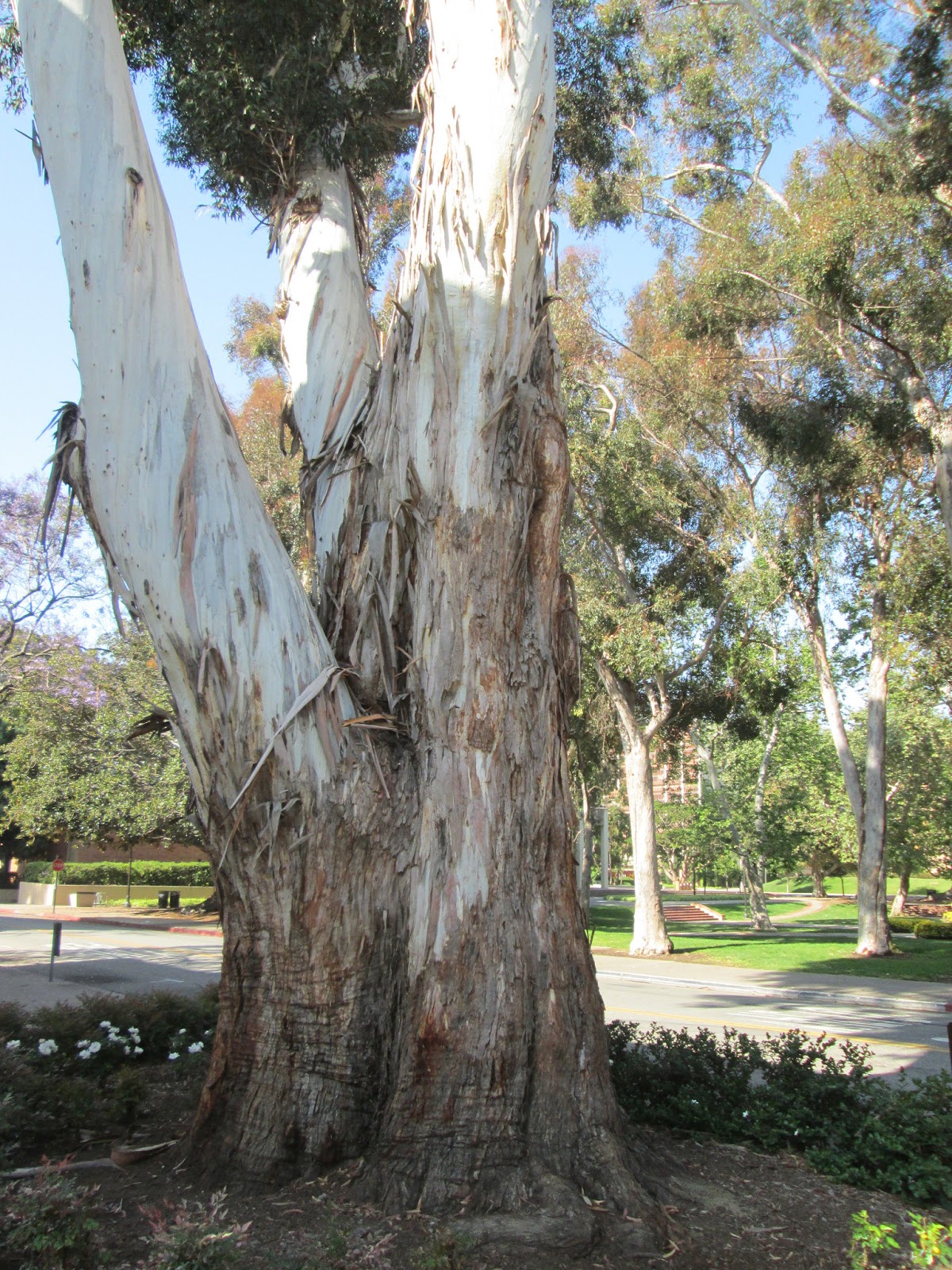
Besides which, there are gum trees everywhere. Over the top of my mental map of old ranches, villages, missions, and stars' homes, I could begin to lay a map of Australian regional references based on the Australian native trees that I see: "Oh, look there's a sideroxylon. I haven't seen one of those since Wangaratta."

The other day in Santa Monica I saw what looked like River Red Gums (Eucalyptus camaldulensis) and was reminded of Adelaide or indeed Alice Springs where they sit in the dry river beds.


I saw this smooth-trunked species Downtown and almost thought of it as another of my "cultural conjunctions". The background is the Standard Oil Company building.


This white-flowering species (Nicholii? Look close) was sighted down near where Topanga Canyon comes out at Malibu.
 

This specimen was in a suburban garden in Encino.


In Silver Lake, I saw a yellow-flowering eucalypt that I last saw as a street tree in Alice Springs. Its natural habitat is on the West Australian goldfields.


How could I ever be homesick in this inverse of Oz? On the other hand, what if, in some sinister universe, there was a American equivalent of Murray Bail's Mr Holland (the lead character in his novel, Eucalyptus), who wouldn't let me go back to Australia until I could name and map every species in Los Angeles County!? Could be worse fates.

At UCLA
Also, at UCLA.

Outside Royce Hall, scene of Schoenberg premieres. See why UCLA reminds me of ANU?


If you liked this blog, others of mine on Los Angeles are:

A daily reminder, 1 April 2011
When you take a closer look, 21 April 2011
The frame (thoughts on the Getty Center), 24 April 2011
A light on the hill (the Reagan Library), 30 April 2011
A couple of snapshots (Malibu and the Valley), 1 May 2011
More to love about LA, 6 Jan 2012
Walking with stars, 10 Apr 2012
En plein air and a little elan, 16 Nov 2012
LA Substantial, 18 Jan 2013
City of Angels, 20 Jan 2013
City of Nets? City of Dreams, 31 Jan 2013
Rounding off - LA vignettes, 2 Feb 2013
Loving the architectural reminders of old Los Angeles, 4 Feb 2013
Cultural conjuntions, 4 Feb 2013
Cultural conjunctions II, 6 Feb 2013

Non-linear lessons, 7 Feb 2013
More than whimsy - Contemporary Art, 8 Feb 2013
Life and movies?, 10 Feb 2013
But, whimsy indeed, 12 Feb 2013
Pockets of charm, 13 Feb 2013
La Reina de los angeles, 18 Feb 2013

Others of mine on Australia are:

Considering the aboriginal land of Altjira, 20 May 2012
Opera in a land of Song, 29 July 2012
Drowned Man in a Dry Creekbed - Happy New Year 1993, 6 August 2012
Virginia in the Desert, 10 Sep 2012
 Victory over death and despair in a bygone age (thoughts on John Strehlow's The Tale of Frieda Keysser), 5 Nov 2012
A trip through the yellow inland, 6 Jan 2013
Observations from the Hill, 12 Jan 2013
City of Nets? City of Dreams, 31 Jan 2013

Thursday, February 7, 2013

Non-linear lessons

Some years ago I learnt not to listen to Beethoven's Emperor Concerto from the beginning. I'd heard it so often I would vague out, find myself compiling tomorrow's shopping list or something, before the end of the exposition. I'd be lulled into a dream by the predictable unfolding of the familiar landscape. Catching snatches of the piece coming out of the open window of someone's living room, however, or absent-mindedly flicking on a radio gave me a new appreciation of the piece. Why? Because what I'd experience when entering the piece in midstream was the actual hue, the full impact of the piece without the dulling of any mental expectation.

This has got me thinking about the mosaic manner in which we most effectively learn something. I'm getting to know Los Angeles in a similar fashion: "Oh, so if that's Westwood, Beverly Hills must be over there" etc...

This has got to be one of the most lovely confusing places I've ever had to orientate myself in. I think it has something to do with mountains on all sides of the San Fernando valley. I wonder how I can be approaching mountains when I've just left mountains behind. But gradually I've begun to piece the city together (it helps to have gotten used to the sun being in the south of course). I've now got a picture in my head of a coast that goes south-east to north-west, then east-west, and then south-east/northwest again. There is a big ring of mountains sitting on the flat bit of coast (bounding the San Fernando Valley), then to the east of that a break leading to the coastal plain where Downtown and Hollywood etc lie. I got a buzz coming home the other day when I knew we were about to hit the Sepulveda Pass into the Valley and "if my predictions are correct, the Getty Center will be up there on the left. Westwood and UCLA are over there on my right, and Santa Monica is behind us to the left." I'm working on the city inside out, rather as a composer does when he's working on a piece and the entire shape isn't yet (can I say "boringly"?) guaranteed.