Showing posts with label Civil War. Show all posts

Friday, December 16, 2011

The 200 year-old debate

In Savannah, I was often fascinated by the after-effects of the Civil War - the house where General Joe Johnston lived for example:


(Out in North Carolina, we had seen the farm where Johnston had surrendered his army to General Sherman in April 1865)


Whenever we walked down Bull Street, I would also stop and take a look at Comer House, where ex-Confederate president Davis was entertained when he visited Savannah in 1886.


I was always fascinated by the way the vanquished Southern leadership was feted in after-years.

I asked a friend from Georgia how this could be, and the best explanation he could come up with (with a shrug) was: 'Family'. Of course, some family members would bristle at my word 'vanquished'. At a lecture we attended, the president of the Georgia Historical Society, W. Todd Groce, warned his audience beforehand that they might find he has some complimentary things to say about General Sherman, the Union general who occupied Savannah from December 1865 to February 1865. And there was an audible shuffle (of discomfort?) when he mentioned that actually, prior to the war, Sherman had been first president of LSU (Louisiana State University).

I admit I, too, wonder to what extent the Southern leadership was vanquished. To a large extent they were incorporated. The stars and stripes flies outside Johnstone's house.
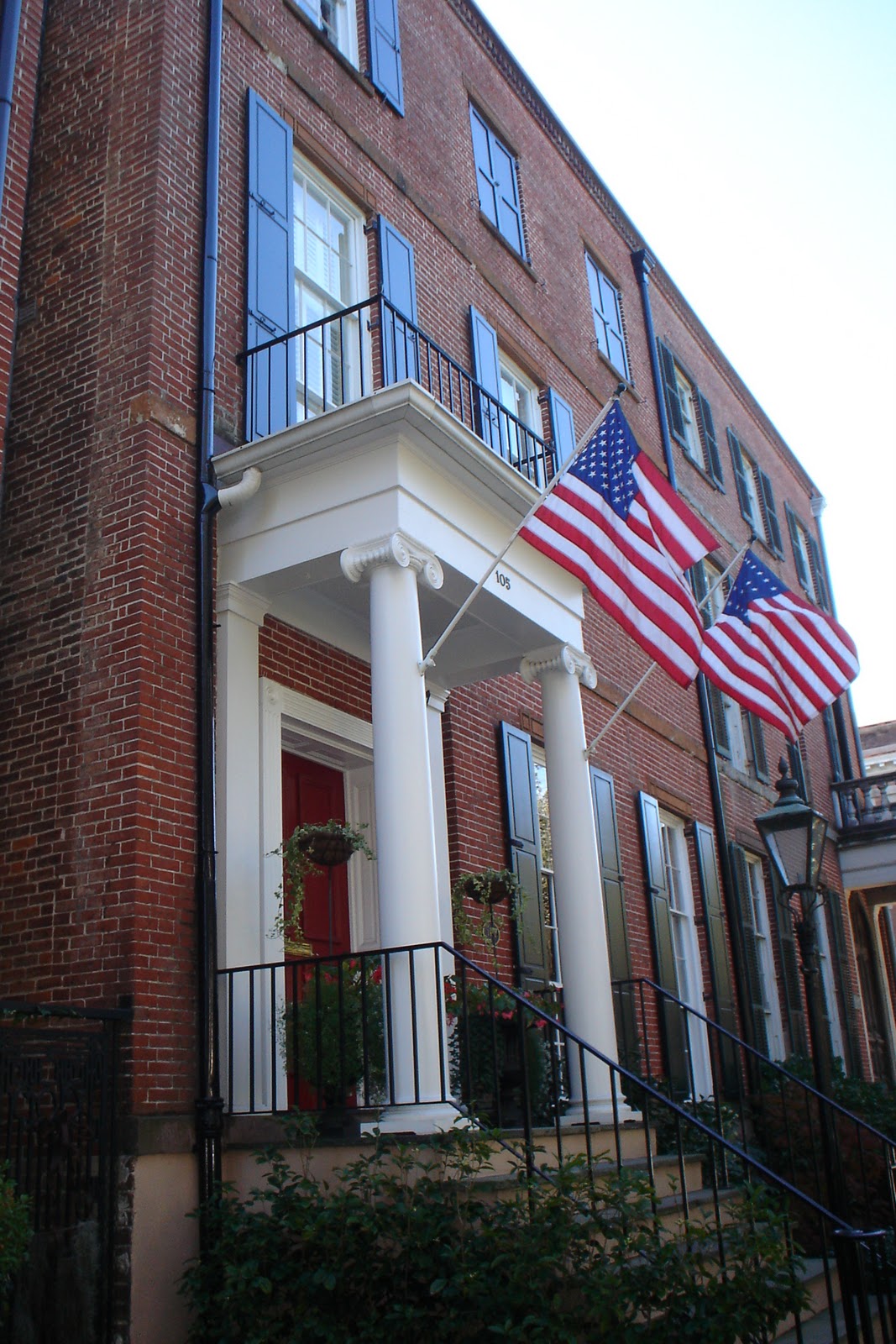

(Of course, Johnston later served in federal administrations.) But I wonder if this approbation is an example of Lincoln's 'let 'em up easy'?


Or is this process of lauding Confederate leaders a way of legitimizing States' Rights as an authentic strand of American life? In the movie Gettysburg, 'General Longstreet' says, 'We should have freed the slaves and then fired on Fort Sumter.' That would have focussed the issue. Fact is, though, they didn't [free the slaves], and they couldn't keep it [the issue of slavery] 'in the family'.

Which, given that Americans live with this oppositional view in their midst, got me thinking about the place of contrary views in American society. Because, as another example, if you think about it, the major American political parties have become their polar opposites over the years. I know I was dismayed to learn, some years ago, that the 'big government' Democratic Party traces its origins back to Jefferson who was a proponent of States' Rights and 'government is best which governs least'. On the other hand, the greatest presidents from the small government, States' Rightist Republican Party were Lincoln and Teddy Roosevelt, who enlarged the federal government, enforcing its authority and regulating industry respectively. Do the supporters of either party recognise these flips? Or recognise them as flips? As someone said on the morning chat show Morning Joe the other day the debate between state and federal government and Strict Construction vs Hamiltonian interpretation (the federal government is empowered to do whatever is necessary to achieve its ends under the constitution) is 200 years old. Is embodiment of this debate, without any requirement to be consistent, enough to register authentic Americanness?

On Monday we left Savannah and took the bus to Atlanta (reversing the path of Sherman's march to the sea. I can see why it would have taken him so long to cover the distance.)


In Atlanta, ninth-largest metropolitan area of these united States, we found the following sign proudly displayed on the corner of Spring and Peachtree Streets:


Here were the outer defences of Atlanta in 1864.

Wednesday, October 26, 2011

Breaks to new mutiny?

 Two households, both alike in dignity,
In fair Verona, where we lay our scene,
From ancient grudge break to new mutiny,
Where civil blood makes civil hands unclean.
 - Shakespeare, Romeo and Juliet: prologue


At Manassas, site of the first Civil War battle


we met a woman who said she reckons another Civil War is coming, 'the way this country's going. It's getting worse by the day.'

I didn't ask her to elaborate. I made certain assumptions. We were in Virginia, which has always resented the federal government. We were in an historic downtown which looked reasonably prosperous. When you run into someone in a CBD who says what she said, they're usually railing about federal taxes (well, taxes state and city as well, but the feds cop it). And we're in an environment where the other side's motives are always purely venal and evil ('the Tea Party are stupid'; 'the Occupy Wall Street people are a mob', although they're actually unhappy about many of the same things). This is a superstition maintained on both sides of politics of course - it is no longer the case that people can concede that both sides have something to offer and that each falls short - so I figured I didn't need to query further.

We are now in Charleston, nine hours away by train from 'Orange Cones; No Phones' and signs of Fall - changing colours, squirrels getting busy carrying oversized nuts, pumpkin lattes...


We've put away winter clothes for now


I wonder if the unhappiness that is expressed to us is at root a symptom of the tectonic plates of American tribalism shifting; the distrust and absolutist opinions a natural consequence of a society opening up its former divisions, an anxiety about the fact that new and more people are these days, as they once sang in the fields round here, 'gwine to sit down at de welcome table'.

Thursday, October 20, 2011

Notes on the State of Virginia

Excuse the Jeffersonian title, but after a visit to Richmond, I am wondering what I might say in a modern-day version of the Notes.

Clearly the history of the place is overwhelming. Richmond is virtually the historical navel of the country. Go down to the water's edge (to the banks of the James) and, not only do you get a sense of the bridges that once carried Confederate troops over it, but you read that Richmond (Powhatan) was the navigable limit of the James reached by Captain John Smith in 1608.

Go out to Hanover Tavern, half an hour away - Hanover for George I, by the way - and you read how in 1781, Lord Cornwallis and General Washington missed each other here by a matter of days, only to turn east a mile south of here and meet for the final showdown at Yorktown. Stuart rode around McClellan's forces stationed here at Hanover Courthouse in 1862.


In Richmond, capital of the old Confederacy, I also get a sense of having stepped into the other side of the great debate (to coin a phrase for the Civil War). Am I imagining it, or do I now really get a sense of what the South must feel, just from wandering around, adopting an awed attitude to DC (the monolith up the road), or from walking along Monument Ave, that grand thoroughfare, and seeing the statues erected to J.E.B. Stuart, Robert E. Lee, Jefferson Davis and Stonewall Jackson in the late 19th century?


It is hard to believe the South lost, or that these men were 'in rebellion', so highly are they honoured. And at first I thought it was sympathy for the underdog that had possessed me. 'He lost his life defending the South', read a headstone in Hollywood Cemetary, and I thought, 'That's it. You automatically admire those who are defending their land against the invader.' Except that, then I reminded myself that the South fired first. The strength and persuasiveness of this 'homage' says something about the power of the mere act of 'veneration'. You don't even have to agree with the honoree to be affected; the veil of romanticism has been created.

I kind of get it - States' Rights. If you think of the states as separate countries, it makes sense. No wonder so few Americans have passports - California, Maine, Louisiana, Wyoming... are sufficiently different to sustain interest. When Jefferson said, 'my country', he mostly meant 'Virginia'.

And this was the experiment in government the Virginians wanted to make - 'separate countries' loosely bound by a few, undeniable but limited, continental concerns. As a Virginian explained, to Virginians the federal government may only exercise the powers specifically delegated to it under the Constitution. (I haven't yet asked a Virginian why a Virginian, Washington, accepted Hamilton's definition of implied powers. And the John Marshall House was shut when we were there,


so I didn't get a chance to hear how the guides presented the longest-serving Chief Justice's work, which basically, in most of his judicial decisions, cemented a stronger union.) But the looser form of federalism is meant to work. Is it the case that it hasn't been allowed to? And is there a resentment that it was Virginia, so slighted, that produced four of the country's first five presidents? (In Fredericksburg, we saw James Monroe's 'town plot'.)


As I say, I kind of get it - States' Rights. 'So do I', said an African-American woman we met, 'but to me it means "Jim Crow".'

But yet, I liked Richmond. It has leafy, walkable suburbs, with cafes.


It has villages and cinemas. When we were here in 1996 the city seemed very run down, and yet there is renovation everywhere.


There is history galore.


Jefferson modelled this, the Capitol, on the Maison Carree. Here former vice president Aaron Burr was tried (by John Marshall) for treason. Here, Lee received his commission.

 Parts of it reminded me of Melbourne: Royal Parade...


or Sydney Road, Coburg or North Carlton. Perhaps it's not a superficial comparison. At first I put it down to the presence of a university. Find a nice village here in the States, and you're bound to find a university - Berkeley, San Luis Obispo, Princeton, Chapel Hill...But beyond that I put it down to old English ideals of town living - harmony, community...

Of course, as long as you weren't a slave. But visiting here has made me want to look deeper into this. What makes Richmond tick? And what is a true history? And now something else occurs to me. Jefferson, who owned property in slaves, specifically omitted 'property' when he copied George Mason's list of 'unalienable rights' into the Declaration.