Showing posts with label Mt Vernon. Show all posts

Saturday, March 30, 2013

Los Angeles whimsy v


Walking up through Koreatown the other day, I came across this on the corner of Beverly and Vermont -

Looking east back toward Downtown along Beverly Blvd

a replica of George Washington's Virginia home, Mt Vernon.


No views of the Potomac River from Beverly and Vermont, though.

You could call this whimsy (I've made it part of my series), but perhaps it's serious. It is remarkable how much extolling of Washington goes on here in the US - streets, cities, mountains, states named after him. A kneejerk quip might be "Thank God he won!" Because he lost just about every battle he commanded. And military buffs will tell you that he wasn't such a great general; he just waited till the British made a mistake - the fatal one - when they got their backs to the sea at Jamestown.

Which, of course, is his greatness - the ability to wait, to stand firm, the extraordinary, almost superhuman endurance. Bruce Wolpe, in the Sydney Morning Herald, once said that in this day and age, when we are cynical about political leaders, George Washington truly was extraordinary. And I'd agree. He was a monument before he was ever marmorealized. And it's not just to do with military leadership. It's also to do with the sober presiding over the creation of a new republic. I sometimes wonder what Washington would make of present-day American attitudes to taxation. In his 1787 Circular to the States, he asked for the 'mutual concessions which are requisite to the general prosperity'...

At any rate, I wonder if my latest example of Los Angeles whimsy is actually kitsch. Or is it genuine hommage?

If you'd like to read my thoughts on Mt Vernon itself, please see Let's Not Forget They Were Farmers at:

http://gordonkaltonwilliams.blogspot.com/2011/10/lets-not-forget-they-were-farmers.html

And if you like my blogs, please vote for Loving Oz and the US in the Australian Writers' Guild's Best Australian Blog competition at:

 http://www.surveymonkey.com/s/BAB2013


Friday, October 7, 2011

Let's not forget they were farmers

Of course, the founding fathers were also - a lot of them - slaveowners, but I have always appreciated the fact that they understood harvests, tides, seasons, flowerings. Most were farmers.

I find it moving that there are still native trees on Mt Vernon that were planted by George Washington himself.


And I've always been touched by the passages in the founders' letters where they discuss farming and husbandry among affairs of state: a new crop rotation method, a new form of plough, Jefferson discussing the form of government in a letter to Washington and then informing his fellow Virginian that 'asparagus has just come to table' (out west, in the Piedmont).

The fact that the founders were farmers tells us a lot about the country they envisaged. They managed little fiefdoms. Washington was so traumatised (not too strong a word I would suggest) by the inability of the individual states to reliably finance the continental army during the Revolution that he urged a strong central government, but should we temper that knowledge by acknowledging also that they probably saw life on this broad continent as a series of little settlements?

And as for Jefferson's ideal of agrarian democracy (a piece of land for each man to work - as he scribbled on a piece of paper that is now in the Library of Congress), if people had actually achieved it, might we have continued to adhere closer to a remembrance of the natural world? On the other hand, could every individual in today's 300 million-strong population have 'a little farm to work'? And did Native Americans appreciate the idea that they should be taught agriculture in order to be able to work smaller plots of land, surrendering their vast domains for Europe's starving thousands?


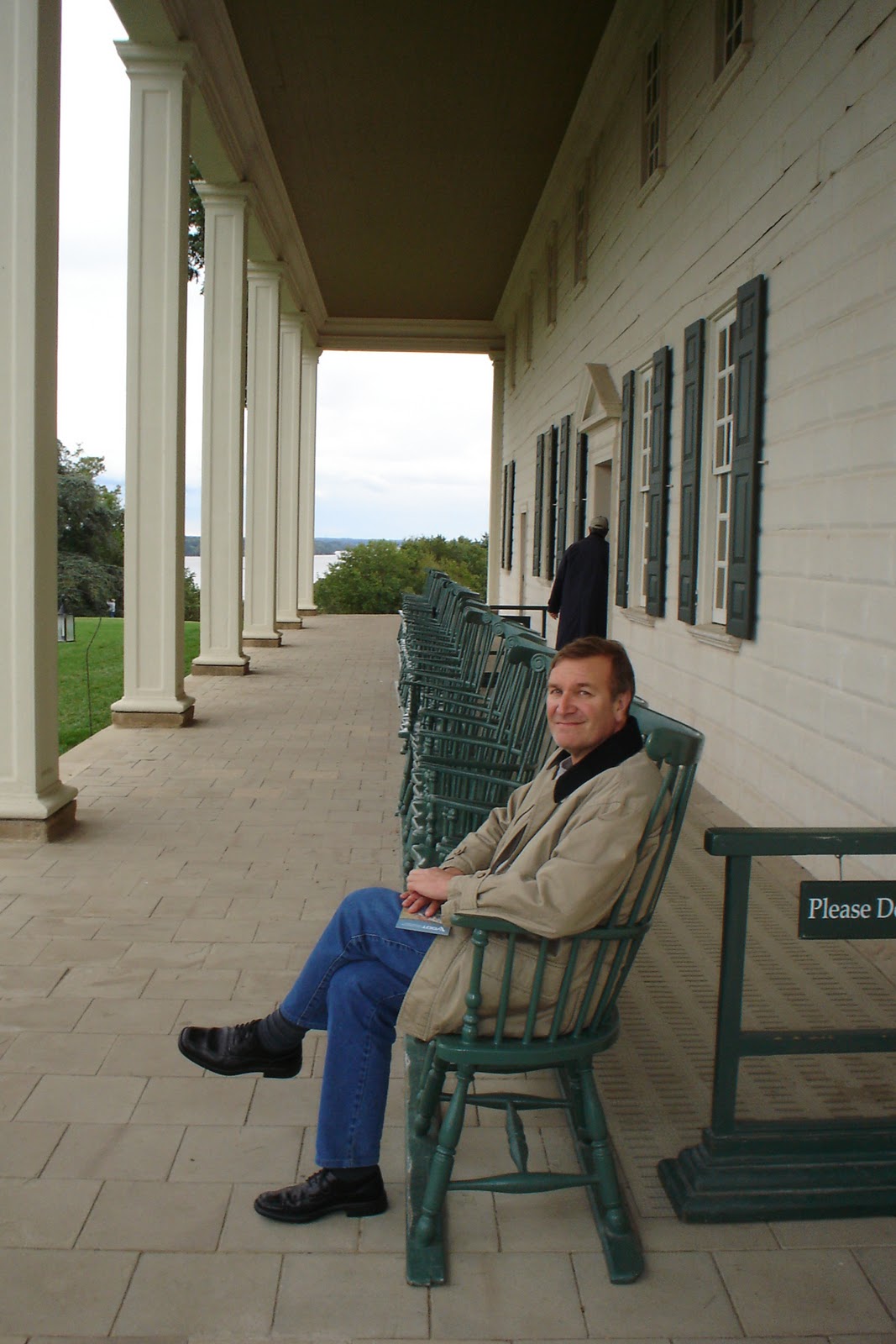
We went out to Mt Vernon (Washington's home), and I sat on the porch.


In 1798 Washington wanted John Marshall (the future Secretary of State and future Chief Justice) to run for congress. Marshall was unenthusiastic; he had just begun his law practice. Washington worked on him at Mt Vernon for several days to no avail. On the final morning of Marshall's stay, he came to say goodbye to the general on this porch. Washington, who had a great sense of theatre, had put on his full dress uniform. It instantly said to Marshall, I could have stayed here in my favourite place on earth, but I have always put service of the nation first. It worked. Marshall ran for election.

The view you see from here today is essentially what Marshall and Washington would have seen.


The Maryland shore is virtually untouched. You can see it through the colonnade. The swamp oak in the foreground below dates from 1770.


According to one of the guides, in the 1950s, Maryland wanted to put an oil refinery opposite; it was Maryland, their land. But the Ladies Committee of Mt Vernon lobbied the federal government and the government acquired the land. Today it is a federal reserve. Because of that you can just about see what Washington and Marshall saw on the opposite bank for the entire turns of your heads. Just as well for tourists these days that the 1950s federal government took Washington's more continental view.