Showing posts with label Alice Springs. Show all posts

Tuesday, August 6, 2013

Drowned Man in a Dry Creekbed - Happy New Year 1993

Since it's the 6th, I thought I'd reprint this story which I first published this time last year.

My friends, Neil and David Bell, and I were out on the path of the Kungka kutjara, a Central Australian travelling songline  – one of those epic Central Australian chants that are meant to have come into being in the Tjukurpa (eternity), or Altjira as the Aranda call it. We were hoping, perhaps too blithely, to make a radio program about it for ABC Classic FM.

We had got some recordings down at Mutitjulu, had just dropped N and B off at the Loritja camp at Hermannsburg and were heading back towards Alice Springs. We sang some of the chant as we rattled over the corrugations of the dirt road, a bit of the song that stuck in our memories – ‘Yulatji luma, Kunpatji luma...’ – not so much as to ‘bring the country up’ as Bruce Chatwin observed aboriginal travellers doing, as to make the time go faster.

As we turned a corner near Ellery Creek we came across a burning car. A Western Desert man was standing beside the car trying to beat out the flames which had already spread, quickly in this heat, to the grass by the side of the road.

Ellery Gorge, photograph: courtesy Andrew Schultz
Neil pulled up and spoke to him. ‘Nyaa palyanin?’ and they had a conversation. As we pulled away, David, Neil’s son, said, ‘Did he say someone’s dead down there?’

We descended to the creek and saw two women stripped to their waists, wailing and hurling dirt in the air. In the dry creek bed we saw a man cradling another in his arms.

A carload of people had been driving from Alice Springs to Kaltukatjara (Docker River). They’d been drinking. At Ellery Creek they jumped into a waterhole and this fellow hadn’t come up.

‘How long has he been like this?’ we asked.

‘Half an hour’.

Back at Hermannsburg the police looked as if they’d hurriedly thrown their khaki uniform shirts over shorts and thongs. It was New Year’s holiday. We took the man’s body inside the station. Then there were a series of interviews. Neil translated, but there were still misunderstandings. ‘Name?’ the police asked one interviewee. ‘Stephen Bradshaw,’ he said (I use a fake name). ‘Well, if you’re Stephen Bradshaw, who’s he?’ they indicated the body bag and opened it. They had identified the deceased by the cicatrice scars on his shoulder. But distinguishing Central Australian aboriginal people by scarification on their shoulders will not get you far.

The police had to go back out to Ellery Creek and gave David and me a choice: sit outside in the 50 degree (122F) heat, or in here with the body. We chose the air-conditioning.

We sat in silence. But I was coming to understand what T.G.H. Strehlow had meant when he said that nowhere else in the world are death and eternity bound together so tightly as in Central Australia. The eternal myths, such as Kungka kutjara, are present in the daily lives of living people; death is out-in-the-open and an all-too-frequent occurrence.

At the end of the day, after five or six hours of witness statements, I was standing outside watching the sun set, waiting to finally get back on the road to Alice Springs. The driver of the Docker River people’s car came over, the car that I later learnt had been burnt in grief. I said, ‘Not a good way to spend New Year’s Day.’ He said, ‘Bad day for me.’ I wondered why him in particular, but was told later that as the driver of the car he could pay for this in a big way. In the past he might have been speared. How was it his fault? When the drowned man’s mother had been dropped off at the Loritja camp, the women had come over and struck her. I don’t know how they’d have known what happened. Something specific in the way she was wailing? But why strike her? These were graphic illustrations of the Central Australian concept of ‘duty of care’ and ‘tribal responsibility’. Awesome obligations of reciprocity necessary I suppose in an environment which will kill an isolated human if they’re not paying attention.

And all we had wanted to do really was make a radio program about an Australian form of music. To help Australians gain a bit more insight into the cultural riches of our land. ABC Classic FM never got that radio program on the Kungka kutjara, but we certainly got more than we had bargained for.


If you liked this blog, others of mine touching on Central Australia are:

Journey to Horseshoe Bend - ten years on, published 28 May 2013

@  http://gordonkaltonwilliams.blogspot.com/2013/05/journey-to-horseshoe-bend-ten-years-on.html

Carving up the pie, 17 December 2012
Life-changing statements, 16 December 2012
Ah, Nathanael, 29 November 2012

Victory over death and despair in a bygone age (thoughts on John Strehlow's The Tale of Frieda Keysser), 5 Nov 2012
@  http://gordonkaltonwilliams.blogspot.com/2012/11/victory-over-death-and-despair-in.html

Virginia in the Desert, 10 Sep 2012
Opera in a land of Song, 29 July 2012
Conocotarius, George Washington, 5 July 2012

Considering the aboriginal land of Altjira, 20 May 2012
@ http://gordonkaltonwilliams.blogspot.com/2012/05/considering-land-of-altjira.html


Sunday, August 4, 2013

Two deserts

There is something about having a line of hills on the horizon, like this, the view of Mt Sadadeen from Stott Terrace over the old Melanka Guest House guest house site in Alice Springs.  


Here in Los Angeles, they're mountains - the San Gabriels behind the Verdugos, but I look forward to seeing these two high lines every time I go down to North Hollywood Metro Station.


So much for comforting similarities, but there are some 12 million people in Los Angeles county. I also like seeing 'just horizon' when you're driving certain places around Alice.


Monday, July 1, 2013

Escape from monolinguism

Back when I used to live in Central Australia, I always used to relish the fact that the main streets of Alice Springs were full of the sound of Arrernte, Pitjantjatjara and Warlpiri. Here I love that LA is bilingual and I hear equal portions English and Spanish around me.


Other blogs of mine on Central Australia are:

Journey to Horseshoe Bend - ten years on, 28 May 2013
Life-changing statements, 16 December 2012
Ah, Nathanael, 29 November 2012
Victory over death and despair in a bygone age (thoughts on John Strehlow's The Tale of Frieda Keysser), 5 Nov 2012
Virginia in the Desert, 10 Sep 2012
Drowned Man in a Dry Creekbed - Happy New Year 1993, 6 August 2012
Opera in a land of Song, 29 July 2012
Considering the aboriginal land of Altjira, 20 May 2012

Monday, April 29, 2013

An antipodean's change of view


For some reason, these scenes out at Santa Clarita reminded me of the kngwelye (Wild Dog Dreaming) side of Alice Springs


and then the hills rising up back of Hollywood do the same thing for me.


In a sense Los Angeles is my antipodes.


Sunday, January 20, 2013

City of the Angels


I hardly need words. It's a beautiful city, I don't care what anyone says.

Honolulu Ave, Montrose

with "Alice Springs" scenery, twenty minutes from Downtown
The view from a Monrovia shopping mall carpark for heaven's sake
and great, quaint architecture at Toluca Lake

If you liked this blog, others of mine on Los Angeles are:

A daily reminder, 1 April 2011
When you take a closer look, 21 April 2011
The frame (thoughts on the Getty Center), 24 April 2011
A light on the hill (the Reagan Library), 30 April 2011
A couple of snapshots (Malibu and the Valley), 1 May 2011
More to love about LA, 6 Jan 2012
Walking with stars, 10 Apr 2012
En plein air and a little elan, 16 Nov 2012
LA Substantial, 18 Jan 2013
City of Nets? City of Dreams, 31 Jan 2013
The combination of effects, 1 Feb 2013
Rounding off - LA vignettes 1, 2 Feb 2013


Monday, December 17, 2012

Carving up the pie

I'm often fascinated by the 'taxonomical' categories that take us beyond the rational divisions of life.

I thought of this again when we visited the Francis Bacon exhibition at the Art Gallery of New South Wales on Sunday.

http://www.artgallery.nsw.gov.au/exhibitions/francis-bacon/

You saw Bacon returning time and again to similar themes - Crucifixion, nailing, meat, carcasses, flesh, crumpling (as in crumpled paper)...

In Singing the Land, Signing the Land, a book brought out some years ago by Helen Chambers with the Yolngu community at Yirrkala and David Wade Chambers, the authors pointed out the way varying divisions of life prove the fictional 'constructedness' of our worlds.

 http://singing.indigenousknowledge.org

The Dyirbal people of Queensland, they mentioned, have a category that includes men, kangaroos, most snakes, storms, rainbows and boomerangs, and another which includes women, fire and dangerous things. There are aboriginal people who would disparage our categorization of emus as birds; emus don't fly. How can we even think of dividing up the world this way?

I wonder what the categories of my blogs might say about me - Central Australia, Sydney scenery, Aranda culture, AFL football, Washington, Jefferson, Wagner opera, Philippa Duke Schuyler, Inner West vignettes...

The closest I have to a photo of Gap Road. This is actually Stott Terrace, which crosses. Gap Road runs perpendicularly to this towards the gap in the ranges on the left of the picture.

And what creates these fusions. For example, I have a strong memory dating from 1983 of sitting in my friends the Christians' house in Gap Road Alice Springs; we all ate Toblerone, drank Earl Gray and listened to Side 4 of Solti's recording of Mahler's Eighth Symphony (the bit beginning with René Kollo singing, 'Blicket auf zum Retterblick (Look up to the redeeming sight...)'

love the use of the fish-eye lens to capture the whole cast of Mahler's 'Symphony of a Thousand'
Mahler's Eighth, with its texts of Veni creator Spiritus and the last scene from Goethe's Faust has nothing to do with quickly-melting chocolate, steaming tea and Alice Springs on sweaty summer nights, but its last half hour is forever wedded to these memories of mine.


If you liked this blog, others of mine on Central Australia are:

Life-changing statements, 16 December 2012
Ah, Nathanael, 29 November 2012
Victory over death and despair in a bygone age (thoughts on John Strehlow's The Tale of Frieda Keysser), 5 Nov 2012
Virginia in the Desert, 10 Sep 2012
Drowned Man in a Dry Creekbed - Happy New Year 1993, 6 August 2012
Opera in a land of Song, 29 July 2012
Considering the aboriginal land of Altjira, 20 May 2012


Monday, September 10, 2012

Virginia in the desert

I've often tried to account for my intense interest in the USA. As a kid in Australia in the 1960s, I grew up with American TV - Combat (with Vic Morrow), Lee Marvin in M-Squad, The Three Stooges, Get Smart...It was that time in Australia's history when Great Britain was losing its cultural dominance.

But Australia was a long way away from the US then - so far away that in the 1956 Stanley Kramer movie, On the Beach, the crew of an US submarine could survive (for the time being) the nuclear cloud that had descended over the northern hemisphere because they were in Melbourne, far far away, at the time. There were no daily flights to LA or San Francisco when I was a kid, much less Qantas's recently-launched direct flights to Dallas. America was almost exotic.

My interest in the US could have gotten a good kick-along I realise though from having lived in Alice Springs in Central Australia, in the early 1980s.

Looking south down the Todd River (Lhere Mparntwe) towards Mt Sadadeen on the left and Mt John, behind. Photo from Wikipedia, uploaded by Shiftchange. It is Mt John that I first noticed glowing at night (see blog Location, Location, 23 August) while crossing the causeway (foreground) at night in 2006
Alice Springs, frozen in time around 1981-2, would make an interesting sociological study. You had your 'foreign legions', the teachers from Queensland and Adelaide doing their couple of years up north to 'repay' a Commonwealth Scholarship, or the clique of Melbourne barristers and QCs who were doing a stint working in the newly brought-in aboriginal Land Rights (some of them later Victorian Supreme Court judges; Land Rights was their rite of passage).

Alice Springs then was a country town that had to be a city. There were no traffic lights, but all the capital city daily newspapers were flown in from the various coastal cities every morning and you could buy The Age or The  Courier-Mail or The West Australian by ten and catch up with the day's news over a coffee in Todd Street at the same time as people in Melbourne and Brisbane and Perth did.

There was the aboriginal 'tapestry' too, of course - women sitting cross-legged under street trees collecting seed; people conversing in sign language across either side of Stuart Highway (the upward rotation of a loosely-held right thumb and forefinger to denote enquiry and so on...); the various reminders of a network of tracks, the paths of legendary creator caterpillars and dogs and 'uninitiated boys' who had passed this way in the Beginning, pre-dating streets and roads and bitumen; the metamorphosed body of the dog creator, the boulder Akngwelye thirrewe, which then stood chained off in the railway yards, but, with the widening of the Stuart Highway, is now outside a fast food outlet...

But the other element that made Alice unique then was the presence of Americans who worked 18 kilometres (11 miles) away at Pine Gap Defence Base and lived in town. Back then, strolling around Alice, you could often feel that you were walking around in the DC suburbs of Virginia or Maryland, in a little bit of Virginia or Maryland flung out into the desert.

I remember having a conversation at a cocktail party at the home of the chief of Pine Gap. There beyond the balcony was Spencer Hill and everything it reminded me of about Spencer and Gillen and their books, their description of the great engwura ceremony staged at the Telegraph Station in 1896; but my conversation this particular afternoon was about environmental pressures on Chesapeake Bay. I also remember Sallie K coming up to me in the street to exclaim, 'The president's been shot'. This was 1981. The president was Ronald Reagan. But citizens of other Australian towns would not have put the news like this. No-one would have said 'the president'; he wasn't ours. And I remember going to the home of another American one afternoon and seeing a video of last weekend's Washington Redskins-Miami Dolphins game, flown in on Monday by Starlifter (which brought in lots of other stuff as well, of course).

But the Americans also meant American music. Alice Springs had homegrown bands like Bloodwood, say, or Ted Egan accompanying himself on his cardboard beer carton. I'm conscious of the fact that there was once another ancient repertoire for the local hills and gaps and soaks and waterholes. But back in the early 80s, Alice Springs had a Big Band, squeal trumpets and all, full of American personnel. I remember playing old favourites from the Great American Songbook - Tuxedo Junction, arrangements by Sammy Nestico or Nelson Riddle, You'd Be So Nice to Come Home To...The band was in great demand. It even played once at a debutantes' ball up the road in the mining town of Tennant Creek, six hours away.

It's funny to think of the disjunctions that existed in Alice Springs in the early 1980s - videos of American Football games brought in by Starlifter, Left Hand Drives, the people who in casual conversation could share my references to Melbourne restaurants, other people living by campfire in the dry creekbed...

It really was a unique time, but convinced me in a sense that I'd already lived in America - and that if it's so nice to come home to someone, there are several places I can come home to.


If you liked this blog, others of mine on Central Australia are:

Carving up the pie, 17 December 20912
Life-changing statements, 16 December 2012
Ah, Nathanael, 29 November 2012
Victory over death and despair in a bygone age (thoughts on John Strehlow's The Tale of Frieda Keysser), 5 Nov 2012
Drowned Man in a Dry Creekbed - Happy New Year 1993, 6 August 2012
Opera in a land of Song, 29 July 2012
Considering the aboriginal land of Altjira, 20 May 2012

Thursday, August 23, 2012

Location, location

I used to say that one of my favourite places on earth was the Alice Springs Drive-In, c.1981. It's derelict now and has recently been slated for subdivision as a new suburb, Kilgariff.

 http://www.abc.net.au/local/stories/2010/05/13/2898433.htm

But it was a fantastic place to watch movies back then. Six kilometres from town, you'd sit outside in the desert night. If you were waiting for the movie to start you'd look at the brilliant starry night or the dinosaur shapes of the MacDonnell Ranges glowing in the dark (they do glow), pick up the odd whiff of eucalyptus smoke or snatch of Pitjantjatjara or Arrernte spoken around the campfires of the fringe camps around the perimeter, and then watch Hollywood movies while surrounded by Americans from Virginia or Maryland who worked at Pine Gap Defence base.

I remember seeing The Elephant Man there in 1981. The Victorian-era story of the dreadfully deformed Joseph Merrick, forced to work as a carnival attraction until rescued by the surgeon Frederick Treves and allowed to live at London Hospital for the remainder of his days, is heart-rending enough. But in the past few days I've watched again some of the scenes where Antony Hopkins perhaps first became recognised universally as a great actor. There's the scene where Treves sees Merrick for the first time. Treves, played by Hopkins, steps out of the shadows where he's been cowering and in the light a solitary tear runs down his face. How did Hopkins do that?

There is also that great scene where Treves is trying to convince Mr Carr-Gom, the administrator of the hospital, that Merrick is not an imbecile and that his needs are best-served at their establishment. He has coached Merrick in The Lord is my Shepherd, but Merrick is struck dumb when Carr-Gom visits. I'm sorry, says Carr-Gom, but he will have to go elsewhere. Outside Merrick's room, on the landing, Treves is disappointed and pensive. But he hears Merrick go on. 'Mr Carr-Gom,' he says, 'I didn't teach him this bit'. What bit is it? The bit that always gets me: 'Yea, though I walk through the valley of the shadow of death, I will fear no evil: for thou art with me; thy rod and thy staff they comfort me'.

But to get back to the Alice Springs Drive In. Here was the other great thing about seeing this movie there. The Elephant Man was in black and white. In the desert night, there was no way of telling exactly where the screen ended and the desert backdrop started. And at the very end of the film, as the sounds of Barber's Adagio stir and Merrick decides to try sleeping lying down 'like ordinary people', though it will asphyxiate him, a huge falling star fell behind the screen and sputtered spectacularly. Everybody, even those out on the perimeter, gasped at that long-ago event timed beautifully for the end of our movie. 

Monday, August 6, 2012

Drowned man in a dry creek bed - Happy New Year 1993


My friends, Neil and David Bell, and I were out on the path of the Kungka kutjara, a Central Australian travelling songline  – one of those epic Central Australian chants that are meant to have come into being in the Tjukurpa (eternity), or Altjira as the Aranda call it. We were hoping, perhaps too blithely, to make a radio program about it for ABC Classic FM.

We had got some recordings down at Mutitjulu, had just dropped N and B off at the Loritja camp at Hermannsburg and were heading back towards Alice Springs. We sang some of the chant as we rattled over the corrugations of the dirt road, a bit of the song that stuck in our memories – ‘Yulatji luma, Kunpatji luma...’ – not so much as to ‘bring the country up’ as Bruce Chatwin observed aboriginal travellers doing, as to make the time go faster.

As we turned a corner near Ellery Creek we came across a burning car. A Western Desert man was standing beside the car trying to beat out the flames which had already spread, quickly in this heat, to the grass by the side of the road.

Ellery Gorge, photograph: courtesy Andrew Schultz
Neil pulled up and spoke to him. ‘Nyaa palyanin?’ and they had a conversation. As we pulled away, David, Neil’s son, said, ‘Did he say someone’s dead down there?’

We descended to the creek and saw two women stripped to their waists, wailing and hurling dirt in the air. In the dry creek bed we saw a man cradling another in his arms.

A carload of people had been driving from Alice Springs to Kaltukatjara (Docker River). They’d been drinking. At Ellery Creek they jumped into a waterhole and this fellow hadn’t come up.

‘How long has he been like this?’ we asked.

‘Half an hour’.

Back at Hermannsburg the police looked as if they’d hurriedly thrown their khaki uniform shirts over shorts and thongs. It was New Year’s holiday. We took the man’s body inside the station. Then there were a series of interviews. Neil translated, but there were still misunderstandings. ‘Name?’ the police asked one interviewee. ‘Stephen Bradshaw,’ he said (I use a fake name). ‘Well, if you’re Stephen Bradshaw, who’s he?’ they indicated the body bag and opened it. They had identified the deceased by the cicatrice scars on his shoulder. But distinguishing Central Australian aboriginal people by scarification on their shoulders will not get you far.

The police had to go back out to Ellery Creek and gave David and me a choice: sit outside in the 50 degree (122F) heat, or in here with the body. We chose the air-conditioning.

We sat in silence. But I was coming to understand what T.G.H. Strehlow had meant when he said that nowhere else in the world are death and eternity bound together so tightly as in Central Australia. The eternal myths, such as Kungka kutjara, are present in the daily lives of living people; death is out-in-the-open and an all-too-frequent occurrence.

At the end of the day, after five or six hours of witness statements, I was standing outside watching the sun set, waiting to finally get back on the road to Alice Springs. The driver of the Docker River people’s car came over, the car that I later learnt had been burnt in grief. I said, ‘Not a good way to spend New Year’s Day.’ He said, ‘Bad day for me.’ I wondered why him in particular, but was told later that as the driver of the car he could pay for this in a big way. In the past he might have been speared. How was it his fault? When the drowned man’s mother had been dropped off at the Loritja camp, the women had come over and struck her. I don’t know how they’d have known what happened. Something specific in the way she was wailing? But why strike her? These were graphic illustrations of the Central Australian concept of ‘duty of care’ and ‘tribal responsibility’. Awesome obligations of reciprocity necessary I suppose in an environment which will kill an isolated human if they’re not paying attention.

And all we had wanted to do really was make a radio program about an Australian form of music. To help Australians gain a bit more insight into the cultural riches of our land. ABC Classic FM never got that radio program on the Kungka kutjara, but we certainly got more than we had bargained for.


If you liked this blog, others of mine on Central Australia are:

Carving up the pie, 17 December 2012
Life-changing statements, 16 December 2012
Ah, Nathanael, 29 November 2012
Victory over death and despair in a bygone age (thoughts on John Strehlow's The Tale of Frieda Keysser), 5 Nov 2012
Virginia in the Desert, 10 Sep 2012
Opera in a land of Song, 29 July 2012
Considering the aboriginal land of Altjira, 20 May 2012

GW in 1993


Thursday, July 5, 2012

Conocotarius, George Washington - eventually

I don't live in Central Australia and haven't since the 1980s. It's been an important strand in my life though, given expression partly in our piece, Journey to Horseshoe Bend. And I guess I think of Central Australia every day. I see myself there. When I am there, visiting in person, I can still see the landscape in vivid detail when I shut my eyes of a night. It's as if it imprints itself on the inside of my eyelids. I sometimes wonder whether it's to do with the power of Central Australia's colours - yellow spinifex growing in red soil, the oranges and purples, the vapoury blue of distant peaks. Aldous Huxley once advanced a theory that stained glass is used in churches because bright colours penetrate deep into our spirit.
 
But it's also the languages I miss. In Sydney I'm not regularly hearing Aranda, the language of the area around Alice Springs and Hermannsburg (Ntaria) and Horseshoe Bend. I don't hear those four or so languages you might hear as you walk down the street in Alice Springs. As an exercise to keep in touch I often rewrite the different orthographies.

As an oral language Aranda, or Arrernte, has been written several ways in the past 100 or so years. When Spencer and Gillen were doing their researches at the remote Alice Springs Telegraph Station in the 1890s they wrote down what they heard by ear.

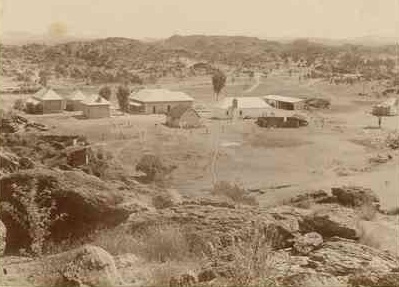
The Alice Springs Telegraph Station in the 1880s. Public domain

No linguists, they had no system for transcribing the words. And I found myself the other night rewriting sentences they'd quoted in 1899's Native Tribes of Central Australia into the more modern Eastern Arrernte script devised by the Institute for Aboriginal Development in the 1980s.

Arakutja wunka oknirra unta munja aritchika [Spencer and Gillen's translation: Plenty of young women, you look and go quickly.]

became

Arrweketye awenke akngerre unte mwenye aretyeke.

I've often found writing in different orthographies a good method for working out how unheard languages might sound. I like to think that since I know a bit of Pitjantjatjara, from northern South Australia, not far (relatively speaking) from Alice Springs, I might have a clue to how languages even further south, like Kaurna the Adelaide language, may have sounded when it was in regular use. I would imagine that all the Central and South Australian languages, those in the central strip extending even to the southern coast, emphasised the first syllable, since that is a common feature of languages around Australia (either first syllable or first syllable after a consonant).

I think you can play this comparison game with American languages. If you look to the US and compare 'Cherokee' with an alternative, preferred spelling 'Tsalagi' (first spelt as 'Chalaque' in De Soto's Portuguese narrative of 1557), you can imagine that originally the 'ch' of Cherokee was more 'hissy' like a 'ts', the 'r' was further back in the throat where 'l' sits, and the 'k' and the 'g' were not very distuinguishable.

My favourite example of this however, is the word: 'hanadahguyas'.

To this day, the Iroquois people of the US northeast address the president of the United States as Hanadahguyus. It means 'town destroyer'. When the Iroquois invited Bill Clinton to the 200th anniversary celebrations of the Treaty of Canandaigua in 1994, the letter to him was addressed to Hanadahguyus, President Bill Clinton, 'hanadahguyas' being a title that has been given to all 44 presidents because it was first given to Washington.

In 1753 young George Washington, then a colonel in the British Virginia militia, ventured into the Ohio country. He met the Seneca chief Tanacharison, or The Half-King. Tanacharison addressed Washington by the name the tribe had given Washington's grandfather. Washington wrote the word as 'Conocotarius'. They had given John Washington this name because he destroyed their villages. But 'conocotarius' doesn't look anything like 'hanadahguyus'. Could it  really be the same word? Well perhaps, if the initial 'c' in 'Conocotarius' is rasping like the 'ch' in the German 'hoch', and the 't' is between a 't' and a 'd', as in many languages. 'The 'r' might have been an indeterminable liquid, easily a 'y'. I can't explain the 'd' where 'Conocotarious has a second 'c'.

But if both words really do mean 'town destroyer' and they're just different ways of writing it, what I most like about the way Washington wrote it is that he gave it a Roman shape. 'Hanadahguyus' doesn't look like the name of a Roman hero. Conocotarius does. Was young Washington, in 1753, already monumentalising himself?

Houdon's statue of Washington in the Virginia State Capitol. Lifesize, it has been placed way above us by the pedestal.


Thursday, June 21, 2012

Prelapsarian Sydney

Among the most pleasing aspects of Australian cities is the way the natural world survives in them; the sense that an urban overlay is only recent and a couple of layers of bitumen thin. Of course I love this. I get nostalgic about the 1980s, when you could stand looking out from Mueller Street or Bradshaw Drive in Alice Springs and the desert started from there. Or, as you walked out of Tennant Creek on a moonless night there was a point where the street lights stopped and the dark hood of the desert night fell; where the only way you could tell where you were was from the texture underfoot - bitumen, bitumen, gravel, gravel, whoops ouch spinifex, gravel, gravel...But even in our biggest cities, you can experience the pinprick of nature. Cross the Yarra at East Richmond (in Melbourne), right near the Skipping Girl Vinegar sign, and you're walking through vineyards and remnant bush where signs by the walking paths warn you to watch out for snakes. Sydney has even more impressive fingers of bush reaching deep into the city and its suburbs.

Squat brown blocks of Commission flats have been demolished recently in Glebe and there, revealed for the first time in however many years, are the sandstone terraces that once stood at the head of Blackwattle Bay when the harbour at this point reached up beyond what is now Wentworth Park Greyhound Track.


Once upon a time there may have been aboriginal engravings here. Flat sandstone terraces often served the Cadigal people as galleries. And there are engravings in similar places around Sydney - huge figures of whales at Berry Island Reserve or by the walking track between Bondi and Tamarama. The one overlooking the sea near Tamarama depicts a man inside the whale. What tragic pre-European event does that record?

But this continuing presence of the natural world; the way the natural networks still connect may explain why the place I loved most in New York was that little pocket in the northwest, Inwood Hill Park, which still looks much the same as when Peter Minuit bought Manhattan Island off the Wiechquasgeck Indians.