Funnily enough we have spent quite a bit of our time in Manhattan escaping into the country, or into parts that are more like country. Last Saturday we went up to Hastings-on-Hudson on the Metro-North line, enjoying our view of the northern tip of Manhattan as we looked back over Spuyten Duyvil (as the waterway at the confluence of the Harlem and Hudson Rivers is called).
It takes about 20 minutes to get to Hastings - and then you're in real Norman Rockwell country.
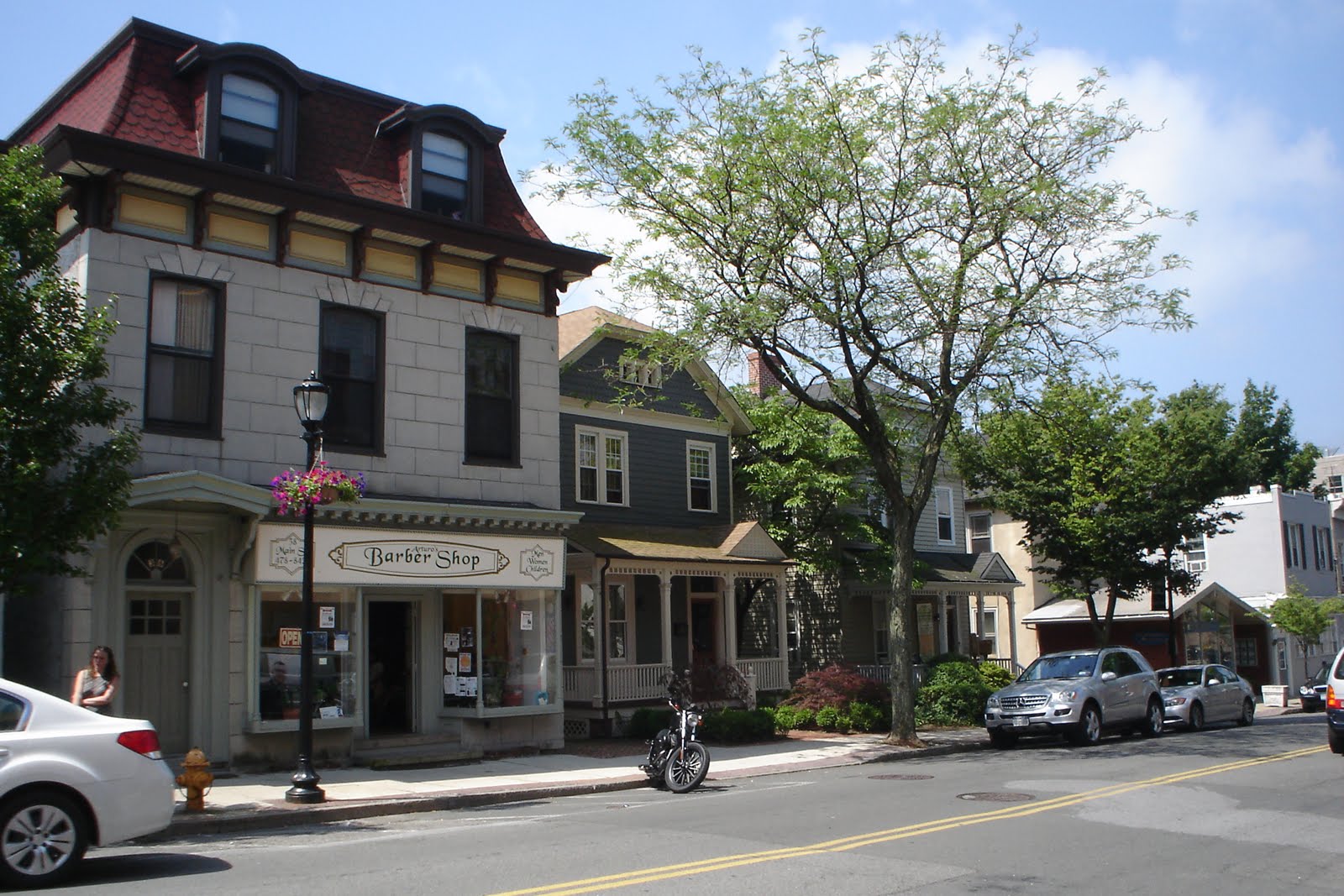
There was the diner straight out of the 50s, it seemed, and people willing to talk everywhere we went.
We spoke to a director of photography who was running a lawn sale on his property. I noticed he was selling books that I have in my collection, such as Jeffrey Shesol's Mutual Contempt, about the rivalry between LBJ and Robert Kennedy. This guy loved the Kennedys. He and his family are moving up to Cape Cod, Kennedy Country. I said, 'What happens when you get up to Cape Cod and someone misquotes Bobby, and you go to reach for your copy of Mutual Contempt?' He said, 'I know, I know, but how many times can you read a book - really, once you've read and reread it a number of times?'
This guy is one of the few people I've met who appreciated Oliver Stone's Nixon. We talked about Eisenhower and Nixon and Republicans today. 'Nixon started the EPA!' this guy said. And I mentioned how Nixon's scriptwriters guessed that Nixon hushed up Watergate because Nixon was afraid that Howard Hunt would spill the beans on the Bay of Pigs affair. There was that great scene where Anthony Hopkins blanched when he heard the name Howard Hunt mentioned in connection with the Watergate break-in: 'Howard Hunt - Jesus Christ - Howard Hunt'. And I mentioned to the DOP guy that months later I saw a copy of a new biography of Nixon, and it said that that actually was the reason why Nixon had tried to hush up Watergate: so, scriptwriters trying to deduce the dramatic truth had stumbled onto the historical reality.
Hastings-on-Hudson is a beautiful town, and all the way along the train line, which follows the Hudson, you can enjoy the New Jersey cliffs.
Clearly this is not the New Jersey which usually, famously is the butt of jokes about people living next door to chemical waste.
We stopped at Juniper's in Warburton Street for lunch, and I thought we may have butted in line, so I checked with the other woman who was waiting. With that, we sat down and talked with her and her mother for a good hour about life up here. She hates the snow, after a year in the Cayman's, but apart from that it's a very nice place. And so close to Manhattan. The DOP says he can get into town in anything ranging from 15 minutes to an hour and a half, depending on traffic. From the station you can see the George Washington Bridge.
It's tiny in the distance, but it's there, as you stand on the Manhattan-bound side for the journey home (Note the glass booth for taking shelter from blizzards.)
But what about this urge for the countryside? I've just now taken another walk through Inwood Hill Park. It's low tide and waterbirds are walking on the mudflats.
I remember in the 80s particularly when the Labor Party was trying to shed its image of the party of soft social conscience, and both sides of politics in Australia were trying to establish themselves as the party of economic management, how newspapers and interviews with politicians (and yes, people at Darlinghurst dinner parties) were always bringing up the term 'economic agenda', and how I ran into a colleague at Darwin airport who said, 'But there are other "agendas". What about seasons, tides, flowerings, seedings, fruitings?' It's one of the five or six statements that I've always remembered. And probably the sort of thing that someone would say from living in Darwin, where the people not far away in Kakadu are immersed in seasons, tides, flowerings, etc...And since then, I've always wanted to maintain a connection with the natural world.
In Inwood Hill Park, I watched as a group of boys on the cliffs on the Bronx side of Spuyten Duyvil prepared to leap into the river. Why is it called Spuyten Duyvil? Because apparently an offsider of Peter Stuyvesant, in the early days, swam across here 'in spuyt den duyvil' to warn Dutch colonists up the river of a feared British attack. He drowned.
I was going to mention the boys on the cliff to a guy sitting on a bench nearby when he slid off the bench onto his knees to pray. I thought for a second that he may have been muslim, except his hands were clasped in prayer and he was facing New Jersey, due west. It was, however, a very modern Norman Rockwell scene and would of course have been more modern had he been muslim - the Huck Finn's opposite, the scene of piety.
The DOP in Hastings told us he used to love Inwood Hill Park, but he was DOP on an episode of America's Most Wanted which told the story of a murder that took place there about 20 years ago. It soured the place for him. Bitterness wasn't the flavour, though, as I walked back through the park. People were walking their dogs, sunbathing, baseballers were batting, children were swinging. They were enjoying themselves - even 'in spuyt den duyvil'.
Showing posts with label Inwood Hill Park. Show all posts
Thursday, June 30, 2011
Monday, June 6, 2011
A walk in the woods (two blocks from Broadway)
I remember when I was a kid, seeing the road dug up outside our house in Prahran (a suburb of Melbourne Australia), and being horrified that the soil was only inches below the bitumen. I had a horror of the countryside. Now I long for the natural environment to creep into cities, and that is one of the features of Inwood, this part of Manhattan. That's New Jersey on the other side.
There may not be bark hanging in strips off tree limbs or the smell of wattle or eucalyptus smoke, but there is birdsong, a woodland smell, and a papery machine-gun rat-a-tat sound as the odd squirrel scuttles over leaf litter on the forest floor. The traffic noise of Riverside Drive is below us. For Sydneysiders who appreciate being able to walk into the bush off city streets, this is almost nostalgic.
We came across the spot where the Indian village once stood. A huge and ancient Tulip Tree (Liriodendron tulipifera) once marked this place, until it died in 1938.
The plaque is nice. It tells us that legend has it that this was the spot where Manhattan was exchanged for a few trinkets. But how much more appropriate would it be in this environmental age, and to acknowledge the prior indigenous population, to replant a Tulip Tree here. I might write to the mayor.
Friday, June 3, 2011
Insights, perhaps, from a good walk (Inwood, NY)
We're in Inwood now. Many of the people are from either the Dominican Republic or Puerto Rica, and Spanish is spoken in the street. There must be a Russian population as well, as signs in the parks are also in Cyrillic.
It's much greener up here and you can feel the past. Around here, on either the Harlem River ship canal, or a waterway with the great name of Spuyten Duyvil, the Brits' Hessian allies landed when they were trying to force the American colonial forces to flee into New Jersey or Westchester.
This is still Manhattan, but Battery Park is 14 miles away. If you walk down Broadway the entire length, you can be overwhelmed by the miles and miles of apartments, many of a similar size and bulk. I tried to convey a sense of what this felt like, the other day, by saying that as I walked down Broadway mile after mile, it was like being a cartoon character who is walking on the spot while the same scenery revolved behind me. Of course, that's to forget to look at the details and realise that many of the buildings are individually quite unique.
One of the notices in the Inwood Parks tells people not to smoke in the park. As I climbed some steps I saw some people cheerfully defying the ban - the good old lack of concern for authority. Were they Russians saying, 'Mycop!'? But it made me wonder something about the pyschology of the Tea Party. I wonder if the reason they rail so vituperously about rules and regulations is because they were the people who always used to obey the rules - to the letter and cheerlessly and increasingly begrudgingly, and now they're 'angry and they're not going to take it anymore'? It's what makes me think many of them will eventually calm down.
Subscribe to:
Posts (Atom)