Second impressions. We walked into I. M.Pei's Meyerson Center last night for the Dallas Symphony Orchestra concert. I.M. Pei? One of the most famous architects of the past century? There were signs in the foyer mentioning that the Dallas Symphony's Music Director, Jaap van Zweden is Musical America's Conductor of the Year. There are CDs on sale of the DSO's performance (under Zweden) of their commission, August 4, 1964. The piece, by Steven Stucky and Gene Scheer (mentioned also in yesterday's blog), is perceptively set on one of the most poignant days in US history, when the inspirational and tragic trajectories of LBJ's presidency (the passage of Civil Rights legislation and the disastrous Vietnam War) intersected in the discovery of the bodies of three murdered civil rights workers in Mississippi and the Tonkin Gulf incident. I figure this is a great arts city in light of all this. Then, before the concert, the mayor gets up and says that we are in the largest contiguous arts precinct in the world. Dallas is rising in my estimation.
This afternoon I walked with Raff Wilson, a colleague from the Hong Kong Philharmonic, to Dealey Plaza where Lyndon Johnson's presidency commenced (ie, after President Kennedy was assassinated there).
'This is it,' said Raff as we came to traffic lights in Elm Street. 'What, here?' This small, tight area?
It is so much smaller than I expected. The grassy knoll is not that far away and yet in film footage of people rushing it (in the direction of where they suspected they heard the shots), it looks like quite a distance. I also never realised that the road runs downhill here.
or how close Kennedy was to getting onto the freeway and away.
Across the road I looked up at the former Texas School Book Depository and it was eerie to see a guy standing in the sixth floor window from where Oswald was meant to take aim, unless you have formed the impression that he didn't do it, or that there was a second shooter by the grassy knoll.
But the theme of this blog is to question impressions. What is needed is evidence.
Would this be evidence that Dallas is on the up?
That's what I always associate public transport and light rail with.
Thursday, June 7, 2012
Wednesday, June 6, 2012
First impressions - Dallas
Arriving in Dallas yesterday, I was struck firstly by how wooded and green it is on the outskirts. This often strikes me about the US. I assume that, as a country that has been settled longer than Australia and with a more rapacious attitude toward nature, it would be over-cleared. No, that is Australia's dubious honour.
Downtown, though, is one of those bleak cityscapes that you'd find in a Jeffrey Smart painting -
carparks, glass towers,
at night: not a soul. How do US cities get to this degree of urban desolation? The people drive their cars into underground carparks and then straight up into their towers?
I crossed Elm Street last night, and there were sequences of charming old Art Deco or 1920s buildings, but it's a bit like a mouth that once had a set of good teeth.
Yet, Dallas is a cultured city. It has a symphony orchestra and an opera. Its opera company commissioned Therese Raquin, the piece by Tobias Picker and Gene Scheer that in some respects is the most successful contemporary opera - because Picker and Scheer figured out that lyricism's true province is the broad depiction of love and death.
It will be interesting to see how my impressions vary over the next few days.
Downtown, though, is one of those bleak cityscapes that you'd find in a Jeffrey Smart painting -
carparks, glass towers,
at night: not a soul. How do US cities get to this degree of urban desolation? The people drive their cars into underground carparks and then straight up into their towers?
I crossed Elm Street last night, and there were sequences of charming old Art Deco or 1920s buildings, but it's a bit like a mouth that once had a set of good teeth.
Yet, Dallas is a cultured city. It has a symphony orchestra and an opera. Its opera company commissioned Therese Raquin, the piece by Tobias Picker and Gene Scheer that in some respects is the most successful contemporary opera - because Picker and Scheer figured out that lyricism's true province is the broad depiction of love and death.
It will be interesting to see how my impressions vary over the next few days.
Monday, May 28, 2012
‘...above the canopy of stars...’ – Beethoven’s Ninth
A US colleague told me about some of the pieces they’ve got planned
next season – Schumann and Beethoven symphonies, Tchaikovsky concertos... Really, I
sometimes think artistic planning consists of taking three spinning wheels
marked ‘overtures’, ‘concertos’ and ‘symphonies’, and spinning the names of the
same two-dozen works in each genre. But it’s got me thinking about a piece I wrote
some years ago.
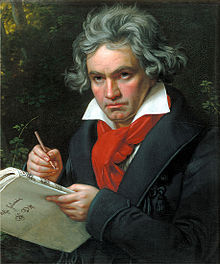
Beethoven’s Ninth was first performed 7 May 1824. In the 188
years since, it has acquired the status of a classic, which means, on one hand,
that it’s been accorded the honour it deserves. On the other, that it inherits
the perennial handicap of a masterpiece: it seems to be set in stone.
Somehow when we hear a work over and over again, we get to
thinking that such a work was always going to turn out the way it did; that it
sprang, like Homer’s Athena, ‘fully armed from the head of Zeus’. Such a belief
diminishes our appreciation of creation, dulls our responses, and may even
blind us to real insights.
Classical music buffs got excited in April 2003 when it was
reported that a Beethoven’s Ninth was going under the hammer at Sotheby’s. The
465 pages bound in three volumes may have been the manuscript used at the
premiere in 1824, the basis of the first printed edition in 1826. Beethoven’s
valued assistant Wenzel Schlemmer had died in 1825, and a number of other hands were
evident in the manuscript. ‘Du verfluchter Kerl’ (‘you damned fool’) Beethoven
wrote above the music at one point, ‘forgetting,’ as New York Times critic James R. Oestereich has pointed out, ‘universal
brotherhood [the theme of the last movement’s Ode to Joy] for an instant.’
There are changes to expression marks and various rethinkings, necessitating in
some cases the sewing in of whole new pages. There is even the odd coffee
stain, which goes to show that the creation of a masterpiece is a form of
industry; the result of labour, second thoughts, crossings out, the work of a
supervening genius, but also of a team of helpers who have to overcome the
hassles of everyday life to make a work of art which speaks beyond the ages.
We think of Beethoven as the supreme musical architect. But
in fact, Beethoven sat on the cusp of the period when composers turned from
improvisers into architects. Beethoven scholar Barry Cooper once likened
Beethoven’s manner of composition to finding one’s way along a wall which is
receding into fog in the distance and only becoming clearer as one gropes
along; and he contrasted this with the working method of Benjamin Britten (1913-1976), who described musical conception as a house becoming
clear in all its details at once. Beethoven’s way of composing seemed to offer
fewer guarantees of success; it is remarkable that he was able to make of his
pieces such integrated wholes. The fact that they are owed a lot to his galvanising genius.
So Beethoven would basically begin at the beginning - not as
common as you’d think. He’d map out the first movement, writing a sort of
synopsis of key moments (not particularly worrying about the joins), while
noting ideas for the movements ahead (and maybe other works). He would then
work on subsequent movements, filling in details behind him as ideas matured,
as understanding grew, while nudging a piece forward. With the Ninth, the very
first idea actually to be conceived (some time after the winter of 1815) was
for a fugue on a theme we now recognise as the main theme of the scherzo second
movement, the most popular movement at the work’s first performance. But not
long after that, Beethoven came up with something similar to the prophetic opening
to the symphony we now know. In the synopsis of the opening to the symphony
sketched by Beethoven in the winter of 1815/16, one sees the same doubtful
suggestion of A minor, and then the decisive landing on D minor; nebulousness
leading to decisiveness, a compositional expression of Beethoven’s customary
manner of working.
It was some time later that Beethoven got around to thinking
about the fourth movement. The famous choral finale may not have been
inevitable. One of Beethoven’s ideas around this time is rather like the last
movement of the String Quartet in A minor, Op.132 – but in D minor, the key of
the Ninth Symphony. Maybe a string-dominated Allegro appassionato was slated for this work. What a different
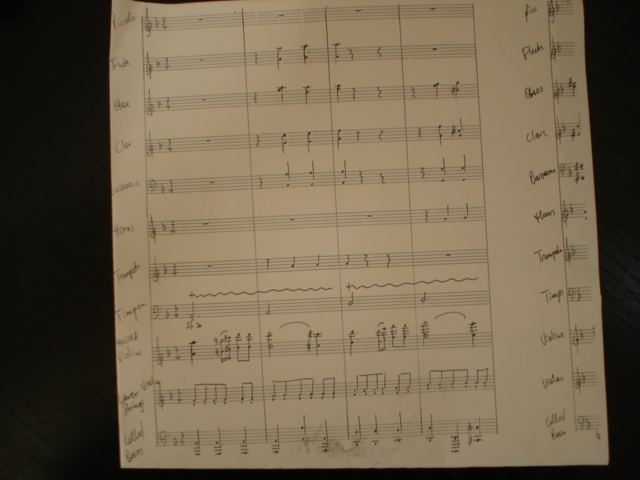
ending we would then have experienced, if this fast music [I’ve
roughly orchestrated it in a sub-Beethoven-type way] had followed upon the radiantly slow third
movement...
Audience reactions in the past 188
years may have been a few decibels lower on the applause-meter.
But Beethoven
also wrote under the 'instrumental' sketch of thsi passage the words ‘Before the Freude’, ‘Freude’ being the
first word of Schiller’s poem. Could he have been thinking, if not of a
completely instrumental last movement, of a different instrumental introduction
to the choral finale, before lighting on the brilliant idea of a choral finale
preceded by the now well-known 'horror fanfare' and ‘critical review’ of all the preceding movements?
Beethoven had been meaning to set Schiller’s ode To Joy to music for many years. There is
mention in a letter to Mrs Schiller dated 1793, over 30 years before the
premiere of the Ninth, that a young composer from the Rhineland, that is
Beethoven, was intending to set the poem. And in the sketchbooks dating from
1798 there is an early setting of the line ‘muss ein lieber Vater wohnen...’
(‘there must dwell a loving father...’), which Beethoven, back then, set to a
melody in C major.
Beethoven had of course written another Choral Fantasia, with an Ode-like
melody, not yet the perfect tune he honed for the Ninth, and based on a text in
praise of music. But why did it take him more than 30 years to finally set the
Schiller?
Political sensitivity? It is well known that Schiller had
substituted ‘Freude’ (joy) for ‘Freiheit’ (freedom) to evade the censors. But
there’s some justification for thinking that ‘Überm Sternenzelt muss ein lieber
Vater wohnen’ was the line that held most significance for Beethoven. ‘Be
enfolded, all ye millions, in this kiss of the whole world! Brothers, above the
canopy of stars must dwell a loving Father’.
This occurs as the first chorus in
Schiller’s version of the poem but Beethoven saves it for later. What he then puts
after the first and second verses is Schiller’s fourth chorus: ‘Joyously, as His
dazzling suns traverse the heavens, so, brothers, run your course, exultant, as
a hero claims victory.’ Beethoven thus edits and rearranges Schiller’s poem in
order to create a sequence that takes us effectively from earthly celebration,
to the hero who advances to the stars, to the benevolent maker (of us all?) who
must be beyond. Is this the real Beethoven, looking towards the open sky, like
the prisoners in his opera Fidelio,
newly freed from their dungeon cells?
And how would we describe the music for this passage? It is
a part of a mysterious adagio that the youthful Beethoven could not have
achieved. In his final setting of these words Beethoven makes use of sounds
that he discovered while working on certain sections of the Missa solemnis, new sounds intended
to depict something beyond the heavens, and inspire a sense of primal awe. It
seems that Beethoven’s final view of the ode To Joy had to wait until after the writing of the more
heavens-gazing sections of the great Mass in D. The significance of Beethoven
having to wait so long before setting Schiller’s poem relates, I think, to his
need to find an elevated view of the text, a more universal view.
But also more personal. Beethoven once said that music was a
higher revelation than religion or philosophy, but what is revealed by looking
behind the scenes at the Ninth? It's more than just an academic exercise. I draw on what
I’ve read of Beethoven’s abused childhood, think of the words ‘lieber Vater’,
and find great poignancy in Beethoven’s extension of a universal hope for
benevolent fathering in the slow section that precedes the tumult and applause-inducing excitement of the loud, prestissimo and oh-so familiar ending of Beethoven’s Ninth.
- first published by Symphony Services International. Reproduced by kind permission
If you are interested in reading other articles of mine on classical music, please see:
Sousa and the Sioux, 19 August 2011
Percy Grainger, the chap who "wanted to find the sagas everywhere", 17 June 2012
A Star and his Stripes - Bernstein, the populist, 29 June 2012
Igor in Oz: Stravinsky Downunder, 17 July 2012
Wagner - is it music or drama? 27 July 2012
"Beautiful...sad": Puccini's La boheme, 29 July 2012
Philippa - an opera [blog 1], idea for an opera on Philippa Duke Schuyler, 16 Sep 2012
Sunday, May 20, 2012
Considering the aboriginal land of Altjira
I haven't been blogging lately, almost as though I've felt inhibited about commenting on events or things seen here in Australia. Yet there are constant eye-openers.
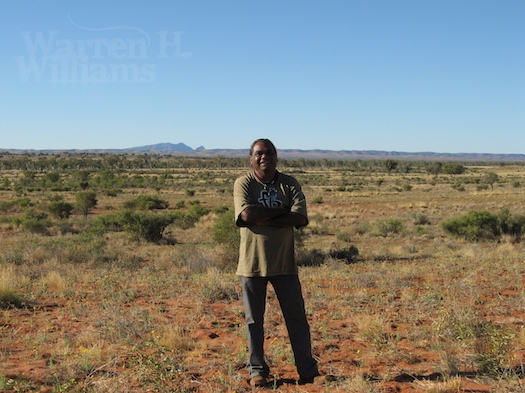
I met up with my mate, Warren Williams, down from Alice Springs a few weeks ago. He was here promoting his CD Winanjjara, his arrangement (orchestrations virtually) of traditional Warumungu Song, song material from the Tennant Creek area that he is entitled-to through his mother's father. One of Warren's geat-grandfathers, Hesekiel, was mentioned in Journey to Horseshoe Bend, the symphonic cantata Andrew Schultz and I wrote based on Ted Strehlow's novel. As usual, the conversation turned to the Arrernte worldview - who is related to whom, who can speak for what, whose country is whose...
I was reminded of this yesterday as I watched excerpts on YouTube from the Metropolitan Opera's Ring cycle. At the beginning of Act III of Siegfried, Wotan, king of the gods is now wandering the world. Still his voice is thunder (to borrow one of Homer's epithets for Wotan's Greek equivalent, Zeus). And in Robert Lepage's Met production, Wotan's staff actually flashes like lightning.
Warren told me that the great-grandfather of another great-grandfather, Johannes Ntjalka, was Kanjira, 'the thunder god'. I had read about Kanjira in Carl Strehlow's Die Aranda und Loritja-Stamme. 'But,' I said to Warren, 'you mean a reincarnation of Kanjira?' 'No', said Warren, 'the actual thunder god'. I was aware that people say that the Altjira (usually translated as Dreamtime) is maybe only a few generations back (or well, really, since I think of the 'altjira' as the eternally creative substratum of reality, it's ever-present). But commissioners in Aboriginal Land Claims have commented on their difficulty in working out sometimes whether a witness is citing a forebear or a mythological figure. Warren's information was a graphic example to me that Central Australia really is 'the land of Altjira', eternity, as Ted Strehlow once said.
And a graphic example to me also, that there really is a lot to comment on in Australia.
If you liked this blog, others of mine on Central Australia are:
Opera in a land of Song, 20 July 2012
Drowned Man in a Dry Creekbed - Happy New Year 1993, 6 August 2012
Virginia in the Desert, 10 Sep 2012
Victory over death and despair in a bygone age (thoughts on John Strehlow’s The Tale of Frieda Keysser), 5 Nov 2012
![]() |
| reproduced by courtesy Warren H. Williams |
I met up with my mate, Warren Williams, down from Alice Springs a few weeks ago. He was here promoting his CD Winanjjara, his arrangement (orchestrations virtually) of traditional Warumungu Song, song material from the Tennant Creek area that he is entitled-to through his mother's father. One of Warren's geat-grandfathers, Hesekiel, was mentioned in Journey to Horseshoe Bend, the symphonic cantata Andrew Schultz and I wrote based on Ted Strehlow's novel. As usual, the conversation turned to the Arrernte worldview - who is related to whom, who can speak for what, whose country is whose...
I was reminded of this yesterday as I watched excerpts on YouTube from the Metropolitan Opera's Ring cycle. At the beginning of Act III of Siegfried, Wotan, king of the gods is now wandering the world. Still his voice is thunder (to borrow one of Homer's epithets for Wotan's Greek equivalent, Zeus). And in Robert Lepage's Met production, Wotan's staff actually flashes like lightning.
Warren told me that the great-grandfather of another great-grandfather, Johannes Ntjalka, was Kanjira, 'the thunder god'. I had read about Kanjira in Carl Strehlow's Die Aranda und Loritja-Stamme. 'But,' I said to Warren, 'you mean a reincarnation of Kanjira?' 'No', said Warren, 'the actual thunder god'. I was aware that people say that the Altjira (usually translated as Dreamtime) is maybe only a few generations back (or well, really, since I think of the 'altjira' as the eternally creative substratum of reality, it's ever-present). But commissioners in Aboriginal Land Claims have commented on their difficulty in working out sometimes whether a witness is citing a forebear or a mythological figure. Warren's information was a graphic example to me that Central Australia really is 'the land of Altjira', eternity, as Ted Strehlow once said.
And a graphic example to me also, that there really is a lot to comment on in Australia.
If you liked this blog, others of mine on Central Australia are:
Opera in a land of Song, 20 July 2012
Drowned Man in a Dry Creekbed - Happy New Year 1993, 6 August 2012
Virginia in the Desert, 10 Sep 2012
Victory over death and despair in a bygone age (thoughts on John Strehlow’s The Tale of Frieda Keysser), 5 Nov 2012
Friday, April 13, 2012
Re-entry
I've lived away from Melbourne so long now that when I come back, I'm a visitor and notice things I'd taken for granted in the 27-odd years I lived there.
For example, on St. Kilda Road is a tall monument, opposite the Shrine, dedicated to those who fell...in the Boer War. The inscription tells how far Australia has 'travelled' since the turn of the 20th century:
IN HONOUR
Erected by the people of Victoria in memory of the Australians who fell in the South African War 1899-1902.
Fighting for the unity of the Empire which is our strength and common heritage.
'Fighting for the unity of Empire'!? No-one sheds a tear for Empire now, and few even think of the Commonwealth, its successor (except for every fourth year, when some Commonwealth nation hosts the Commonwealth Games). I compare this to similar monuments in the American South, keeping alive the spirit of the Confederacy. 1902? - Australians have long since gone to the beach.
Judge Kirby, formerly of the High Court, wants to bring out a document, a charter which can be used in schools to promote Commonwealth values - a commitment to universal peace and tolerance, a commitment to democracy... (He remembers how the Universal Declaration of Human Rights, sponsored by Mrs Roosevelt, was handed out to him and his mates at school some 60 years ago, and the effect this had on him.) I like the idea. When you realise that the Crown couldn't get rid of primogeniture without the permission of all Commonwealth nations in Perth last year, you realise there is influence in belonging to the Commonwealth. The great majority of Commonwealth countries are parliamentary democracies. Why would you want to be ignorant of that?
Other things I noticed in Melbourne are the shopping strips that look like 'Western' towns,
distinctive Victorian terraces, quite a deal of beauty in the built landscape:
and public art that I saw all through my childhood and never noticed until now.
Of course, Melbourne doesn't have Sydney's spectacular natural beauty as I once again had the opportunity to appreciate as we flew back in over Port Jackson from the southeast.
I found myself trying to imagine what it must have been like arriving at ground level, by sea, that first day, January 26th in 1788. I admire the courage of those people coming halfway round the world back then. Most of them didn't want to be here. There were dreadful problems in the establishment of this nation, many of which continue still. It was an incursion, a usurpation of the aborigines of course. But we could be proud of some of the features of our Commonwealth.
For example, on St. Kilda Road is a tall monument, opposite the Shrine, dedicated to those who fell...in the Boer War. The inscription tells how far Australia has 'travelled' since the turn of the 20th century:
IN HONOUR
Erected by the people of Victoria in memory of the Australians who fell in the South African War 1899-1902.
Fighting for the unity of the Empire which is our strength and common heritage.
'Fighting for the unity of Empire'!? No-one sheds a tear for Empire now, and few even think of the Commonwealth, its successor (except for every fourth year, when some Commonwealth nation hosts the Commonwealth Games). I compare this to similar monuments in the American South, keeping alive the spirit of the Confederacy. 1902? - Australians have long since gone to the beach.
Judge Kirby, formerly of the High Court, wants to bring out a document, a charter which can be used in schools to promote Commonwealth values - a commitment to universal peace and tolerance, a commitment to democracy... (He remembers how the Universal Declaration of Human Rights, sponsored by Mrs Roosevelt, was handed out to him and his mates at school some 60 years ago, and the effect this had on him.) I like the idea. When you realise that the Crown couldn't get rid of primogeniture without the permission of all Commonwealth nations in Perth last year, you realise there is influence in belonging to the Commonwealth. The great majority of Commonwealth countries are parliamentary democracies. Why would you want to be ignorant of that?
Other things I noticed in Melbourne are the shopping strips that look like 'Western' towns,
distinctive Victorian terraces, quite a deal of beauty in the built landscape:
and public art that I saw all through my childhood and never noticed until now.
Of course, Melbourne doesn't have Sydney's spectacular natural beauty as I once again had the opportunity to appreciate as we flew back in over Port Jackson from the southeast.
I found myself trying to imagine what it must have been like arriving at ground level, by sea, that first day, January 26th in 1788. I admire the courage of those people coming halfway round the world back then. Most of them didn't want to be here. There were dreadful problems in the establishment of this nation, many of which continue still. It was an incursion, a usurpation of the aborigines of course. But we could be proud of some of the features of our Commonwealth.
Tuesday, April 10, 2012
Walking with Stars
I
spent Christmas/New Year in Los Angeles. It’s my other favourite city. Perhaps I should say why.
I don’t focus on the cars and freeways. I notice coyotes in the hills, snow-capped peaks, citrus, sun and birdsong. I see the boundaries of old ranches on the street maps. Mostly, I see the movies.
I
walked around Hollywood and admired the mural on the eastern wall of Hollywood
High School. It depicted alumni – Laurence Fishburne, Judy Garland, Carol
Burnett...You can’t blame Hollywood for celebrating movie actors. But then, on
Hollywood Boulevard, I stopped dead in my tracks.
There, memorialised in the pavement, was the name of Joseph Szigeti, cited for his work in the recording industry. I’d had no idea that classical musicians were honoured with stars on the Walk of Fame. But then I saw more of them – Lotte Lehmann, Pierre Monteux, Igor Stravinsky, Jascha Heifetz.
I remembered then that classical music was once mainstream. I guess I’m talking about the 1940s, the 50s at a pinch. Bugs Bunny could put a mop on his head and everyone knew he was mocking Leopold Stokowski. The Three Stooges could murder ‘the Sextet from Lucy’, and the sextet from Lucia di Lammermoor was familiar enough for the joke to float.
What
went wrong? Could you do that now? Could Jay Leno include Gustavo Dudamel in
his nightly spiel and raise a laugh?
Two recent articles got me thinking about this even more. The first was a story in Hawaii Magazine (29 Feb, 2012) about the resurrection of a symphony orchestra on Oahu. The Hawaii Symphony Orchestra has risen to replace the Honolulu Symphony which collapsed last year after operating under Chapter 11 bankruptcy protection for almost a year. They gave their debut performance on 4 March, and have announced their calendar until May. What struck me most however was the program they’re offering – Beethoven, Brahms, Brahms, Beethoven, Brahms, Mozart... Fair enough, they don’t want to scare away an audience, but is Sibelius, Rachmaninov and Rodrigo as much of the 20th century as an audience can take? Arutunian, represented by his trumpet concerto, is still alive, and they’ve scheduled Tan Dun’s Internet Symphony, but the common language dates back to the middle of last century. The mid century, I suppose, after which there was a dreadful disconnect between orchestral repertoire and most of the modern world.
Then
I opened up the 29 February Toronto Globe and Mail,
which was carrying an interview with Peter Eötvös. ‘Never give what the public asks’
it was headed, and the story talks about how little it matters to Eötvös
whether the hard-edged contemporary music he champions has achieved widespread
popularity.
These
two stories portray a gulf. You’ve got sticking (mostly) with what’s safe on
one hand, and a perfectly contented lack of concern about public response on
the other. I wonder how far Hollywood would have come with such attitudes? ‘Who
cares if you watch?’ Can you imagine a film executive echoing Milton Babbitt’s
‘Who cares if you listen?’
Yet
Hollywood keeps pumping out new films all the time. Not all of them are
brilliant, sure. But most Hollywood films are okay. Some are very good. A few
each year ‘push the envelope’ (to use that ‘cutting edge’ term). It’s probably
about the same proportion of enduring excellence that you got in mid 19th-century
Italy, where Verdi, Ponchielli and Boito stood above the ruck. And all
Hollywood movies play to audiences that classical music would kill for.
What
does Hollywood do that’s different, I wondered. I stopped in a bookstore and
browsed through a screenwriting magazine. ‘A lot of the cuts are from
the first act,’ said screenwriter Dustin Lance Black in an interview about the
Clint Eastwood film, J. Edgar. ‘Some
of it was in the Bruno Hauptmann story....at a certain point it was clear
enough and we didn’t want the audience to be ahead of it.’ What! ‘We didn’t want the audience to be ahead of
it’? They’re conscious of where the audience is in relation to their
storytelling? I wondered if this might offer a clue. It seems to be completely
the opposite of what Eötvös seems to be saying. Is this the sensitivity that
disappeared in classical music sometime in the 20th century?
I wondered if Rachmaninov
and Sibelius thought this way. As I went back through Beverly Hills,
Rachmaninov’s old suburb, I thought, ‘Nah, probably not. They would have been
expressing themselves too, and if it happened to gain them an audience, all the
better.’ But then, they and their audience shared a common language.
Gordon Kalton
Williams © 2012
Reprinted from The Podium, the e-newsletter of Symphony Services International, Sydney
Sunday, April 1, 2012
Encountering the unexpected
Savannah, Georgia is renowned for its visual beauty and ambience - Live Oaks dripping with Spanish moss, gaslit streets, beautiful squares...
But what is its sound? Rob Gibson, director of the annual Savannah Music Festival, spoke inspiringly of the music of the South as he introduced the Sweet-Singing Harmony Harmoneers at the festival last week. 'We believe gospel grew up in Georgia,' he said. I'll write more on the festival later in The Podium. But for now, let me just note that anyone interested in the history of music in the past 100 years could do worse than immerse themselves in the aural ambience, too, of the South.
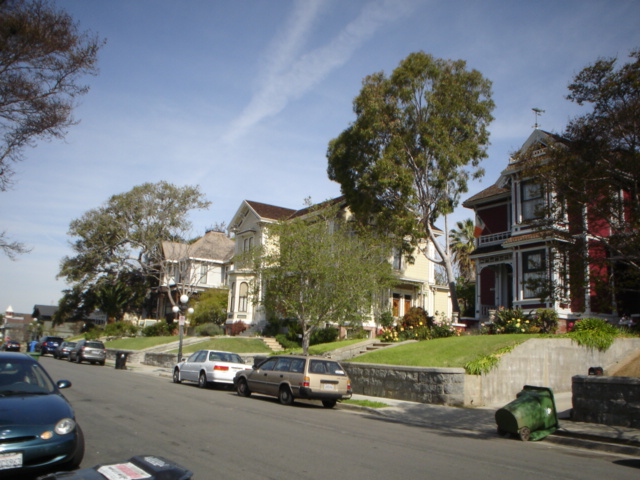
I flew from Savannah to California, the 'left coast' according to some Georgians. I think it's part of the wonderful kaleidoscope that is America. And even here, there are details you don't expect, such as the Victorian district of LA, only minutes from downtown.
I can't help thinking of the people who frequented these streets in the years before freeways and movies, some of them having ventured across the Wild West from the East, well before that great flowering of the music of the South.
But what is its sound? Rob Gibson, director of the annual Savannah Music Festival, spoke inspiringly of the music of the South as he introduced the Sweet-Singing Harmony Harmoneers at the festival last week. 'We believe gospel grew up in Georgia,' he said. I'll write more on the festival later in The Podium. But for now, let me just note that anyone interested in the history of music in the past 100 years could do worse than immerse themselves in the aural ambience, too, of the South.
I flew from Savannah to California, the 'left coast' according to some Georgians. I think it's part of the wonderful kaleidoscope that is America. And even here, there are details you don't expect, such as the Victorian district of LA, only minutes from downtown.
I can't help thinking of the people who frequented these streets in the years before freeways and movies, some of them having ventured across the Wild West from the East, well before that great flowering of the music of the South.
Subscribe to:
Posts (Atom)